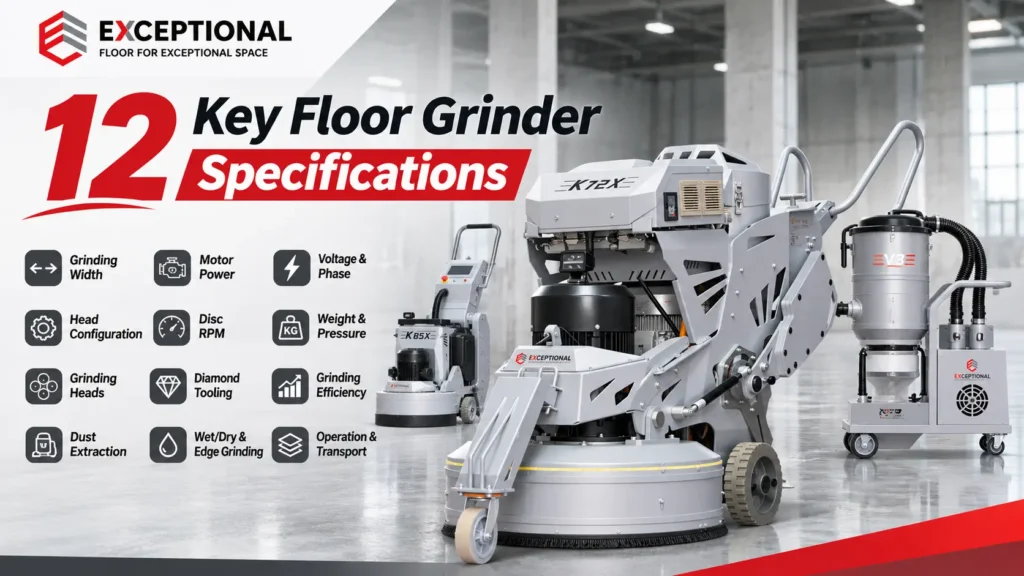
Understanding floor grinder specifications helps contractors and equipment buyers select machines that match their projects, power supplies, and performance requirements. Grinding width, motor power, RPM, machine weight, and grinding pressure all affect how a floor grinder works.
Yet these numbers tell only part of the story. A powerful grinder may struggle with the wrong diamond tools. A wide machine may slow down in narrow spaces. A three-phase grinder may not work at a jobsite without the correct electrical supply.
This guide explains 12 key concrete floor grinder specifications. It draws on China’s JB/T 15101-2025 floor grinder standard, manufacturer technical data, and practical requirements for concrete surface preparation, coating removal, and polishing.
Floor Grinder Specifications at a Glance
Before comparing models, learn what each technical specification measures and how it affects your work.
| Specification | Unit or measurement | Why it matters |
|---|---|---|
| Grinding width | mm / inches | Determines the effective working path |
| Motor power | kW / HP | Indicates the grinding motor’s rated output |
| Electrical requirements | V, A, Hz, phase | Determines jobsite power compatibility |
| Grinding head configuration | Single Disc, rotary, planetary | Affects grinding movement and surface finish |
| Grinding disc speed | RPM | Controls tool rotation and cutting action |
| Machine weight and grinding pressure | kg, lb, kN | Influence tool loading, handling, and stability |
| Grinding head quantity and size | Number, mm / inches | Determine tool-holder arrangement and contact pattern |
| Diamond tooling compatibility | Mounting type, tool size | Affects abrasive selection and replacement costs |
| Grinding efficiency | kg/min, m²/hour | Measures material removal or work coverage |
| Dust extraction | CFM, m³/h, kPa | Determines dust-collection system requirements |
| Wet/dry and edge capabilities | Water feed, edge clearance | Determines available operating methods |
| Operation and transport | Dimensions, control type, vibration | Affects handling, site access, and operator workload |
JB/T 15101-2025 identifies seven basic machine parameters: grinding width, maximum grinding pressure, grinding efficiency, machine weight, grinding disc height difference, total power, and voltage.
Professional equipment buyers should evaluate these parameters alongside motor current, RPM, drive configuration, tooling compatibility, and dust control.
1. Grinding Width and Working Coverage
Grinding width describes the effective surface width a floor grinder covers during one pass. Manufacturers normally express it in millimeters or inches.
A wider grinding path can cover more floor area per pass. However, it also requires more working space and may increase machine weight, power demand, and transport requirements.
How Grinding Width Affects Floor Grinding Productivity
Floor grinders come in different widths for specific applications.
| Grinding width | Typical application | Main consideration |
|---|---|---|
| 250–300 mm | Edges, garages, small rooms, confined spaces | Maneuverability |
| 300–450 mm | Residential and light commercial floor preparation | Access and grinding capacity |
| 500–700 mm | Commercial flooring, concrete polishing, industrial renovation | Coverage and power requirements |
| 750–900+ mm | Warehouses, factories, large industrial floors | High-area coverage and transport |
These ranges serve as practical selection guidelines, not fixed equipment classifications.
For example, the Exceptional Grinder YM-320V has a 300 mm working width. Its compact design suits garages, workshops, corridors, and restricted working areas.
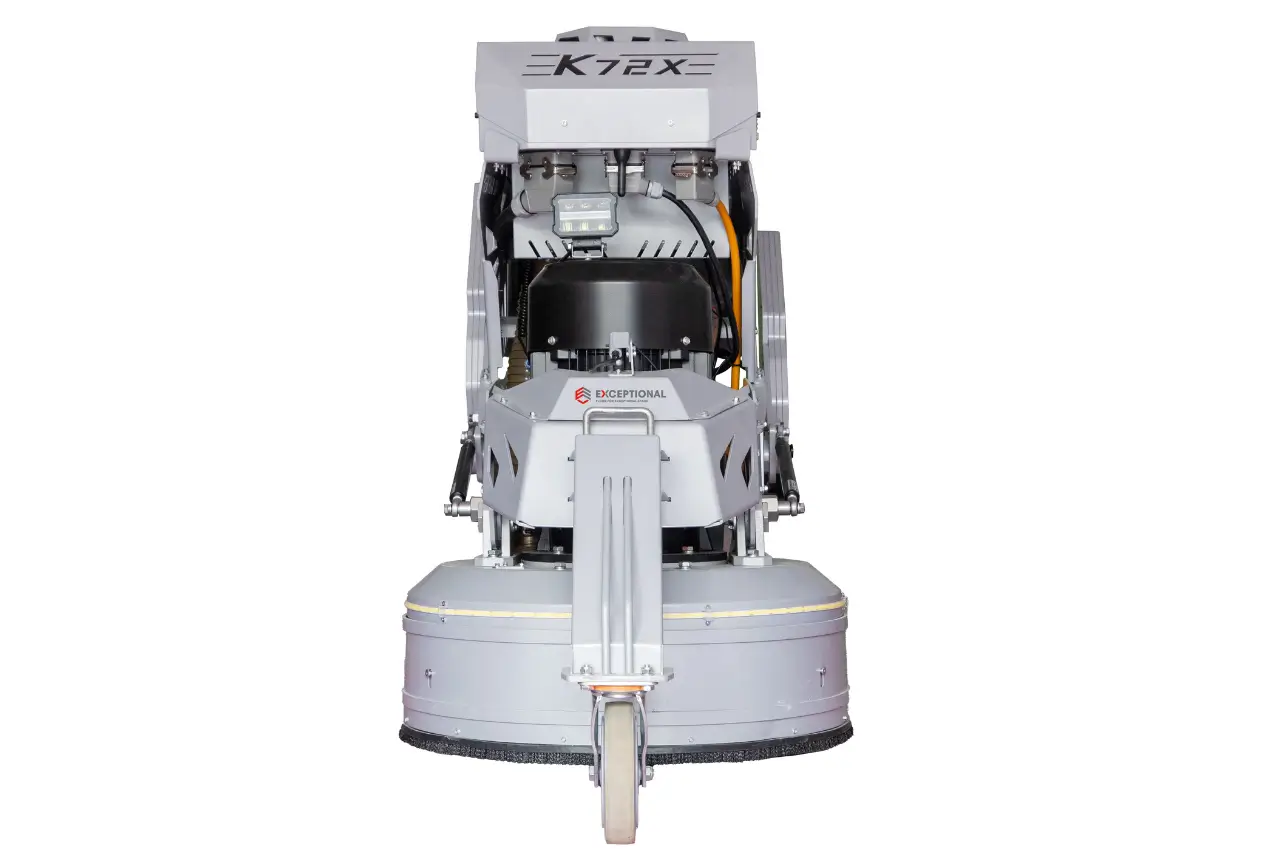
The Exceptional Grinder K-72 Planetary Floor Grinder offers a 700 mm grinding width. Its larger working path suits commercial flooring and industrial surface preparation.
Grinding Width vs. Overall Machine Width
Grinding width and machine width measure different things.
A grinder may have a 700 mm working path but a wider frame, wheelbase, or dust shroud. This difference matters when moving equipment through doorways, elevators, and corridors.
Check the machine’s complete dimensions before ordering. A wide working path offers little value if the machine cannot reach the work area.
Buyer tip: Compare grinding width with site access, turning space, and actual project size. Do not select equipment based on working width alone.
2. Motor Power: kW, Horsepower, and Rated Output
Motor power indicates the grinding motor’s rated mechanical output. Manufacturers commonly express it in kilowatts (kW) or horsepower (HP).
One horsepower equals approximately 0.746 kW.
Higher motor power can help a grinder sustain demanding loads. However, motor power alone does not determine grinding efficiency.
Grinding pressure, disc speed, diamond tooling, and concrete hardness also affect material removal.
How Much Motor Power Does a Concrete Floor Grinder Need?
Smaller grinders often use lower-power motors for compact surface preparation. Large planetary machines need greater motor capacity to drive wider grinding systems under heavy loads.
Consider three Exceptional Grinder models:
| Model | Grinding motor | Working width |
|---|---|---|
| YM-320V | 3.7 kW / 5 HP | 300 mm |
| K58 | 7.5 kW / 10 HP | 580 mm |
| K-72 | 15 kW / 20 HP | 700 mm |
The K-72 uses twice the grinding motor power of the K58. It also uses a wider four-head planetary system.
This does not mean the K-72 completes every grinding task twice as fast. Their different grinding widths, tooling arrangements, and working conditions affect the result.
Grinding Motor Power vs. Total Machine Power
Some floor grinders also contain travel motors, vacuum motors, or other electrical equipment.
For example, the Exceptional Grinder K58 includes a 7.5 kW grinding motor and a separate 2.55 kW dust extraction motor.
The 7.5 kW rating describes the grinding motor. It does not represent the complete machine’s electrical demand.
When comparing machines, request separate motor ratings and the complete electrical requirements.
Buyer tip: Match motor power with grinding width, tool speed, and expected working load. Check whether the published power refers to the main grinding motor or the complete system.
3. Voltage, Phase, Frequency, and Amperage
Electrical compatibility should come before many other buying decisions.
A grinder cannot perform its job if the site lacks a suitable power supply.
Four electrical specifications deserve attention: voltage (V), phase, frequency (Hz), and current (A).
Single-Phase vs. Three-Phase Floor Grinders
Single-phase grinders suit projects with suitable residential or light-commercial electrical circuits. Three-phase grinders commonly serve industrial applications with higher electrical power demands.
However, voltage alone does not determine the electrical phase.
A 220 V grinder may use single-phase or three-phase electricity, depending on its design.
| Electrical supply | Common applications | Main consideration |
|---|---|---|
| 110–120 V single-phase | Selected compact equipment in North America | Circuit capacity limits available motor power |
| 220–240 V single-phase | Residential and commercial sites with suitable circuits | Verify amperage and connectors |
| 208–240 V three-phase | Industrial and commercial installations | Requires matching three-phase supply |
| 380–415 V three-phase | Industrial equipment in many international markets | Common for professional floor grinders |
| 460–480 V three-phase | Industrial installations, including North America | Requires the correct machine version |
These values describe common supply configurations. Actual installations vary by country, building, and electrical system.
Check Amperage, Not Just Voltage
The Exceptional Grinder YM-320V offers single-phase and three-phase 220 V configurations.
Its technical data lists different maximum grinding motor currents for those versions. Buyers must confirm which figure applies to the machine they order.
A high-power single-phase grinder may require a dedicated circuit. Do not assume that every 220 V machine can use a standard household outlet.
The same rule applies when selecting a generator. Check the complete system load, starting requirements, voltage stability, and manufacturer recommendations.
What Does a Variable Frequency Drive Do?
A variable frequency drive (VFD) controls motor speed by changing the electrical frequency supplied to the motor.
A suitable VFD system can provide speed adjustment, controlled starting, and motor protection.
Some VFDs accept single-phase input and drive three-phase motors. However, this depends on the specific drive, motor, and complete machine design.
A VFD does not automatically make every three-phase floor grinder compatible with single-phase electricity.
Buyer tip: Request the exact voltage, phase, frequency, maximum current, plug type, and circuit requirements for your destination market.
Explore Exceptional Grinder Single Disc Floor Grinders for compact models with different electrical configurations.
4. Grinding Head Configuration and Drive System
The grinding head determines how diamond tools move across the concrete surface.
Floor grinding machines use several mechanical configurations, including single-disc, rotary, and planetary systems.
Single Disc Floor Grinders
A single-disc grinder uses one main rotating grinding head.
This design offers a compact structure and concentrated grinding action. Contractors use these machines for floor preparation, high-spot removal, and coating removal with suitable diamond tools.
Single-disc grinders often suit smaller working areas or projects where access matters more than maximum coverage.
Rotary and Planetary Floor Grinders
A planetary floor grinder uses several smaller grinding heads inside a larger rotating assembly.
The individual heads rotate while the planetary carrier moves them across the floor. This produces overlapping grinding paths that can help deliver a consistent scratch pattern.
A rotary grinder uses a different head movement and may offer concentrated cutting action for aggressive surface treatment.
| Feature | Single Disc / Rotary | Planetary |
|---|---|---|
| Grinding movement | Direct rotary action | Multiple heads with planetary movement |
| Typical working areas | Small to medium areas, selected industrial tasks | Commercial and industrial floors |
| Main strength | Compact design or aggressive grinding action | Controlled grinding and polishing |
| Tool arrangement | One or more directly driven discs | Multiple satellite grinding heads |
| Main buying factor | Working load, motor power, tooling | Head design, speed, tooling, grinding width |
Neither system suits every application. Concrete hardness, coating thickness, tooling, and the target finish determine the better choice.
Read our Planetary vs. Rotary Concrete Floor Grinders comparison for a detailed explanation.
Belt Drive vs. Gear Drive
The transmission transfers motor power to the grinding heads.
Different machines use belts, gears, chains, or combined transmission systems.
Buyers should evaluate transmission design, sealing, lubrication, replacement parts, and service access. A gear drive does not guarantee better durability than every belt-driven system.
Buyer tip: Choose the grinding mechanism according to the work you perform. Then compare the transmission design and maintenance requirements.
5. Grinding Disc RPM and Variable Speed Control
RPM means revolutions per minute. It measures how fast a rotating component completes one revolution.
Grinding speed affects cutting action, friction, surface finish, and abrasive tool performance.
However, higher RPM does not always produce faster grinding.
Grinding Disc RPM vs. Planetary Head RPM
Planetary grinders may have several rotational speeds:
| Speed measurement | What it describes |
|---|---|
| Motor RPM | Rotational speed of the electric motor |
| Grinding disc RPM | Speed of the individual tool holder |
| Planetary carrier RPM | Speed of the main planetary assembly |
These values are not interchangeable.
For example, Husqvarna publishes separate grinding disc and grinding head speeds in its PG 830S technical data.
When comparing planetary grinders, confirm which rotating component the manufacturer refers to.
Fixed-Speed vs. Variable-Speed Floor Grinders
Fixed-speed machines offer a simpler operating system. Variable-speed grinders provide greater control across different floor conditions and abrasive tools.
The Exceptional Grinder YM-320V offers adjustable tool-holder speeds from 300 to 720 RPM.
The Exceptional Grinder YM-420 provides variable speed up to 1,000 RPM, using a 7.5 kW grinding motor.
Variable speed allows contractors to adjust the grinding action when changing tools or moving between surface preparation and polishing stages.
Does Higher RPM Improve Grinding Efficiency?
Not in every case.
Excessive speed can increase heat, soften or smear certain coatings, and shorten abrasive life. Inadequate speed may reduce cutting performance.
Choose RPM according to the diamond tool manufacturer, floor material, coating condition, and required finish.
Buyer tip: Compare the operating speed range, not only the maximum RPM. Confirm the permitted speed for each abrasive tool.
6. Machine Weight and Maximum Grinding Pressure
Machine weight affects transport, handling, stability, and the load the grinding system can transfer to the floor.
However, machine weight and grinding pressure are not the same measurement.
Total Machine Weight vs. Grinding Head Load
A floor grinder transfers its weight through several contact points.
The grinding heads carry part of that load. Wheels and supporting structures carry the remainder.
Therefore, a 600 kg machine does not necessarily apply 600 kg of load to the diamond tools.
The machine’s geometry, working position, and counterweight system affect the load at the grinding head.
What Is Maximum Grinding Pressure?
JB/T 15101-2025 defines maximum grinding pressure as the greatest downward force the grinding discs apply while the machine operates normally with its maximum permitted counterweight.
The standard expresses this force in kilonewtons (kN).
Manufacturers also publish grinding load in kilograms or pounds. These figures often describe the mass equivalent of the applied load rather than pressure per unit area.
For comparison:
| Measurement | Unit | Meaning |
|---|---|---|
| Machine weight | kg / lb | Total machine mass |
| Grinding load | kg / lb | Mass-equivalent load carried by the grinding system |
| Grinding force | N / kN | Downward force on the grinding system |
| Contact pressure | Pa / kPa | Force divided by contact area |
The distinction matters when buyers compare machines from different manufacturers.
Adjustable Counterweights and Grinding Performance
Counterweights change the load distribution between the grinding heads and the machine’s supporting wheels.
The Exceptional Grinder K58 uses a four-position adjustable counterweight system.
Operators can change the grinding load to suit concrete hardness, abrasive tooling, coating removal, or surface refinement.
More pressure does not always improve results. Excessive loading can increase tool wear, motor load, vibration, and floor damage.
Buyer tip: Request the grinding-head load, adjustable weight positions, and testing method. Do not use total machine weight as a substitute for grinding pressure.
7. Grinding Disc Quantity, Size, and Alignment
Grinding head quantity and tool-holder size affect the machine’s working pattern and abrasive contact.
Common planetary systems use three or four grinding heads. Single-disc machines use one main grinding plate.
Three-Head vs. Four-Head Planetary Grinders
Consider these Exceptional Grinder models:
| Model | Grinding heads | Working width |
|---|---|---|
| K58 | 3 × 252 mm | 580 mm |
| K-72 | 4 × 252 mm | 700 mm |
| K-85 | 4 × 298 mm | 850 mm |
More grinding heads do not automatically mean faster material removal.
Motor power, available grinding load, tool-holder diameter, rotation speed, and abrasive design all affect performance.
The number of heads also differs from the number of diamond segments. One tool holder may carry several grinding shoes or abrasive segments.
What Is Grinding Disc Height Difference?
Grinding disc height difference refers to the vertical difference between grinding disc mounting planes.
JB/T 15101-2025 includes this measurement among its main technical performance parameters.
Section 6.2.5 describes a method for measuring three positions around each grinding disc. The standard also specifies a ±1 mm deviation from the design value in its technical parameter requirements.
Proper alignment helps the grinding heads maintain consistent contact with the floor.
Poor alignment, worn mounting parts, or damaged components can contribute to uneven tool loading and unwanted grinding marks.
However, alignment alone does not determine the final floor flatness.
Buyer tip: Compare head quantity, tool-holder diameter, mounting arrangement, and mechanical alignment. Check the manufacturer’s inspection requirements.
For more detail, read our Three-Head vs. Four-Head Planetary Floor Grinder Guide.
8. Diamond Tooling and Mounting Compatibility
Diamond tools perform the actual cutting, grinding, and polishing.
Even a powerful floor grinder cannot deliver consistent results with the wrong abrasive tools.
Tooling compatibility also affects operating costs, replacement availability, and the machine’s service life.
Common Floor Grinder Diamond Tools
| Tool type | Common application |
|---|---|
| Metal-bond diamond segments | Concrete grinding, leveling, surface opening |
| PCD grinding tools | Removal of compatible epoxy, coatings, and adhesives |
| Hybrid or transitional abrasives | Scratch refinement between grinding stages |
| Resin-bond polishing pads | Concrete and stone surface polishing |
| Specialized carbide or coating tools | Selected coating and surface-removal tasks |
Tool selection depends on the substrate and the material that contractors need to remove.
Hard concrete often requires a softer diamond bond to maintain cutting action. Soft or abrasive concrete generally needs a harder bond to limit premature tool wear.
Check the Tool Mounting System
Floor grinders may use magnetic holders, bolt-on plates, quick-change systems, or specific branded attachments.
Not every mounting system accepts every diamond tool.
Buyers should confirm the mounting pattern, tool dimensions, holder quantity, rotation direction, maximum operating speed, and replacement availability.
A low machine price may provide little value if contractors cannot source compatible diamond tools at a reasonable cost.
Tooling Cost and Long-Term Ownership
For distributors and rental fleets, tool availability affects customer support and repeat business.
Request the complete tooling list with the machine quotation. Include replacement holders, fastening hardware, polishing pads, and coating-removal tools.
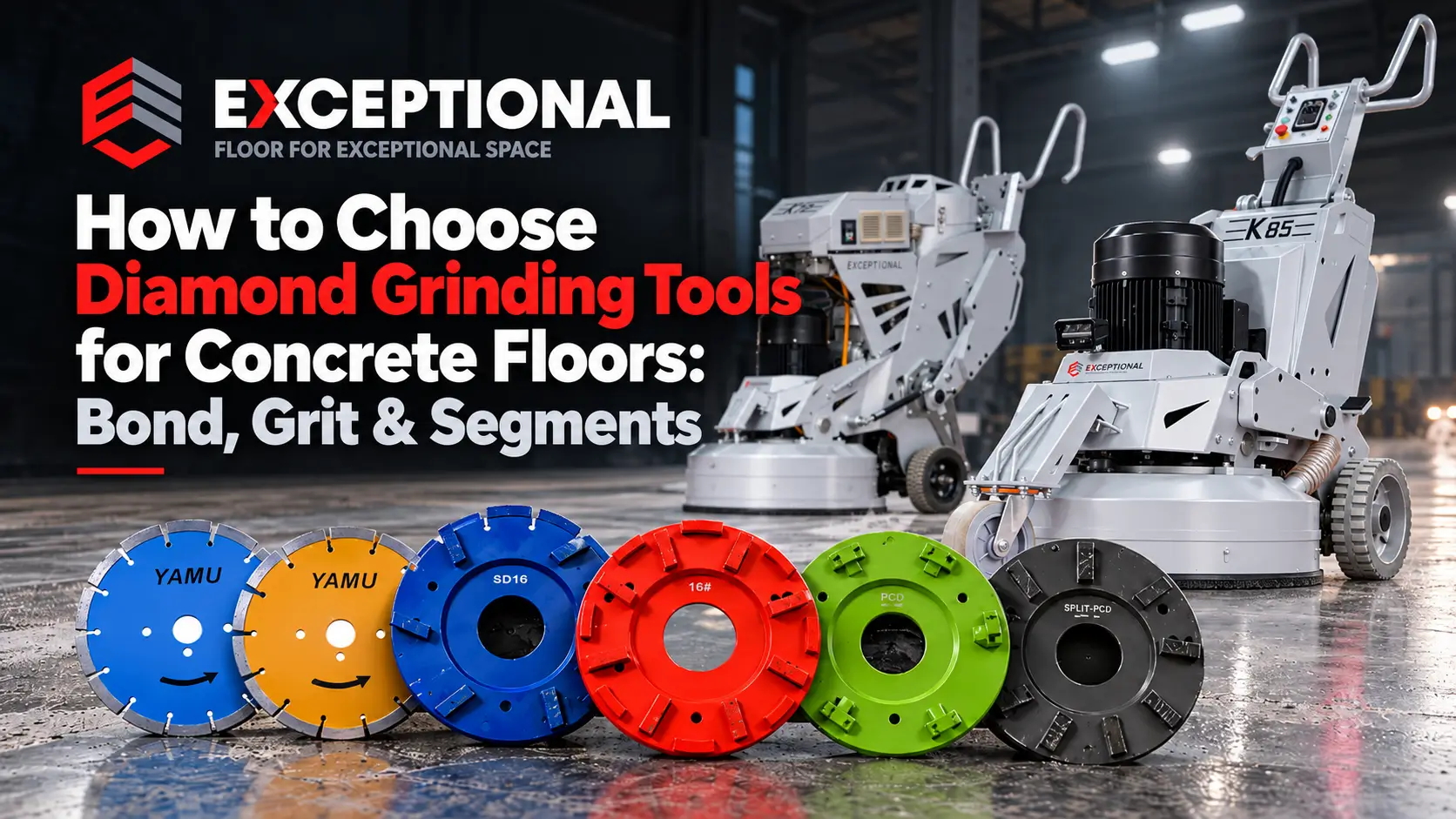
Exceptional Grinder supplies diamond grinding tools and accessories for concrete preparation and floor polishing.
Read our Diamond Grinding Tools for Concrete Floors Guide for bond, grit, and segment selection.
Buyer tip: Verify the complete tooling system before buying the grinder. Tool compatibility affects both performance and operating costs.
9. Grinding Efficiency and Actual Jobsite Productivity
Grinding efficiency measures how effectively a floor grinder removes material during operation.
However, different testing methods use different measurements.
A machine’s material removal rate does not directly equal the amount of finished floor it can complete each hour.
How Does JB/T 15101-2025 Define Grinding Efficiency?
The Chinese industry standard defines grinding efficiency as the mass of grinding dust generated per unit of grinding time.
It expresses the result in kilograms per minute (kg/min).
Section 6.2.3 specifies a test using 30-grit abrasive on a concrete surface with Mohs hardness 3. The grinder travels at 3 m/min while its grinding discs run at maximum speed. The test lasts at least five minutes.
The testing method calculates grinding efficiency from the collected dust mass and grinding duration.
This provides a controlled measure of material removal under defined conditions.
Grinding Efficiency vs. Grinding Productivity
Professional contractors often measure productivity in square meters per hour (m²/hour) or square feet per hour (ft²/hour).
These values describe working coverage rather than the mass of material removed.
| Metric | Unit | What it measures |
|---|---|---|
| Grinding efficiency | kg/min | Material removal by mass during a defined test |
| Grinding coverage | m²/hour | Area treated during a given period |
| Completed-floor productivity | m²/hour | Finished area meeting the required specification |
| Diamond tool consumption | Tools or cost per completed area | Abrasive operating cost |
A machine may cover a large area during one grinding pass but require several more passes to achieve the required surface profile.
Actual productivity depends on concrete hardness, coating thickness, tool selection, grinding depth, overlap, operating speed, and finishing requirements.
How to Compare Manufacturers’ Productivity Claims
Ask for the test conditions behind every published productivity figure.
A useful test report should identify the concrete surface, abrasive tools, grinder settings, working area, test duration, number of passes, and final surface condition.
For large projects, test equipment on a representative floor area before confirming production targets.
Buyer tip: Compare completed work that meets the same acceptance criteria. Do not treat maximum grinding width or a brochure’s m²/hour figure as guaranteed productivity.
10. Dust Extraction and Vacuum Compatibility
Concrete grinding releases fine dust, including respirable crystalline silica from silica-containing materials.
Effective dust control protects workers, improves visibility, and helps keep the work area cleaner.
Floor grinders may use built-in dust extraction or connect to an external industrial dust collector.
Built-In vs. External Dust Extraction
Integrated extraction systems combine grinding and dust collection within one machine.
External extractors use a separate vacuum connected through a hose and dust shroud.
| System | Main advantage | Main consideration |
|---|---|---|
| Built-in vacuum | Fewer separate machines and hoses | Capacity and maintenance of onboard system |
| External dust extractor | Flexible equipment pairing and service access | Hose compatibility, airflow, and transport |
| Wet dust suppression | Controls airborne dust at the grinding surface | Water delivery and slurry collection |
The Exceptional Grinder K58 uses an integrated 2.55 kW vacuum motor with a maximum listed airflow of 415 m³/h.
The Exceptional Grinder K-85 uses a 70 mm dust outlet for an external extractor.
What Vacuum Specifications Matter?
Compare airflow, vacuum pressure, hose diameter, filter performance, filter cleaning, and dust-collection capacity.
Airflow indicates how much air the extractor moves. Vacuum pressure indicates its ability to create suction.
Both measurements matter, but maximum airflow and maximum suction figures don’t describe the system’s performance under working conditions.
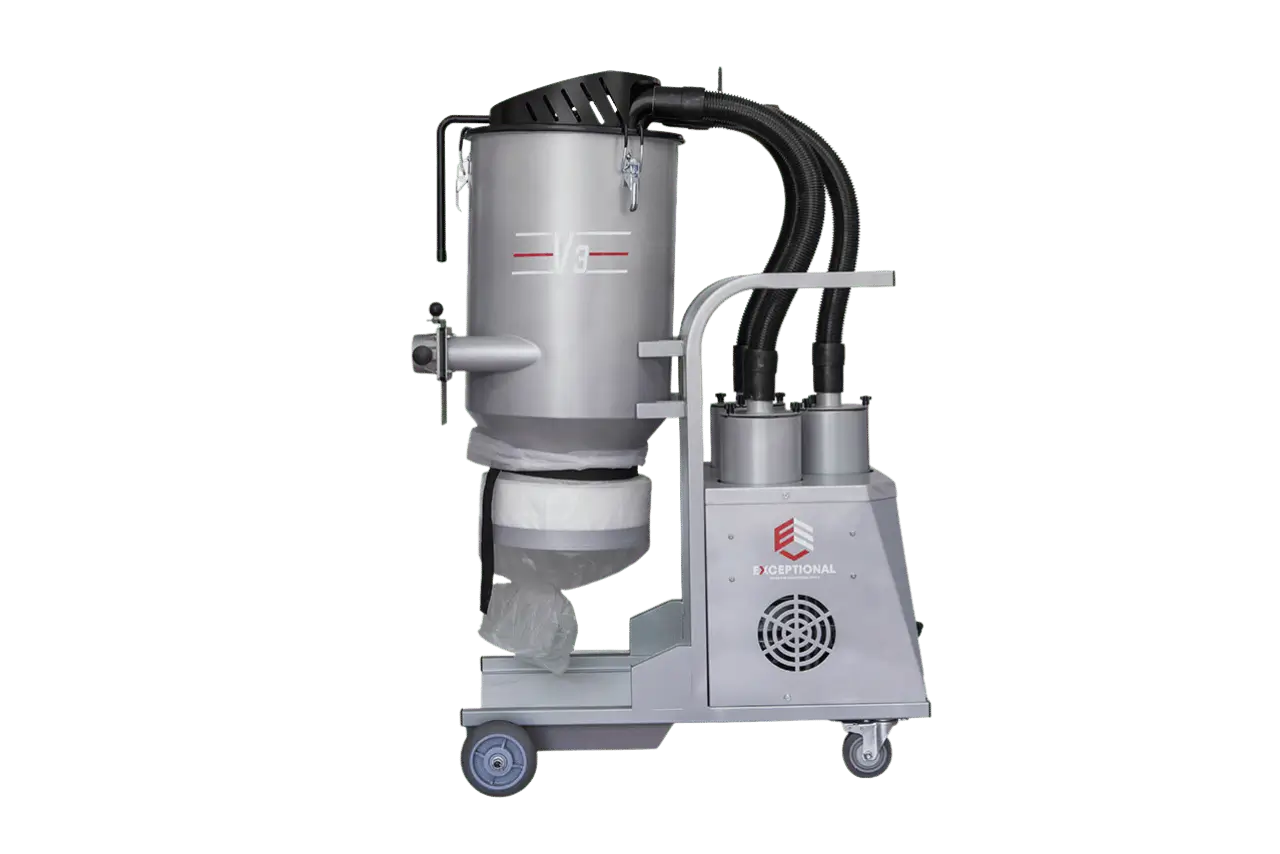
For example, the Exceptional Grinder V3 Industrial Dust Extractor lists a maximum airflow of 468 m³/h and a maximum vacuum pressure of 0.23 bar.
Its standard hose measures 50 mm in diameter. Buyers connecting it to a machine with a different dust-port size must check adapters, airflow requirements, and system compatibility.
Dust Extraction and OSHA Silica Requirements
In the United States, OSHA’s 29 CFR 1926.1153 addresses respirable crystalline silica in construction.
Table 1 includes control methods for walk-behind floor grinders. It describes wet methods and manufacturer-recommended dust collection systems with specified filtration and airflow requirements.
The dry-collection option calls for a filter with at least 99% efficiency and a filter-cleaning mechanism. For indoor or enclosed work, the specified method also calls for HEPA-filtered vacuum cleaning between passes.
A filter efficiency claim alone does not establish compliance. Contractors must evaluate the complete system and follow the applicable exposure-control requirements.
Read our Built-In Vacuum vs. External Dust Extraction Guide for a detailed comparison.
Buyer tip: Match the grinder, dust shroud, extractor, hose, and filtration system. Request supporting test data when a project has specific dust-control requirements.
11. Wet/Dry Grinding and Edge Grinding Capabilities
Some floor grinders support both wet and dry operation. Others focus on one method.
The correct choice depends on the floor material, abrasive tools, required finish, and jobsite conditions.
Wet Grinding vs. Dry Grinding
Dry grinding uses suitable dust extraction to collect debris during operation.
Wet grinding introduces water at the working surface. Water helps suppress dust and may improve cooling during suitable grinding and polishing operations.
| Factor | Dry grinding | Wet grinding |
|---|---|---|
| Dust management | Requires suitable extraction | Uses water to suppress dust |
| Waste | Dry dust | Slurry |
| Cleanup | Filter and dust disposal | Slurry collection and disposal |
| Surface visibility | Depends on dust extraction | Water and slurry may obscure the surface |
| Tooling | Dry-compatible abrasives | Wet-compatible abrasives |
Wet grinding does not eliminate cleanup. Contractors must collect slurry and dispose of it according to site and local requirements.
Never assume that a dry-only machine or abrasive tool supports wet operation.
Edge Grinding Capability
Large planetary grinders may leave an untreated strip beside walls, columns, and other obstacles.
Contractors then need an edge grinder or a machine with a suitable edge-grinding mechanism.
The Exceptional Grinder MB-300T Concrete Floor Edge Grinder features a 300 mm grinding head, adjustable guide wheels, and a zero-distance edge-grinding design.
It also combines edge preparation with integrated dust extraction.
For projects with extensive wall perimeters, edge-grinding capability can reduce the time spent switching between machines.
Buyer tip: Check water-feed compatibility, edge clearance, shroud adjustment, and how many machines you need for the full project.
12. Operation, Ergonomics, and Transport Dimensions
Machine specifications also affect the operator’s workload and the contractor’s ability to move equipment between sites.
A grinder may offer high cutting capacity but create transport problems or demand more physical effort than the operator can manage.
Manual, Self-Propelled, and Remote-Controlled Grinders
Floor grinders use different control methods.
| Operation type | Main characteristics | Common applications |
|---|---|---|
| Manual walk-behind | Operator guides the machine | Small and medium flooring projects |
| Self-propelled | Powered travel reduces manual pushing | Larger working areas |
| Remote-controlled | Operator controls movement and grinding from a remote unit | Large industrial floors and repeated grinding passes |
| Ride-on | Operator works from a seat | Selected large-scale grinding applications |
The Exceptional Grinder K-85 uses full-function wireless remote control.
Operators can adjust travel speed, grinding speed, steering, and movement without pushing the machine through every pass.
Remote control can reduce physical effort. However, operators must maintain visibility, control the machine, and follow its safety instructions.
Handle Design, Vibration, and Operator Comfort
Adjustable handles help operators find suitable working positions.
Vibration also matters during extended grinding operations.
JB/T 15101-2025 includes requirements for mechanical vibration and operating force. Its performance section specifies a weighted vibration acceleration limit of less than 1.91 m/s² under the standard’s measurement conditions.
These technical requirements help manufacturers evaluate machine performance. They do not replace workplace exposure assessments or national safety requirements.
Transport Weight and Machine Dimensions
Check the complete machine length, width, height, and mass.
Large grinders may need loading ramps, mechanical lifting equipment, or suitable transport vehicles.
Measure doorways, elevators, access routes, and loading limits before confirming an equipment order.
Also check folding handles, detachable components, lifting points, and the equipment’s transport configuration.
Buyer tip: Evaluate the machine during operation and transport. A suitable grinder must reach the work area and remain practical for the operator.
Additional Floor Grinder Quality, Safety, and Reliability Specifications
The 12 specifications describe the machine’s main operating capabilities. Buyers should also check safety features, construction quality, and maintenance requirements.
JB/T 15101-2025 covers electrical protection, machine vibration, overload performance, safety markings, and factory inspection.
| Technical feature | What buyers should verify |
|---|---|
| Emergency stop | Accessible emergency stop and correct operation |
| Overload protection | Motor and electrical protection against excessive load |
| Electrical insulation | Manufacturer test reports and applicable electrical safety requirements |
| Gearbox construction | Seals, lubrication, transmission design, and service access |
| Grinding head guards | Protection against flying debris and contact with rotating parts |
| Noise and vibration | Test data and applicable workplace limits |
| Water and dust protection | Protection appropriate for the machine’s operating environment |
| Factory inspection | Inspection records and identification of tested machine versions |
| Spare parts | Availability of motors, belts, seals, bearings, tools, and electrical components |
| Warranty and service | Written coverage, service procedures, and local support arrangements |
For bulk orders, ask the manufacturer to explain its factory inspection process and provide the appropriate documentation for the destination market.
A manufacturer’s declaration or a general company certificate does not prove that every machine version meets every international requirement.
Exceptional Grinder Specifications: Model Comparison
Exceptional Grinder supplies compact Single Disc machines, planetary floor grinders, and remote-controlled industrial equipment.
The following table compares selected published model specifications.
| Specification | YM-320V | K58 | K-72 | K-85 |
|---|---|---|---|---|
| Grinder type | Single Disc | Planetary | Planetary | Remote planetary |
| Working width | 300 mm | 580 mm | 700 mm | 850 mm |
| Grinding motor | 3.7 kW | 7.5 kW | 15 kW | 20.5 kW |
| Machine weight | 110 kg | 430 kg | 670 kg | 625 kg |
| Grinding heads | Single head | 3 × 252 mm | 4 × 252 mm | 4 × 298 mm |
| Listed tool speed | 300–720 RPM | 0–1,500 RPM | 0–1,500 RPM | 0–1,800 RPM |
| Electrical options | 220 V, single/three-phase | Three-phase | Three-phase | Three-phase |
| Dust system | Built-in | Built-in | Built-in | External connection |
| Remote control | No | No | No | Yes |
Source: Exceptional Grinder product specifications. Models and electrical versions may vary by market. Confirm the final technical data sheet before ordering.
Each machine serves different working conditions.
The YM-320V offers a compact grinding width and flexible electrical options for smaller sites. The K58 combines a three-head planetary system with integrated dust extraction.
The K-72 provides a wider grinding path and greater motor power for industrial projects. The K-85 adds remote-controlled travel and a larger four-head grinding system.
Browse Exceptional Grinder Floor Grinders to compare available equipment and configurations.
How to Read a Floor Grinder Technical Data Sheet
Manufacturers do not always use the same terms, units, or measurement methods.
One company may list maximum grinding pressure in kN. Another may describe grinding load in kilograms.
One machine may show the grinding motor rating. Another may include the vacuum motor in its total power description.
Use the following checklist when reviewing equipment quotations.
| Buying question | Specification to verify |
|---|---|
| Will the machine fit through the site entrance? | Overall dimensions and grinding width |
| Can the site power the machine? | Voltage, phase, frequency, amperage |
| Can it handle the required grinding load? | Motor power, RPM, grinding pressure |
| Will it accept suitable diamond tools? | Head size, mounting system, tool compatibility |
| Can it achieve the required finish? | Drive configuration, speed control, tooling |
| How does the manufacturer measure productivity? | Test conditions, removal rate, completed area |
| Can it control dust? | Extractor requirements, airflow, filtration |
| Can our team transport and service it? | Weight, lifting points, maintenance access |
| Can we maintain it over time? | Spare parts, manuals, service support |
Compare specifications under matching conditions. If the supplier cannot explain a performance figure, request its measurement method or supporting test data.
For larger orders, arrange a machine demonstration on a floor that resembles your normal projects.
Floor Grinder Specifications by Application
Different applications place different demands on the grinder.
The table below shows which specifications matter most for common flooring projects.
| Application | Specifications to prioritize | Suitable equipment direction |
|---|---|---|
| Residential garage preparation | Electrical supply, working width, maneuverability | Compact Single Disc grinder |
| Epoxy coating removal | Grinding load, motor capacity, PCD compatibility | Single Disc or planetary grinder |
| Commercial concrete polishing | Planetary movement, RPM control, resin pad compatibility | Variable-speed planetary grinder |
| Industrial warehouse grinding | Working width, sustained motor performance, productivity | Large planetary grinder |
| Terrazzo and stone restoration | Variable speed, tooling, controlled grinding load | Suitable planetary grinder |
| Concrete floor edge preparation | Edge clearance, tool access, dust extraction | Dedicated edge grinder |
| Large-area industrial renovation | Working width, powered travel, remote control | Remote-controlled planetary grinder |
Treat these recommendations as starting points. Concrete hardness, floor condition, available electricity, and the target surface finish determine the final equipment choice.
For a broader selection framework, see the Concrete Floor Grinder Buying Guide.
Frequently Asked Questions About Floor Grinder Specifications
What are the most important floor grinder specifications?
Grinding width, motor power, voltage, electrical phase, RPM, machine weight, grinding pressure, head configuration, diamond tooling, and dust extraction form the main selection criteria. Buyers should also review productivity test methods, transport dimensions, and safety features.
How much horsepower does a concrete floor grinder need?
Motor requirements depend on working width, grinding load, concrete hardness, tooling, and the application. Small floor grinders may use motors around 3–5 HP, while large industrial machines may exceed 20 HP. Compare the complete grinding system rather than selecting equipment by horsepower alone.
What is a good RPM for a concrete floor grinder?
The correct RPM depends on the tool, floor material, grinding mechanism, and required finish. Some compact grinders operate around 300–800 RPM, while larger planetary models may offer tool-holder speeds above 1,500 RPM. Always follow the grinder and abrasive manufacturer’s operating limits.
Does a wider grinding width always improve productivity?
No. A wider machine can cover more floor area per pass, but narrow working areas, turning time, concrete hardness, and repeated grinding passes can reduce actual productivity. Compare completed area under matching project conditions.
Is grinding pressure more important than machine weight?
Grinding pressure and effective grinding load describe how much force reaches the tools. Total machine weight also affects transport, balance, and handling. Buyers should evaluate both values because two machines of similar weight may transfer different loads to their grinding heads.
Can a 220 V floor grinder run on single-phase electricity?
Only if the manufacturer supplies a suitable single-phase version. Some 220 V grinders require three-phase power. Verify the phase, amperage, frequency, plug, and circuit requirements before connecting the machine.
What is the difference between grinding disc RPM and planetary head RPM?
Grinding disc RPM measures the rotation of individual tool holders. Planetary head RPM measures the rotation of the larger carrier assembly. These components may operate at different speeds. Buyers should confirm which speed the data sheet describes.
How do manufacturers measure floor grinder grinding efficiency?
JB/T 15101-2025 defines grinding efficiency through the mass of grinding dust generated per unit of grinding time, expressed in kg/min. Contractors also measure working coverage in m²/hour. These methods describe different aspects of machine performance and should not be compared as equivalent figures.
Why does diamond tooling compatibility matter?
The mounting system determines which diamond tools fit the grinder. Incompatible tools may prevent correct installation or safe operation. Tool size, bond type, grit, operating speed, and replacement availability also affect grinding results and long-term costs.
What technical documents should distributors request from a floor grinder manufacturer?
Request the model-specific data sheet, electrical configuration, operating manual, safety information, applicable inspection reports, spare parts list, warranty terms, and tooling compatibility details. Confirm that the documents match the machine version and destination market.
Choose Floor Grinder Specifications That Match Your Project
The best floor grinder does not always have the highest horsepower, largest grinding width, or heaviest frame.
The right machine balances grinding capacity, electrical compatibility, disc speed, effective grinding load, tooling, dust extraction, and operating requirements.
Compare these 12 specifications before committing to a purchase. Ask for model-specific technical data and verify performance under conditions that match your work.
Exceptional Grinder manufactures concrete floor grinders, planetary grinding machines, single-disc grinders, dust extractors, and diamond grinding tools for contractors, equipment rental companies, and international distributors.
For equipment selection, send us your floor material, project area, coating condition, required finish, available electrical supply, destination country, and order quantity.
Contact Exceptional Grinder for technical specifications, machine recommendations, and factory quotations.
Technical References
- JB/T 15101-2025. Building Construction Machinery and Equipment – Floor Grinder Machine. Sections 3–7. Ministry of Industry and Information Technology of China. Effective November 1, 2025.
- T/FJDP 005-2023. Floor Grinder Machine – Terminology. Fujian Flooring Industry Association.
- T/FJDP 006-2023. Floor Grinder Machine – Grinding Efficiency Test Method. Fujian Flooring Industry Association.
- T/QZZB 001-2019. Floor Grinding Machine. Quanzhou Equipment Manufacturing Industry Association.
- Occupational Safety and Health Administration. 29 CFR 1926.1153 – Respirable Crystalline Silica. https://www.osha.gov/laws-regs/regulations/standardnumber/1926/1926.1153
- Husqvarna Construction. PG 830 Series – Technical Data and Operator Documentation.
- Exceptional Grinder. Floor Grinder Product Specifications. https://exceptionalgrinder.com/floor-grinders/