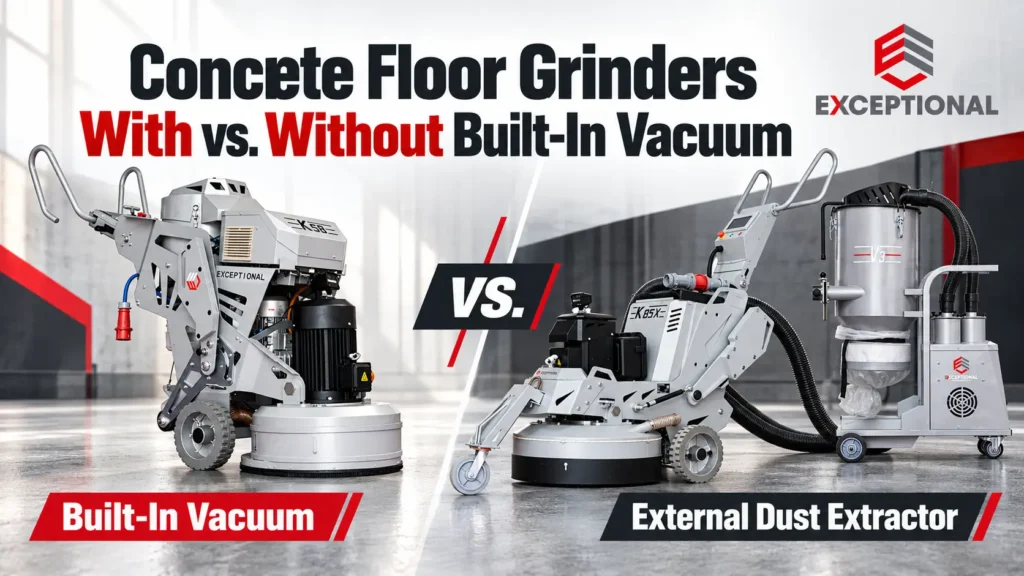
Concrete floor grinders with built-in vacuum systems combine grinding and dust extraction in one machine. They can reduce jobsite dust, simplify setup, and improve surface visibility. Grinders without built-in vacuums may cost less, offer simpler maintenance, and give contractors more freedom to choose an external dust extractor.
Which option works better? The answer depends on the floor area, working environment, grinding power, dust collection capacity, and operating costs.
At Exceptional Grinder, we manufacture both configurations. Most of our floor grinder models feature built-in vacuum systems. Others support compatible external industrial dust extractors. Our equipment experience shows that each design offers advantages for different flooring projects.
This guide compares their performance, costs, maintenance, grinding quality, and safety. We also use the Exceptional Grinder K58 Dust-Free Planetary Concrete Floor Grinder to explain how an integrated vacuum system works in practice.
Concrete Floor Grinders With vs. Without Built-In Vacuum: Main Differences
A concrete floor grinder with a built-in vacuum combines grinding and dust collection in one machine. The vacuum captures concrete dust near the grinding head and directs it through filters into a collection container.
A grinder without a built-in vacuum uses a different arrangement. It may connect to a separate industrial dust extractor or support a manufacturer-approved wet grinding method.
The term “without vacuum” should not mean grinding dry concrete without dust protection.
Built-In Vacuum vs. External Dust Extractor Comparison
| Comparison factor | With built-in vacuum | Without built-in vacuum |
|---|---|---|
| Dust control | Integrated collection system | Requires suitable external extraction or approved wet controls |
| Initial purchase | Often higher equipment price | Often lower grinder price |
| Setup | Fewer separate machines | Requires external equipment and connections |
| Grinding power | Depends on grinding motor and power supply | Depends on grinding motor and power supply |
| Working efficiency | May reduce dust-related interruptions | Depends on extraction setup and cleanup time |
| Maintenance | Includes onboard filters, motor, ducts, and seals | Simpler grinder; external extractor needs separate maintenance |
| Surface visibility | Good with effective dust capture | Good when the external system captures dust |
| Filter capacity | Limited by onboard design | Wider choice of extractor sizes |
| Machine weight | May increase due to extraction components | Grinder may weigh less |
| Mobility | Fewer trailing hoses | Hoses and cables need management |
| Noise | Grinding and vacuum noise from one platform | Separate grinder and extractor noise |
| Equipment flexibility | Integrated system serves one grinder | Extractor may serve multiple compatible machines |
| Wet grinding | Depends on machine approval | Depends on machine approval |
| Best applications | Indoor projects, compact work areas, convenient daily operation | Large projects, flexible equipment fleets, specialized extraction needs |
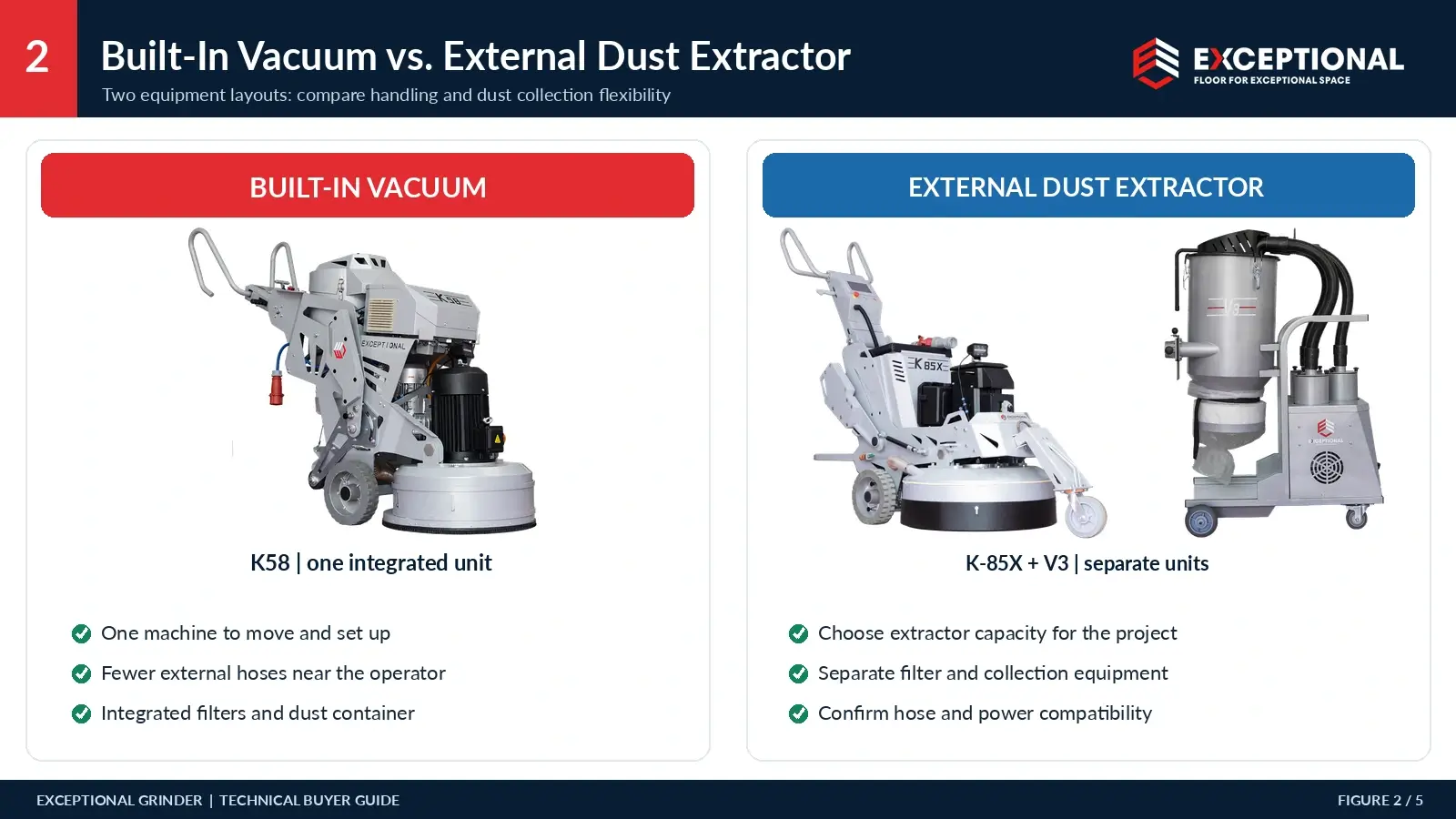
Neither design guarantees better grinding speed or dust collection.
A properly matched external extractor may outperform a small onboard vacuum. A well-designed integrated system may also offer better handling and workflow than a separate arrangement.
Contractors should compare complete machine configurations, not vacuum placement alone.
How Does a Concrete Floor Grinder With Built-In Vacuum Work?
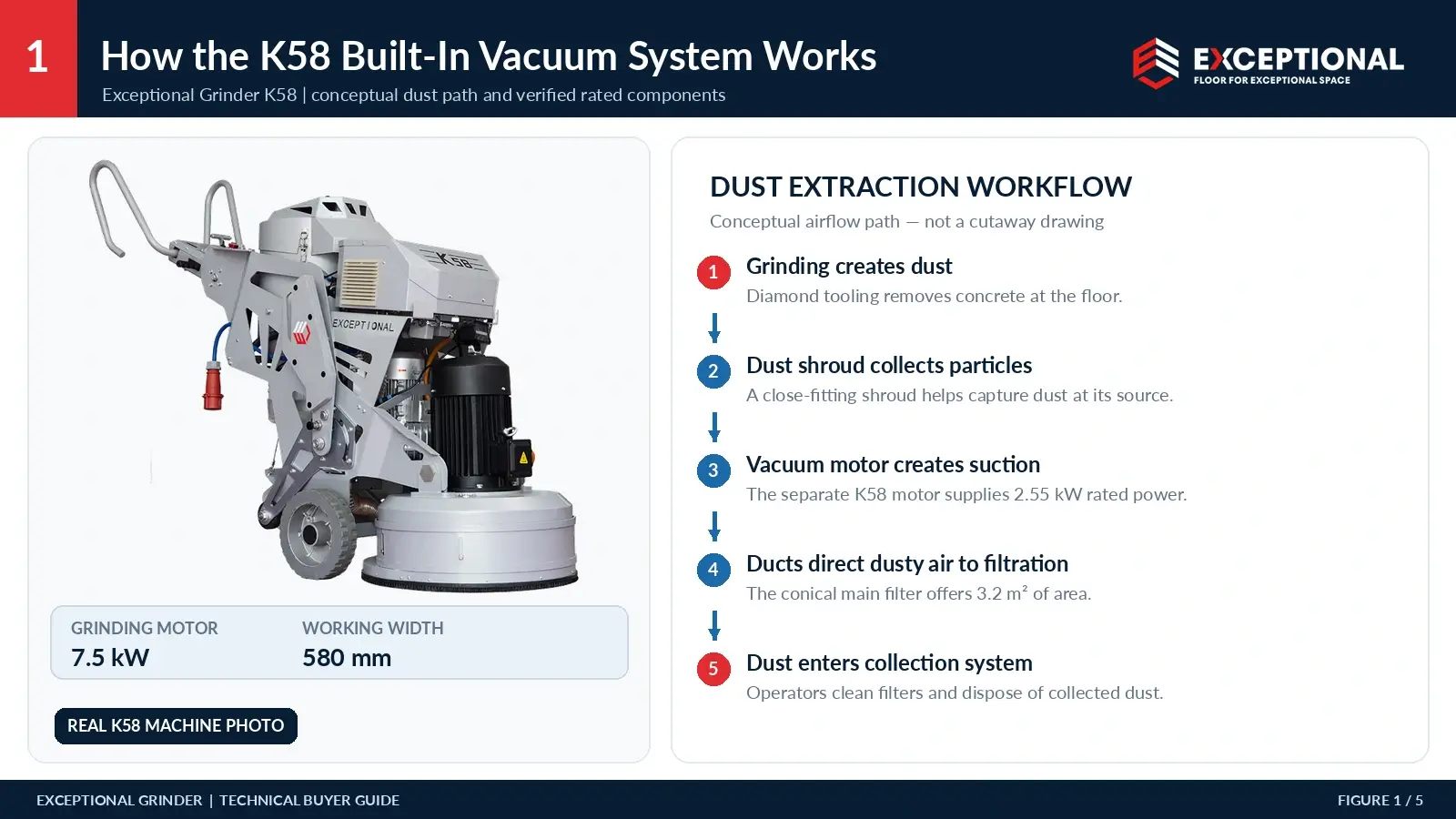
A built-in vacuum system collects concrete dust while the grinding heads remove material from the floor.
The machine places a dust shroud around the grinding area. A vacuum motor creates airflow that carries loose dust through internal ducts and into the collection system.
Filters separate dust from the air. The collection container or bag holds the material until the operator removes it.
Main Components of an Integrated Vacuum System
| Component | Main function |
|---|---|
| Grinding motor | Drives the grinding heads and diamond tools |
| Vacuum motor | Creates airflow and suction |
| Dust shroud | Helps contain dust near the grinding heads |
| Air ducts | Carry dust toward the collection system |
| Main filter | Captures particles and protects downstream components |
| Filter-cleaning system | Removes accumulated dust from filter surfaces |
| Dust container or bag | Stores grinding debris for disposal |
| Seals and connections | Reduce air leakage and support dust capture |
Most industrial systems use separate motors for grinding and extraction.
This distinction matters when comparing power consumption. The vacuum does not automatically take mechanical power away from the grinding motor.
How the Exceptional Grinder K58 System Works
The Exceptional Grinder K58 combines a three-head planetary grinding system with onboard dust extraction.
Its 7.5 kW grinding motor drives the diamond tooling. A separate 2.55 kW vacuum motor handles dust collection.
The system delivers up to 415 m³/h of airflow and uses a 3.2 m² conical main filter. Manual and automatic filter cleaning help maintain airflow as dust accumulates.
The K58 gives contractors a single machine for grinding and dust collection without requiring a separate extractor for its normal integrated configuration.
Working Environment: Indoor vs. Outdoor Concrete Grinding
The working environment often determines how much value a contractor gains from built-in dust extraction.
Dust control affects operator comfort, visibility, housekeeping, and the conditions in surrounding work areas.
Advantages of Built-In Vacuum Systems for Indoor Grinding
Indoor concrete grinding can create large amounts of fine dust.
Shopping malls, warehouses, offices, hospitals, and occupied buildings often require careful dust management. Airborne particles can spread beyond the work area and settle on equipment, walls, and finished surfaces.
A concrete grinder with built-in vacuum collection can help reduce dust at the source. Operators may spend less time cleaning the floor and surrounding work areas.
Integrated systems also remove the need to position a separate dust collector near the grinder. This can help in corridors, small rooms, and areas with limited access.
However, indoor projects may still require barriers, ventilation, HEPA cleanup, and other exposure controls.
Disadvantages of Built-In Systems in Demanding Conditions
Large concrete fragments and other debris can obstruct air ducts or collection openings.
For this reason, contractors should remove loose stones, metal pieces, and large debris before grinding.
A blocked duct or heavily loaded filter can reduce dust collection performance. The operator may need to stop and clean the system.
For projects with high dust loads, a separate high-capacity extractor may offer greater collection volume and more flexible filter management.
Can Contractors Use Grinders Without Vacuums Outdoors?
Some contractors prefer simpler grinding machines for outdoor renovation and rough surface removal.
Open working areas may offer easier equipment movement. Contractors may also have more room for external extractors or approved wet grinding systems.
However, outdoor conditions do not eliminate silica dust exposure or environmental concerns.
Wind can carry concrete dust toward workers, neighboring properties, and other construction activities. Contractors still need suitable dust-control measures.
Exceptional Grinder’s recommendation: Choose the dust-control method based on the material, site conditions, equipment specifications, and applicable safety requirements—not whether the project takes place indoors or outdoors.
Grinding Efficiency: Does a Built-In Vacuum Make Floor Grinding Faster?
Grinding efficiency involves more than the speed of the grinding heads.
Contractors need to consider material removal, surface inspection, interruptions, filter cleaning, and final cleanup.
Advantages: Less Dust Buildup and Better Visibility
During dry grinding, concrete dust can collect around the tooling and across the floor.
Dust accumulation can make it harder to see scratches, coating residue, uneven areas, and missed grinding sections.
Built-in extraction helps remove this loose material during operation.
In our equipment experience, this can reduce cleaning interruptions during fine grinding and floor preparation. Operators can inspect the working surface and make adjustments before moving to the next area.
This benefit matters for epoxy floor preparation, concrete polishing, and other jobs that require consistent surface treatment.
Disadvantages: Filter Cleaning and Collection Interruptions
Dust collection creates its own maintenance tasks.
Fine powder can clog filters and reduce airflow. Operators must clean filters and empty collection containers according to the machine’s instructions.
Machines with effective filter-cleaning systems may reduce these interruptions.
The K58 uses manual and automatic filter-cleaning functions to help restore airflow. The system supports extended grinding work, but it still requires routine inspection and maintenance.
Do Grinders Without Built-In Vacuums Have More Grinding Power?
Not necessarily.
Some contractors find that basic grinders without onboard extraction cut faster under certain working conditions. Machine weight, motor configuration, tooling, and power availability may help explain the difference.
A separate vacuum motor does not automatically reduce the grinding motor’s rated output.
However, the complete machine draws more electrical power when both motors operate.
For example, the K58 has a 7.5 kW grinding motor and a 2.55 kW vacuum motor. Their combined rated motor power totals 10.05 kW.
This figure does not represent a constant measured electrical draw. Actual consumption depends on motor load and operating conditions.
If the jobsite power supply cannot support the complete system, contractors may face breaker trips, reduced operating flexibility, or other electrical problems.
Measure Productivity Across the Complete Job
A grinder that cuts quickly may still increase total project cost if workers spend more time cleaning dust and correcting missed areas.
| Productivity factor | What to measure |
|---|---|
| Grinding rate | Completed m² or sq ft per hour |
| Material removal | Coating or concrete removal rate |
| Surface consistency | Missed areas and rework |
| Filter maintenance | Cleaning frequency and downtime |
| Dust disposal | Bag changes and collection time |
| Final cleanup | Labor hours after grinding |
| Total job time | Time from setup through final cleaning |
The best productivity measure is the completed floor area per working hour, including preparation and cleanup.
Purchase Cost and Maintenance: Built-In Vacuum vs. External Dust Extractor
Purchase cost remains one of the biggest concerns for flooring contractors and equipment distributors.
Exceptional Grinder’s field experience provides useful reference ranges, although actual prices depend on machine configuration and local market conditions.
Initial Purchase Price: Exceptional Grinder’s Experience
In some equipment comparisons, concrete floor grinders with built-in vacuum systems cost approximately 30–60% more than comparable basic grinders.
The added cost comes from the vacuum motor, filtration components, ducts, collection system, and related controls.
A grinder without onboard extraction often has a lower initial price. However, professional dry grinding may require a separate industrial dust extractor.
Based on our field experience, a suitable external extractor or bag-type collection system may add approximately 20–40% of the grinder’s purchase price.
These ranges represent our indicative equipment comparisons. They do not establish fixed price differences across every model or market.
Example: Comparing Equipment Purchase Costs
The following example uses a basic grinder price of 100 cost units. It applies our experience-based percentages to show how the total investment may compare.
| Equipment configuration | Illustrative purchase cost |
|---|---|
| Basic grinder without onboard vacuum | 100 units |
| Grinder with integrated vacuum | 130–160 units |
| Basic grinder plus external extractor | 120–140 units |
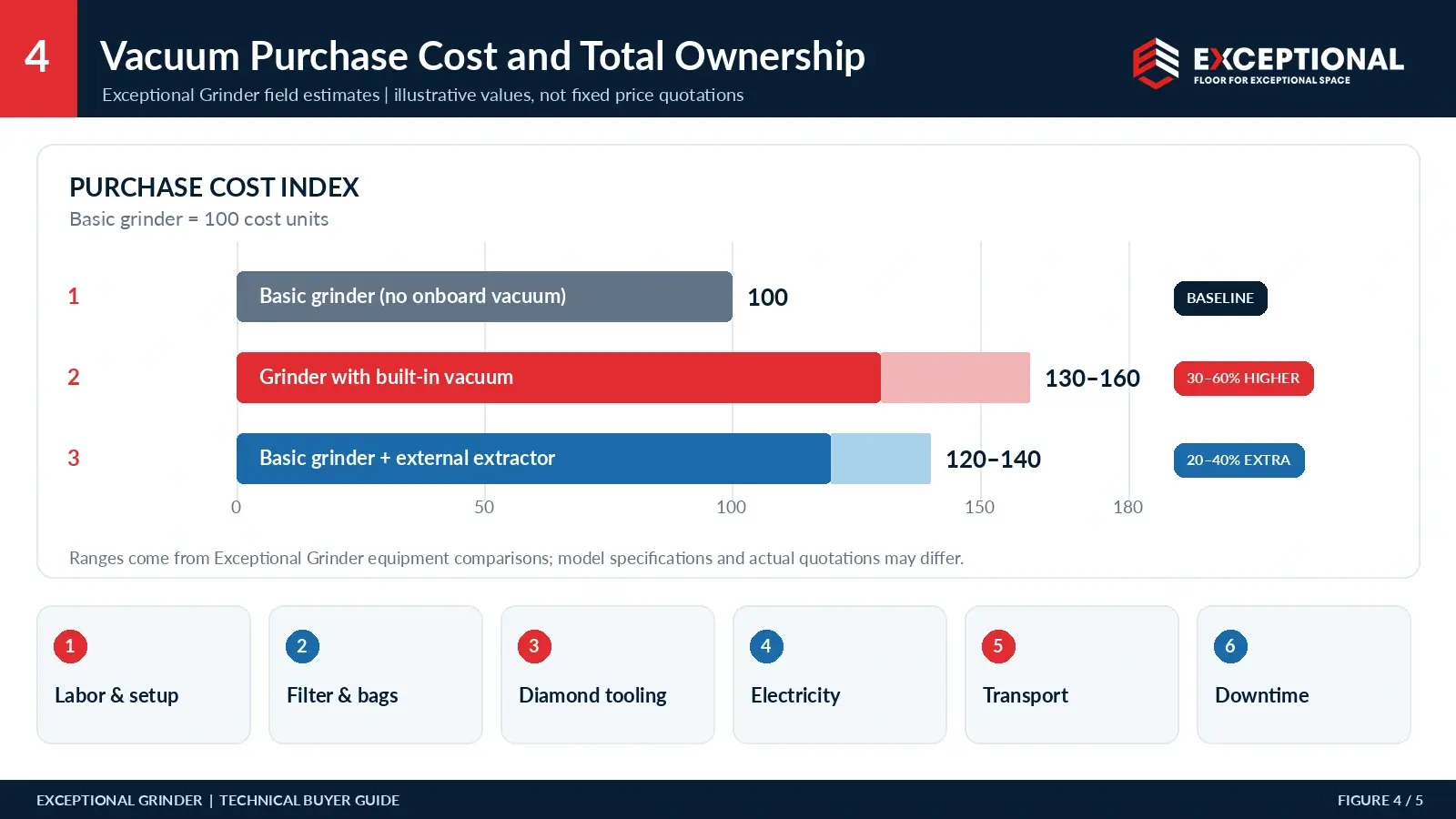
The example excludes optional tooling, freight, taxes, and other accessories.
The two dust-controlled configurations overlap in cost. This means an integrated grinder does not necessarily cost more than a complete grinder-and-extractor package.
For a procurement decision, request quotations for comparable machine sizes, grinding power, dust collection capacity, and accessories.
Maintenance Costs and Consumable Parts
Integrated systems contain more components within the grinder.
Operators must maintain the grinding drive and the vacuum equipment. This includes filters, collection bags, seals, ducts, bearings, and electrical components.
A basic grinder may require less maintenance on the grinder itself. However, its separate dust extractor still needs filter cleaning, motor service, and consumable replacement.
| Maintenance item | Built-in vacuum grinder | Grinder with external extractor |
|---|---|---|
| Grinding motor and gearbox | Required | Required |
| Diamond tools | Required | Required |
| Vacuum motor | Onboard | External unit |
| Dust filters | Onboard | External unit |
| Dust bags or containers | Onboard | External unit |
| Hose inspection | Internal ducts and connections | External hose and connections |
| Cleaning work | One machine platform | Two separate machines |
| Service flexibility | Integrated components | Units can undergo separate service |
A contractor may prefer integrated equipment for its simpler daily setup.
A rental business may prefer separate extractors because technicians can service or replace one machine without taking the whole fleet out of service.
Total Cost of Ownership Matters More Than Purchase Price
The lowest initial price does not guarantee the lowest operating cost.
Contractors should include equipment depreciation, diamond tools, filter replacement, electricity, cleanup labor, transport, and downtime.
A practical cost-per-area calculation is:
Cost per m² = (Allocated equipment cost + Labor + Consumables + Electricity + Maintenance + Cleanup) ÷ Completed floor area
For buyers, the strongest comparison uses the same concrete conditions, coating thickness, diamond tooling, and required surface finish.
Grinding Quality: Surface Visibility, Consistency, and Edge Grinding
Dust collection can affect how operators inspect the floor during grinding.
It does not replace the cutting action of diamond tools or the grinding machine’s mechanical performance.
Better Surface Visibility During Epoxy Preparation
Epoxy coatings require a clean and suitable concrete substrate.
During surface preparation, operators need to identify coating residue, weak laitance, scratches, and areas that still need grinding.
An effective built-in vacuum helps remove dust from the grinding path. This makes it easier to inspect the surface during operation.
In our field experience, clearer visibility can help operators reduce missed spots and unnecessary repeat passes.
The benefit becomes more useful when contractors work through multiple grinding stages or prepare concrete for thin coating systems.
Surface Flatness and Grinding Uniformity
A dust collection system does not determine floor flatness on its own.
Grinding head design, diamond tooling, working pressure, machine speed, and operator control influence the finished surface.
However, dust buildup can hide high spots, uneven grinding, and remaining material.
Good dust removal supports better inspection and can help the operator adjust machine settings before continuing.
For technical surface preparation, contractors should still inspect the final profile and follow the coating manufacturer’s requirements.
Edge Grinding and Corners
Some floor grinder designs have shrouds or vacuum components that restrict access near walls.
Dust may also remain around corners when the collection system lacks sufficient airflow or the shroud does not seal well.
This issue depends on machine geometry, not vacuum type alone.
Contractors may need edge grinders, suitable diamond tools, and additional dust-collection equipment to reach corners and narrow areas.
Operator Safety, Machine Weight, and Noise
Worker health should influence every concrete grinding equipment purchase.
Grinding concrete can release respirable crystalline silica. Workers may inhale these fine particles without seeing a visible dust cloud.
An integrated vacuum can reduce dust release, but it cannot guarantee zero exposure.
How Dust Extraction Supports Worker Health
Collecting dust near the grinding head helps reduce the amount that spreads through the work area.
This can improve visibility and reduce dust accumulation on equipment and nearby surfaces.
It also supports better housekeeping and may lower worker exposure when contractors use a suitable system.
Respiratory protection, exposure assessment, maintenance, and other controls still depend on the applicable regulations and actual working conditions.
A built-in vacuum does not automatically replace a respirator when the job requires one.
OSHA Silica Dust Control Requirements
In the United States, OSHA 29 CFR 1926.1153 covers respirable crystalline silica exposure in construction.
The regulation sets a permissible exposure limit of 50 µg/m³ as an eight-hour time-weighted average.
For walk-behind floor grinders, OSHA Table 1 provides specified control options.
| Control method | OSHA Table 1 requirement |
|---|---|
| Water delivery | Use a machine with a system that supplies water continuously to the cutting surface |
| Dust collection | Use the dust collection system the manufacturer recommends |
| Extraction airflow | Meet or exceed the manufacturer’s recommended airflow |
| Filter efficiency | At least 99% |
| Filter cleaning | Dust collector must include a filter-cleaning mechanism |
| Indoor dry grinding cleanup | Use a HEPA-filtered vacuum to remove loose dust between passes |
These requirements apply when the employer follows the relevant Table 1 control method. Other OSHA provisions also govern exposure assessment and worker protection.
Contractors should follow the complete regulation rather than judge compliance from the presence of a vacuum motor.
Read the official OSHA Respirable Crystalline Silica Standard.
Does Built-In Extraction Increase Machine Weight?
Built-in extraction adds motors, filters, ducts, containers, and other components.
In some equipment configurations we have compared, these components increased total machine weight by approximately 10–20%.
This increase may affect loading, unloading, transport, and movement between working areas.
Additional weight may also support grinding stability in some machine designs. However, the result depends on weight distribution and working pressure.
For example, the Exceptional Grinder K58 weighs 430 kg. Its four-position counterweight system lets operators adjust grinding pressure for different floor conditions.
Buyers should compare the actual model weights and handling features instead of applying the 10–20% estimate to every machine.
Noise and Operator Comfort
A built-in vacuum adds motor and airflow noise to the grinding process.
However, an external dust extractor also creates noise. The difference depends on the equipment and where workers position the extractor.
For indoor work and long shifts, contractors should compare operating sound levels under similar conditions.
Remote control, adjustable handles, machine vibration, and movement also affect operator comfort.
How to Evaluate Concrete Grinder Vacuum Performance
Vacuum motor power alone cannot tell buyers how well a dust collection system will work.
Airflow, suction pressure, filtration, hose design, and filter condition all influence performance.
Airflow: CFM and m³/h
Airflow measures how much air moves through the vacuum system over time.
Manufacturers commonly report airflow in cubic feet per minute (CFM) or cubic meters per hour (m³/h).
A grinder that produces large amounts of fine dust needs enough airflow to capture particles and carry them through the collection system.
However, maximum rated airflow does not always match airflow at the grinding head during operation.
Hose length, bends, restrictions, and loaded filters can reduce actual airflow.
Vacuum Pressure: kPa, Bar, and mbar
Vacuum pressure indicates the system’s ability to create a pressure difference.
It helps the machine move dust and debris through hoses and filters.
High vacuum pressure does not always mean high airflow. Buyers need to evaluate both properties.
The best extractor must provide suitable airflow and suction under the expected working conditions.
HEPA Filtration and Filter Cleaning
Concrete grinding creates fine particles that require suitable filtration.
Buyers should compare filter efficiency, test documentation, filter surface area, sealing, and cleaning mechanisms.
A large filter surface may help the system manage dust loading. Manual or automatic filter cleaning can help restore airflow.
Filtration efficiency alone does not prove complete dust-control performance. Air leakage, filter damage, and poor collection at the grinding head can reduce the system’s effectiveness.
Hose Diameter, Length, and Dust Collection Capacity
External extraction systems introduce more variables.
A long or narrow hose may restrict airflow. Sharp bends and damaged connections can also reduce performance.
The collection system must handle the expected dust volume without frequent blockages or excessive downtime.
For large grinders, confirm the hose diameter, dust port, airflow requirements, filter capacity, and available power before selecting an extractor.
Dry vs. Wet Concrete Grinding: Do Both Require Dust Extraction?
Dry and wet grinding use different dust-control methods.
The right choice depends on the machine, flooring system, jobsite conditions, and cleanup requirements.
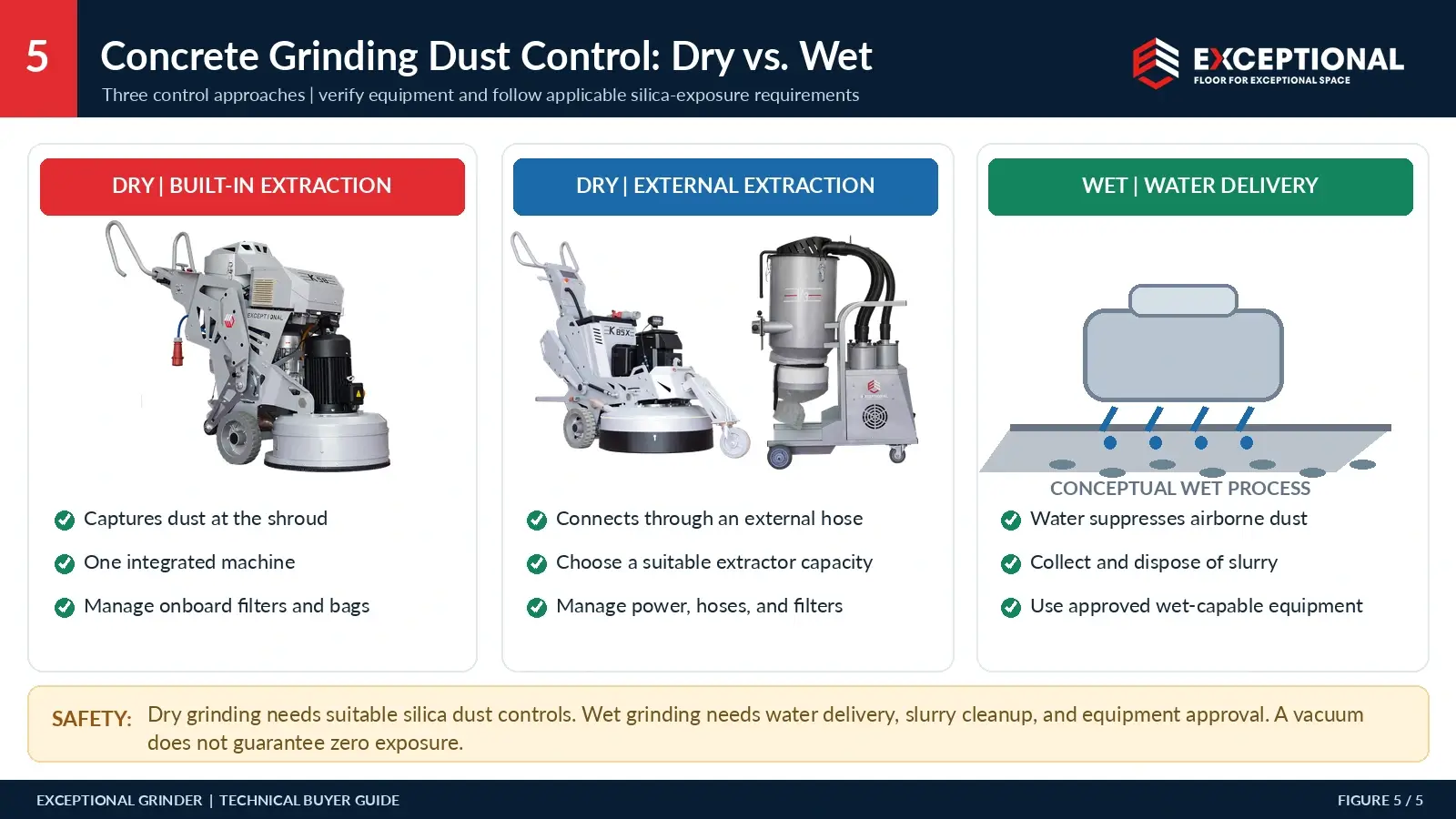
Dry Grinding With Dust Extraction
Dry grinding uses metal-bond diamond tools or other suitable abrasives without adding water to the cutting surface.
The grinding process can create airborne concrete dust. An onboard vacuum or compatible external extractor helps capture that material.
Dry grinding often suits coating preparation and jobs where contractors want to avoid introducing additional water.
However, contractors must maintain the extraction system and follow the relevant dust-control requirements.
Wet Grinding With Water Delivery
Wet grinding supplies water to the cutting area.
Water helps suppress dust and cool the tooling. The process creates concrete slurry rather than collecting dry powder through a vacuum system.
Contractors must collect and dispose of the slurry using suitable methods.
They must also use equipment that the manufacturer approves for wet operation.
Can a Grinder Without a Vacuum Work on Wet Floors?
Some floor grinders without onboard dry extraction support wet grinding.
This can offer flexibility for projects involving slurry-based processing, concrete polishing, or certain stone surfaces.
However, a machine’s lack of a vacuum does not make it suitable for wet operation.
Water can damage electrical components or vacuum systems that lack wet-operation protection.
Contractors should confirm the grinder’s water-feed design, electrical protection, and operating instructions before working on damp or wet surfaces.
For epoxy floor preparation, they must also allow sufficient drying time and verify substrate moisture conditions before installing the coating.
Which Vacuum Configuration Works Best for Different Flooring Projects?
Different applications create different dust loads and equipment demands.
The following recommendations combine Exceptional Grinder’s experience with practical equipment selection factors.
| Application | Configuration to consider | Main reason |
|---|---|---|
| Epoxy floor preparation | Built-in or matched external extraction | Surface visibility and dust control |
| Concrete polishing | Either suitable configuration | Multi-stage grinding and fine dust collection |
| Shopping malls and offices | Built-in vacuum grinder | Less separate equipment and convenient handling |
| Hospitals and occupied facilities | Verified dust-controlled system | Dust containment and worker protection |
| Large warehouse renovation | Integrated or high-capacity external extraction | Sustained collection and project productivity |
| Heavy coating removal | System sized for dust and debris volume | Filter loading and collection demands |
| Small repair projects | Compact built-in vacuum grinder | Transport and setup convenience |
| Outdoor concrete grinding | Suitable dry extraction or approved wet controls | Worker exposure and surrounding conditions |
| Wet grinding applications | Manufacturer-approved wet grinder | Water delivery and slurry management |
| Equipment rental businesses | Both configurations | Flexibility across customer needs |
| Contractors with limited budgets | Vacuum-ready grinder plus compatible extractor | Flexible purchasing and equipment sharing |
When Should You Choose a Built-In Vacuum Grinder?
Built-in vacuum models often suit contractors who work indoors and move between many small or medium-sized jobs.
They reduce the number of separate machines the crew must transport and position.
They may also suit businesses that want a standard equipment package for daily grinding and dust collection.
When Should You Choose an External Dust Extractor?
External extractors may suit contractors who operate several different grinders or need more flexibility in dust-collection capacity.
A separate extractor can serve multiple compatible machines across different projects.
For larger grinding widths or heavy coating removal, contractors may prefer an extraction system that matches the expected dust load.
Using one extractor with different machines depends on hose compatibility, airflow, electrical requirements, and scheduling.
Exceptional Grinder K58: Built-In Vacuum System Case Study
The Exceptional Grinder K58 shows how a manufacturer can combine grinding performance and dust extraction in one industrial machine.
It uses a three-head planetary system with a 580 mm working width.
The integrated vacuum supports concrete grinding, surface opening, coating removal, and polishing without requiring a separate dust extractor in the standard configuration.
Exceptional Grinder K58 Technical Specifications
| Technical parameter | K58 specification |
|---|---|
| Model | K58 |
| Product type | Dust-Free Planetary Concrete Floor Grinder |
| Grinding motor | 7.5 kW / 10 HP |
| Vacuum motor | 2.55 kW / 3.4 HP |
| Grinding width | 580 mm / 23 in |
| Grinding heads | 3 × 252 mm |
| Tool speed | 0–1,500 rpm |
| Maximum airflow | 415 m³/h / 244 CFM |
| Maximum vacuum pressure | 0.17 bar |
| Main filter area | 3.2 m² |
| Main filter type | Conical filter |
| Filter cleaning | Manual and automatic |
| Counterweight adjustment | Four positions |
| Machine weight | 430 kg / 948 lb |
| Standard voltage | Three-phase, 220–380 V |
| High-voltage option | 400–480 V |
What Makes the K58 Suitable for Dust-Controlled Grinding?
The K58 combines its grinding and vacuum systems on one platform.
This reduces setup work and removes the need to position a separate extractor beside the machine.
The onboard vacuum captures dust as the grinding heads work. Filter-cleaning functions help operators manage dust buildup during extended use.
The machine also features adjustable counterweights and a sealed planetary grinding head. These features support grinding pressure control and help protect the drive components from dust.
K58 Operating Considerations
The K58 requires sufficient electrical power for its grinding and vacuum motors.
Its 430 kg weight also affects transport, loading, and jobsite access.
Operators must clean filters, inspect ducts, and empty the collection system according to the machine instructions.
For projects with unusual dust loads or special filtration requirements, contractors should review the complete extraction specifications before selecting equipment.
The K58 provides an example of integrated dust collection, not a guarantee that all integrated grinders perform the same way.
Exceptional Grinder Floor Grinders: Built-In Vacuum vs. External Dust Extraction
Exceptional Grinder offers different grinding and dust-control configurations for professional contractors and equipment buyers.
Most of our grinder models feature onboard vacuum systems. Other machines provide connections for compatible external industrial dust extractors.
This range lets buyers choose equipment based on grinding width, motor power, control method, and dust collection needs.
Exceptional Grinder Model Comparison
| Model | Grinding width | Grinding motor | Dust extraction |
|---|---|---|---|
| K58 | 580 mm | 7.5 kW | Built-in 2.55 kW vacuum |
| K-72 | 700 mm | 15 kW | Built-in 3 kW vacuum |
| K-72X | 700 mm | 15 kW | Built-in 3 kW vacuum |
| K-85 | 850 mm | 20.5 kW | External extractor connection |
| K-85X | 850 mm | 21.5 kW | External extractor connection |
The K58, K-72, and K-72X serve buyers who prefer integrated dust extraction.
The K-85 and K-85X use external dust extractor connections. They offer wider grinding paths and remote-controlled operation for larger flooring projects.
The K-85 and K-85X feature 70 mm vacuum ports. Buyers should confirm hose adapters and extraction capacity before choosing an external collector.
V3 Industrial Dust Extractor for Concrete Floor Grinding
Exceptional Grinder also supplies the V3 Industrial Dust Extractor.
The V3 uses three vacuum motors with a combined rated power of 3 kW. It delivers up to 468 m³/h of airflow and 0.23 bar of maximum vacuum pressure.
Its filtration system includes a main conical filter and three final-stage filters. The published specification lists 99.9% filtration efficiency at 0.3 μm.
The V3 uses a 50 mm hose. Contractors should confirm connection compatibility and suitable operating airflow before pairing it with a grinder that uses a larger dust port.
For projects with specific HEPA or occupational exposure requirements, buyers should request supporting filter test reports and confirm the complete system meets the applicable standard.
How to Choose a Concrete Floor Grinder With or Without Built-In Vacuum
A good purchasing decision starts with the work the machine must perform.
Contractors should compare grinding width, power, dust extraction, maintenance, and total operating costs.
Match Dust Collection With Grinder Size and Dust Load
Large grinding heads and aggressive tools can produce substantial dust and debris.
A small collection system may struggle to keep up with heavy material removal.
Ask the manufacturer for the recommended airflow, filter arrangement, and dust collection capacity for the exact grinder model.
Check Electrical Requirements
Built-in vacuums add electrical demand to the grinder.
External extractors require their own electrical supply or an approved shared power arrangement.
Check voltage, phase, amperage, plug type, and generator capacity before ordering.
Compare Maintenance and Spare Parts
Filters, seals, hoses, vacuum motors, and dust containers need routine service.
Buyers should confirm replacement-part availability and maintenance procedures.
For rental fleets, consider how easily technicians can inspect, clean, and repair each system.
Evaluate the Total Project Cost
Purchase price offers only part of the answer.
A built-in vacuum may reduce setup time and equipment handling. An external extractor may provide greater flexibility across several grinders.
The better investment depends on operating hours, floor area, cleaning requirements, service costs, and equipment utilization.
Buying Checklist for Contractors and Distributors
| Buying question | What to confirm |
|---|---|
| What flooring work will the machine perform? | Epoxy removal, concrete grinding, polishing, or repair |
| How large are the projects? | Working width and expected productivity |
| Will the machine operate indoors? | Dust control, access, power, and site restrictions |
| How much dust will the work produce? | Removal depth, tooling, and collection capacity |
| Does the machine include a vacuum? | Onboard motor, filters, cleaning, and collection design |
| Can it connect to an external extractor? | Dust-port diameter and approved equipment |
| What power does it need? | Voltage, phase, amperage, and generator capacity |
| Which maintenance parts need replacement? | Filters, seals, hoses, motors, and consumables |
| What costs matter over time? | Labor, cleanup, downtime, electricity, and parts |
| Does the supplier provide support? | Spare parts, technical documents, and service guidance |
For more equipment selection advice, read our Concrete Floor Grinder Buying Guide.
Why Exceptional Grinder Prioritizes Dust-Controlled Floor Grinding
At Exceptional Grinder, we believe that grinding performance and dust control should work together.
High grinding productivity matters. So do worker health, clean jobsites, and the surrounding environment.
Most of our concrete floor grinders feature built-in vacuum systems. Other models support compatible external industrial dust extractors.
This product approach gives contractors more freedom to select suitable dust-control equipment for different floor preparation projects.
We also focus on practical operating needs, including filter cleaning, machine maintenance, dust containment, and operator handling.
Our goal is to help flooring contractors reduce airborne dust, improve worksite conditions, and protect the people who operate and work near grinding equipment.
No floor grinder can guarantee zero dust exposure. Contractors must still follow applicable safety regulations and maintain their dust-control equipment.
As a concrete floor grinder manufacturer in China, Exceptional Grinder supplies planetary grinders, rotary grinders, diamond tools, floor scarifiers, and dust extraction equipment for contractors, rental companies, and international distributors.
Frequently Asked Questions About Concrete Floor Grinders With and Without Vacuum
1. Is a Concrete Floor Grinder With a Built-In Vacuum Better?
A built-in vacuum grinder can offer easier setup, fewer separate machines, and convenient dust collection.
However, an external industrial dust extractor may provide greater flexibility or capacity for demanding projects.
The better choice depends on floor area, dust load, working environment, and equipment costs.
2. Can You Use a Concrete Floor Grinder Without a Vacuum?
A grinder does not need an onboard vacuum if it uses another suitable dust-control system.
Contractors may connect a compatible external extractor or use manufacturer-approved wet grinding equipment.
They should not assume that uncontrolled dry grinding is acceptable.
3. Does a Built-In Vacuum Reduce Grinding Motor Power?
Not automatically.
Many industrial grinders use separate motors for grinding and vacuum extraction.
The vacuum adds electrical demand, but it does not automatically reduce the grinding motor’s rated output.
4. Are Built-In Vacuum Floor Grinders More Expensive?
In some comparisons from Exceptional Grinder’s field experience, integrated vacuum grinders cost approximately 30–60% more than comparable basic models.
The difference depends on machine size, motor power, filtration equipment, and configuration.
Buyers should compare the complete purchase cost rather than the grinder price alone.
5. Does a Concrete Floor Grinder With Vacuum Produce No Dust?
No.
A suitable dust extraction system can reduce airborne dust, but it cannot guarantee zero emissions or exposure.
Actual performance depends on airflow, filtration, shroud condition, filter maintenance, and work practices.
6. How Much Airflow Does a Concrete Floor Grinder Need?
The required airflow depends on the manufacturer’s recommendations and the complete grinding system.
A wide grinder with aggressive tooling may need more dust-collection capacity than a compact machine.
Check airflow at the working configuration, not just the extractor’s maximum rating.
7. Can You Connect an External Vacuum to a Grinder With Built-In Extraction?
Some grinder designs may support additional extraction connections, but buyers should not assume compatibility.
Check the manufacturer’s instructions, available ports, airflow requirements, and approved connection methods before making modifications.
8. Which Floor Grinder Works Better for Epoxy Coating Preparation?
Both configurations can prepare concrete for epoxy coatings with suitable diamond tooling and dust controls.
A built-in vacuum can make surface inspection and equipment handling easier.
An external extractor may offer greater collection capacity for heavy coating removal or larger projects.
9. Can You Use a Floor Grinder Without Built-In Vacuum for Wet Grinding?
Some machines support wet grinding through a suitable water-feed system.
However, the manufacturer must approve the machine for wet operation.
Contractors also need to collect slurry and protect electrical components from water.
10. Which Vacuum Configuration Is Better for Equipment Rental Businesses?
Rental companies may benefit from offering both configurations.
Built-in systems can simplify equipment packages and customer setup.
Separate extractors let rental operators match collection equipment to different compatible grinders and project demands.
Choosing the Right Concrete Floor Grinder for Your Business
Concrete floor grinders with built-in vacuum systems offer a convenient way to combine grinding and dust collection.
Machines without onboard vacuums may cost less upfront and offer more flexibility when paired with suitable external extractors.
Exceptional Grinder’s experience shows that the decision involves more than equipment cost. Working conditions, surface visibility, maintenance, electrical supply, machine weight, and cleanup labor all influence the final result.
For indoor contractors who value simple setup and integrated dust management, the Exceptional Grinder K58 offers a practical option. For larger projects with different extraction requirements, models such as the K-85 and K-85X support external dust collection systems.
At Exceptional Grinder, we place strong value on worker health and environmental protection. Our integrated and external dust extraction solutions help contractors balance grinding performance with cleaner jobsite operation.
Contact Exceptional Grinder to compare concrete floor grinding machines, dust extraction systems, diamond tooling, and suitable equipment configurations for your next project.