
Rotary Concrete Grinders Manufacturer in China
Explore professional rotary concrete grinders from Exceptional Grinder, a leading floor grinding equipment manufacturer in China. Choose from single-disc and dual-disc floor grinders for aggressive concrete grinding, epoxy coating removal, surface leveling and industrial floor preparation, with multiple working widths, dust-control configurations and factory-direct supply.
- CE-Certified Equipment
- 20+ Patented Technologies
- Factory-Direct Supply
- Global Distributor Support
Exceptional Grinder manufactures heavy-duty rotary concrete grinders for professional flooring contractors, industrial maintenance companies, equipment distributors and rental businesses. Unlike planetary grinders, rotary floor grinders use one or more grinding discs rotating around fixed axes, delivering controlled cutting action for concrete surface preparation, high-spot removal, floor leveling and coating removal.
Our range includes compact single-disc concrete grinders, variable-speed floor grinding machines, integrated dust-extraction models and large dual-disc grinders. From the 250 mm YM-250 high-speed grinder to the 600 mm YM-600 heavy-duty machine, buyers can select equipment according to concrete hardness, working width, motor power, available voltage and project requirements. Compatible diamond grinding tools and dust-control solutions are also available.
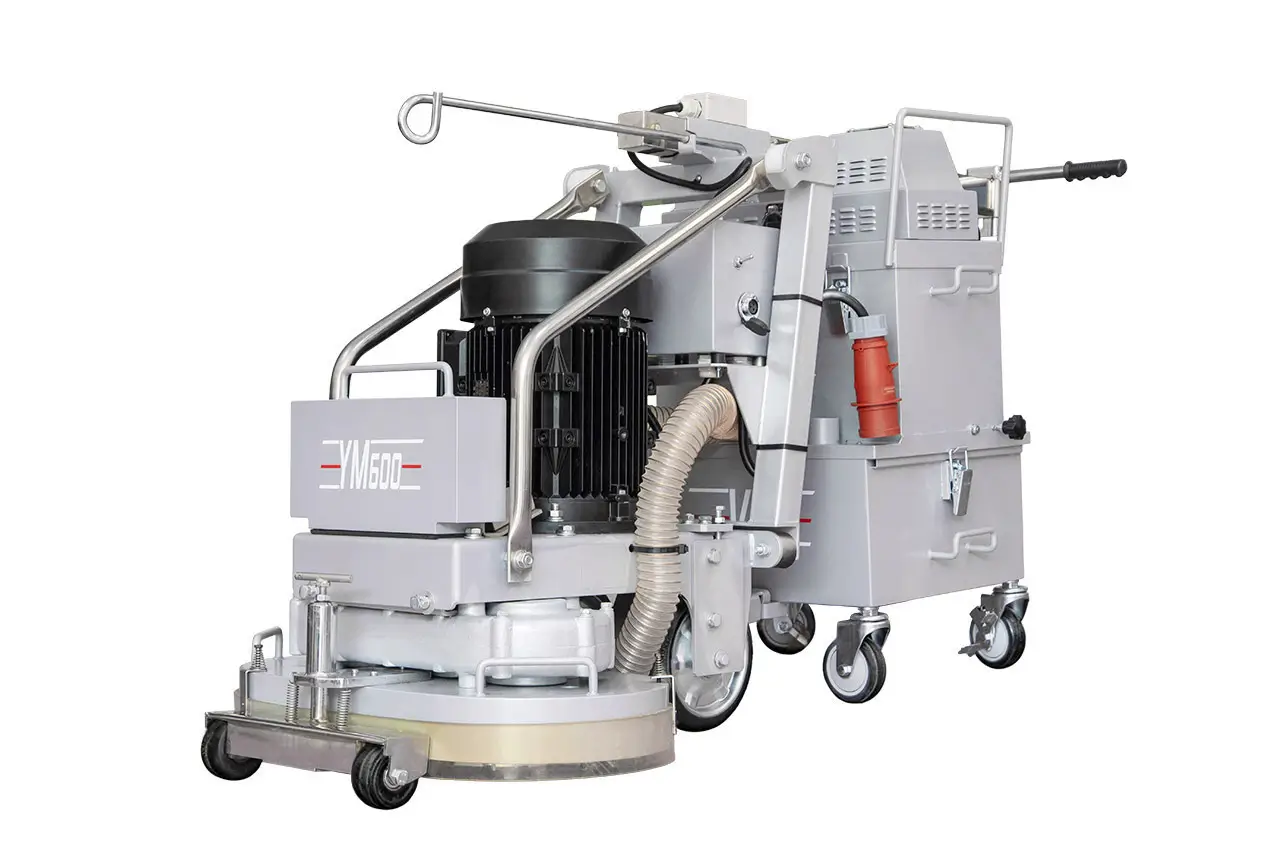
YM-600 Concrete Floor Grinder
What Are Rotary Concrete Grinders?
Rotary concrete grinders are professional floor grinding machines that use rotating diamond tools to remove, level or refine the surface of concrete and other compatible flooring materials. They are also called rotary floor grinders, single-head concrete grinders or dual-disc concrete grinders, depending on the grinding-head design.
Unlike handheld angle grinders or small die grinders, industrial rotary concrete grinders are generally walk-behind machines built for floor preparation. Their rotating heads use metal-bond diamond segments, grinding plates or specialized coating-removal tools to process hardened concrete, old epoxy coatings, adhesives, terrazzo and other floor surfaces.
Rotary grinders may use one or more fixed-axis grinding heads. Single-disc machines concentrate grinding pressure over a smaller working area, while dual-disc machines provide wider coverage for larger projects.
Applications of Rotary Concrete Floor Grinders
Rotary concrete grinding machines are widely used in commercial construction, industrial flooring, warehouse renovation, parking facilities, manufacturing plants and concrete floor restoration. Their performance depends on the grinding-head configuration, motor power, diamond tooling and floor conditions.
Concrete Grinding and Floor Leveling
Heavy-duty rotary grinders can reduce concrete high spots, remove cement laitance, open dense concrete surfaces and smooth uneven floors. They are useful when preparing worn industrial concrete, emery floors, hardened concrete and warehouse slabs for new flooring systems.
Epoxy Coating and Adhesive Removal
With suitable diamond segments or PCD coating-removal tools, rotary concrete grinders can remove old epoxy flooring, paint, adhesives, resin coatings and other surface materials. The correct tooling helps contractors expose a sound concrete substrate before installing new epoxy, polyurethane or other resin flooring.
Concrete Surface Profiling and Polishing
Rotary floor grinders can create a suitable concrete surface profile (CSP) for coatings, overlays and floor repairs. With compatible finer-grit diamond tools and polishing pads, certain models can also support surface refinement, terrazzo renovation and concrete polishing. The final surface profile and finish depend on the tooling, grinding sequence and machine design.
Single-Disc vs. Dual-Disc Rotary Concrete Grinders
Rotary floor grinding machines are available in different grinding-head configurations. The most suitable choice depends on the working area, removal requirements, handling preferences and available electrical power.
| Feature | Single-Disc Rotary Grinders | Dual-Disc Rotary Grinders |
|---|---|---|
| Grinding system | One rotating head | Two rotating heads |
| Working coverage | Narrower, concentrated | Wider working path |
| Typical applications | High-point removal, smaller areas, coating removal | Larger floor areas, grinding and renovation |
| Maneuverability | Generally better in restricted spaces | Better coverage in open areas |
| Grinding pressure | Often concentrated on one head | Distributed across two heads |
| Representative Exceptional models | YM-250, YM-320V, YM-420 | YM-600 |
Exceptional Grinder offers several rotary concrete grinding machines for different applications. The YM-250 Heavy-Duty Concrete Floor Grinder combines a 5.5 kW motor, a 250 mm grinding width and adjustable speed up to 1,700 RPM for aggressive grinding on hard concrete.
For contractors requiring integrated dust collection, the YM-420 Concrete Floor Grinder provides a 400 mm working width, a 7.5 kW grinding motor and dual built-in vacuum motors. For larger projects, the YM-600 Dual-Disc Concrete Floor Grinder offers a 600 mm working width and a dual-disc system for wider floor coverage.
Rotary vs. Planetary Concrete Floor Grinders: What’s the Difference?
The main difference between rotary and planetary concrete floor grinders is the movement of their grinding heads.
Rotary grinders use one or more heads that rotate around fixed axes. This design is often preferred for concentrated grinding, high-spot correction and heavy coating removal. Planetary floor grinders use multiple smaller heads that rotate while orbiting a central carrier. Their overlapping grinding paths generally help produce a more uniform scratch pattern during multi-stage concrete grinding and polishing.
Neither system is best for every job. Rotary grinders can be an economical and effective choice for surface preparation, while planetary models are often preferred for large-scale polishing and applications requiring consistent surface refinement.
Learn more in our Planetary vs. Rotary Concrete Floor Grinders comparison, or explore our Planetary Floor Grinders for alternative grinding solutions.
How to Choose the Right Rotary Concrete Grinder
Selecting a rotary concrete grinding machine requires more than comparing motor power or grinding width. Contractors, rental companies and equipment distributors should consider the flooring application, daily workload, electrical supply and operating costs.
Grinding width and project size: Compact 250–300 mm grinders provide greater control in small rooms, corridors and localized repair areas. Wider machines, such as 400 mm and 600 mm models, can cover more floor area per pass.
Motor power, RPM and grinding pressure: Motor output, tool-holder speed and downward grinding pressure influence removal performance. Variable-speed machines allow greater adjustment for different diamond tools, concrete hardness and coating conditions.
Electrical configuration: Check the required voltage, frequency, phase and available amperage before ordering. Exceptional Grinder offers selected rotary floor grinders in single-phase and three-phase configurations for different international markets.
Dust extraction and maintenance: For indoor projects, consider an integrated dust-extraction grinder or a machine compatible with an industrial dust extractor. Also review machine weight, transportation requirements, tooling availability, maintenance access and replacement-part support.
Diamond Grinding Tools and Dust Control
Diamond tooling is essential to the performance of a rotary concrete grinder. Metal-bond diamond segments are commonly used for concrete grinding, leveling and surface opening, while PCD tools may be selected for suitable coating-removal applications.
Concrete hardness affects tool selection. Hard concrete generally requires a softer diamond bond, while softer, more abrasive concrete typically requires a harder bond. Diamond grit, segment shape, tool quantity and grinding speed also influence cutting efficiency, tool wear and surface finish.
Explore Exceptional Grinder’s Diamond Tools for concrete surface preparation and coating-removal applications.
Dry concrete grinding can generate hazardous respirable crystalline silica dust. A properly matched dust-control system is therefore an important part of professional floor preparation. Select suitable extraction equipment, follow local workplace safety requirements and maintain the filters and collection system.
See our Industrial Dust Extractors for compatible floor grinding and dust-control solutions.
Frequently Asked Questions About Rotary Concrete Grinders
What is a rotary concrete grinder used for?
A rotary concrete grinder is used to grind, level, roughen and prepare concrete floors. Common applications include removing epoxy coatings, paint, adhesives and cement laitance, correcting concrete high spots, preparing surfaces for new coatings and restoring worn industrial floors.
What is the difference between a rotary grinder and a planetary grinder?
A rotary grinder uses grinding heads that rotate around fixed axes, while a planetary grinder uses heads that also orbit a central carrier. Rotary machines are often suited to concentrated material removal, while planetary machines generally provide more uniform grinding patterns for multi-stage polishing.
Can a rotary concrete grinder remove epoxy coatings?
Yes. Rotary concrete grinders can remove many types of epoxy floor coatings when fitted with suitable diamond segments or PCD coating-removal tools. The best tooling depends on coating thickness, hardness, adhesion and the condition of the underlying concrete.
Can rotary concrete grinders polish concrete floors?
Yes, certain rotary concrete grinders can support concrete polishing and surface refinement when equipped with compatible polishing tools. However, not every rotary grinder is designed for high-gloss polishing. Planetary grinders are often preferred for multi-stage polishing projects where finish consistency is a priority.
What size rotary concrete grinder should I buy?
For localized repairs and smaller work areas, a 250–300 mm rotary grinder may provide better maneuverability. For medium-sized commercial floors, a 400 mm machine offers wider coverage. A 600 mm dual-disc grinder may be better suited to larger open areas. Consider the required removal rate and available power as well as working width.
How do I choose diamond tools for a rotary floor grinder?
Select diamond tools according to concrete hardness, coating type, required removal rate and target surface profile. Hard concrete usually needs a softer diamond bond, while soft concrete needs a harder bond. Coarse metal-bond diamonds suit initial grinding, while specialized coating-removal tools or finer grits serve different preparation stages.
Rotary Concrete Grinder Manufacturer and Wholesale Supplier in China
Exceptional Grinder manufactures professional rotary concrete grinders for flooring contractors, equipment distributors, rental companies and industrial buyers worldwide. Our product range includes single-disc and dual-disc grinding machines, integrated dust-collection models, diamond grinding tools and compatible floor preparation equipment.
We provide factory-direct equipment supply, selected OEM and ODM customization options, international electrical configurations, technical guidance and spare-parts support. Buyers can compare models according to grinding width, motor power, floor conditions, application and target market requirements.
Whether you need rotary floor grinders for epoxy coating removal, industrial concrete grinding or commercial floor renovation, our team can help you choose a suitable machine and diamond tooling combination.
Looking for Rotary Concrete Grinders at Factory Prices?
Contact Exceptional Grinder to request product specifications, manufacturer quotations, OEM information and equipment recommendations for your next project.