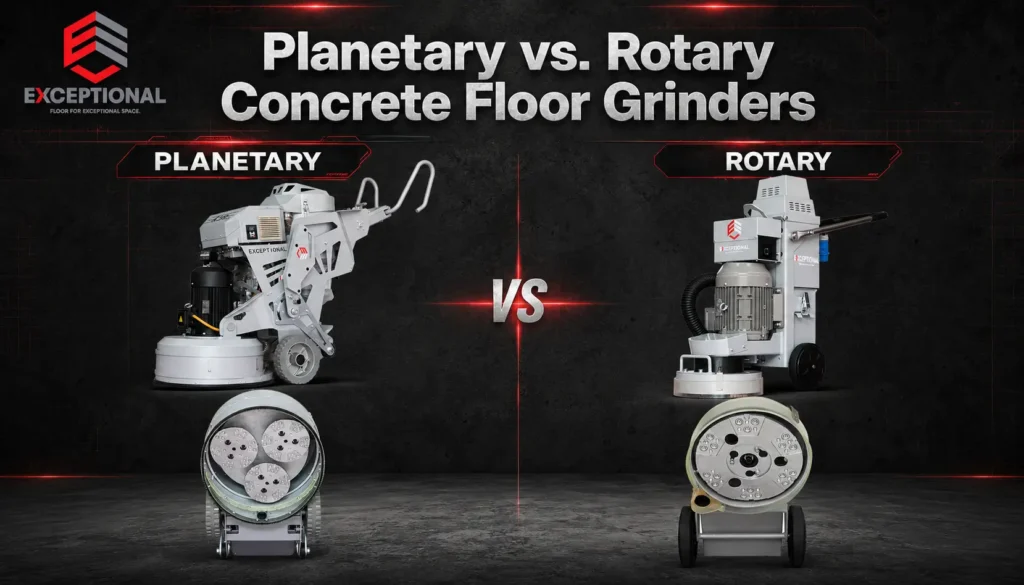
When comparing planetary vs. rotary concrete floor grinders, planetary machines generally provide a more evenly distributed scratch pattern. They are highly versatile for grinding, honing, and concrete polishing.
Choosing a rotary concrete grinder allows you to apply more torque and grinding pressure. This makes them very effective for heavy floor coating removal and high-spot correction.
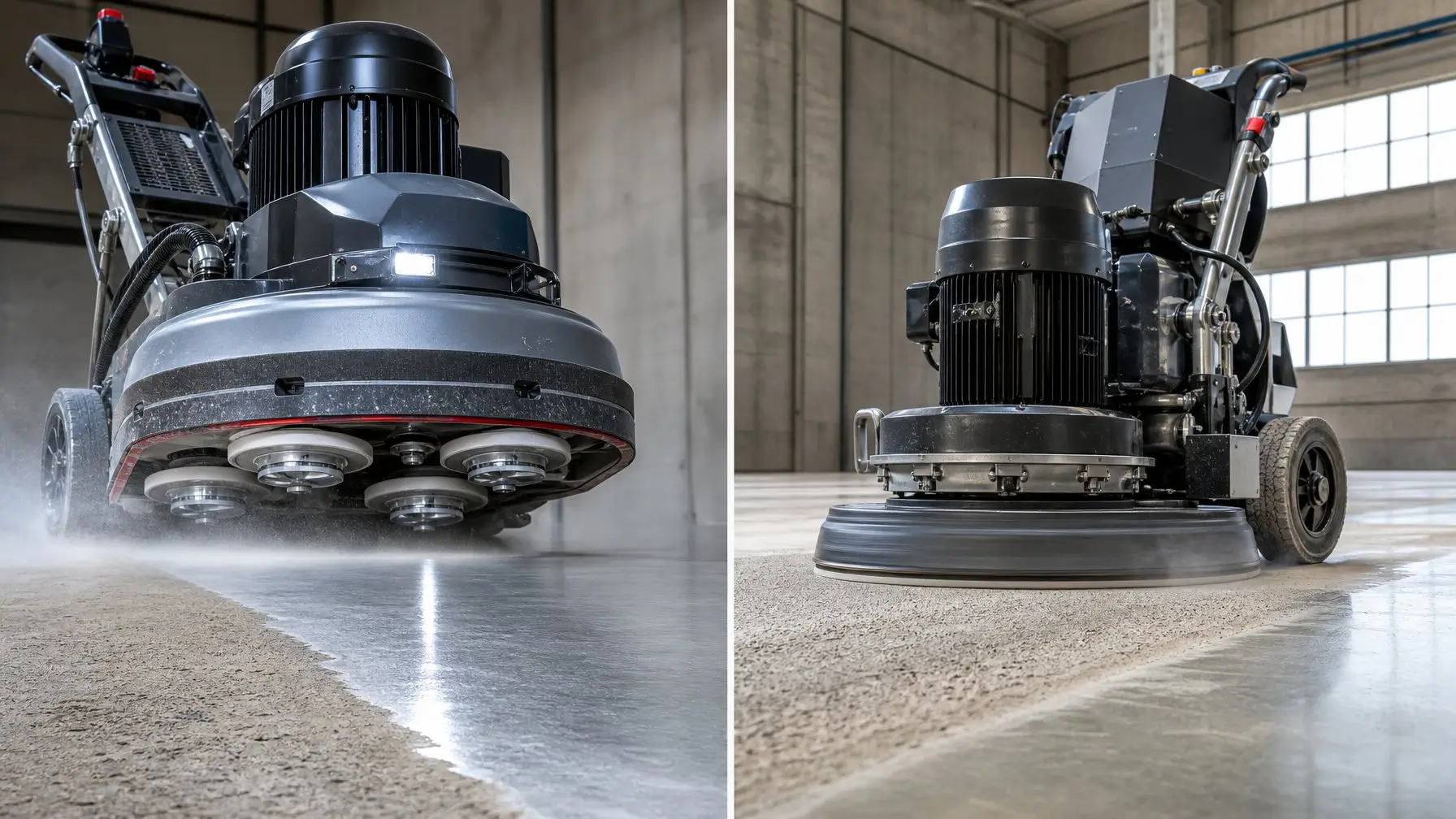
Machine weight, motor output, and tooling are vital for successful concrete surface preparation. The drive system alone does not determine the final concrete surface prep quality. Professionals often look for specific concrete grinding machines that match their project scale and desired finish.
The grinding-head system influences scratch pattern, operator handling, tooling behavior, and finish consistency, so the choice between planetary and rotary determines how efficiently you move through each step of a project. Both systems perform floor grinding and surface prep. They can both technically perform coating removal, leveling, and aggregate exposure. Neither system is automatically better for every floor.
Your final choice depends on coating thickness, concrete hardness, required finish, and project area. Tooling configuration and production goals also play a role. This article compares the two drive systems in terms of motion mechanics, aggressiveness, and polishing capability. If you are looking for equipment from brands like Xtreme Polishing Systems, understanding these mechanics is essential.
You can find many of these units at the EpoxyEtc Store to suit your specific project. Reach out to Exceptional Grinder to discuss your floor area and required concrete polish. The team can recommend a matched grinder, diamond-tool configuration, and dust-extraction system.
Planetary And Rotary Systems At A Glance
The planetary vs. rotary distinction centers on how your grinding heads move relative to the machine chassis. It is not simply based on how many discs are mounted underneath. Understanding this mechanical difference helps you predict scratch distribution and torque behavior.
How Head Movement Defines The System
A planetary grinder mounts multiple smaller satellite heads on a larger rotating carrier. Each tool head rotates about its own axis while orbiting the carrier’s central axis. This complexity is often taught at Polished Concrete University for those seeking professional results.
A rotary grinder uses one or more grinding heads that rotate about fixed axes. The heads do not orbit around a separate central planetary carrier. Configurations include single-disc, dual-disc, and multi-head designs, in which each head spins in place. These machines are commonly used for aggressive removal of floor coatings. Many professional flooring contractors rely on rotary floor grinders when facing challenging removal projects.
The motion resembles the difference between planets orbiting a sun versus tops spinning in fixed positions. That orbital path is the defining feature of planetary motion. This distinction is critical when selecting machinery for concrete surface preparation.
Why Multiple Discs Do Not Automatically Mean Planetary Motion
A three-head grinder is not automatically planetary. Multiple discs do not create planetary motion unless those discs orbit around a separate central axis. Some manufacturers label multi-head machines as planetary when the heads actually rotate around fixed shafts.
Before purchasing, request a drive-system diagram from the manufacturer. Confirm whether the heads orbit a central axis or simply spin in fixed positions. Terminology varies between brands, so verifying head movement protects you from specification mismatches.
Quick Comparison Of Strengths, Tradeoffs, And Best-Fit Applications
| Factor | Planetary Grinder | Rotary Grinder |
|---|---|---|
| Head movement | Tools rotate and orbit around a central axis | Tools rotate around fixed axes |
| Common configurations | Three-head, four-head, dual-drive | Single-disc, dual-disc, multi-head |
| Scratch distribution | Generally more evenly distributed | More directional or concentrated |
| Aggressiveness | Adjustable from preparation to polishing | Often aggressive with suitable tooling |
| Coating removal | Effective with PCD and metal tools | Often strong for concentrated removal |
| High-spot leveling | Effective but distributes pressure | Concentrated action can be advantageous |
| Polishing | Usually highly suitable | Possible, but depends strongly on design |
| Operator side torque | Usually reduced by counter-rotation | Can be higher on single-disc machines |
| Tool count | Usually more tools | Often fewer tools |
| Mechanical complexity | Generally higher | Often simpler |
| Purchase cost | Commonly higher | Commonly lower for comparable compact machines |
| Best general use | Multi-step grinding and polishing | Aggressive preparation and removal |
These are general tendencies. A heavy dual-drive planetary grinder can be more aggressive than a small rotary machine. A counter-rotating rotary grinder may be smoother to operate than a basic single-disc machine.
How Planetary Machines Work On The Floor
Planetary grinding systems generate their characteristic finish through combined rotation and orbital movement. The interaction between the sun gear and satellite heads determines scratch pattern distribution. This ensures the machine addresses surface flatness across the working width.
Planetary Motion, Sun Gear, And Satellite Head Rotation
In a planetary gear system, a central sun gear meshes with satellite gears mounted on a carrier. When the carrier turns, each satellite head rotates around its own shaft while orbiting the sun gear. This dual movement creates overlapping tool paths across the surface.
The ratio between carrier speed and satellite-head speed is often fixed in single-drive machines. Plasma-nitrided gears resist wear and maintain consistent speed ratios under load. This directly affects finish uniformity over time during the concrete grinding process.
On the floor, each diamond segment traces a complex, looping path. That looping action distributes scratches across multiple directions. This is why planetary machines tend to leave a more uniform scratch pattern than a fixed-axis disc.
Active Planetary Vs. Passive Planetary Drive
Active planetary machines use a motor to power both the carrier and satellite-head rotation independently. You can adjust carrier RPM and head RPM separately. This gives you fine control over cutting aggressiveness and scratch refinement.
Passive planetary systems rely on floor friction to spin the satellite heads as the carrier rotates. The heads turn because they contact the floor surface. Passive designs are mechanically simpler but offer less control over head speed.
Active planetary drives deliver more consistent grinding efficiency on hard concrete. On soft concrete, passive systems can sometimes over-cut because head speed increases with reduced resistance. Knowing which type your machine uses helps you predict behavior on different slabs.
Where Planetary Machines Excel In Grinding, Honing, And Polishing
Planetary grinders are preferred for multi-step polishing of concrete and terrazzo. The overlapping tool paths minimize visible circular scratch patterns. This is important when transitioning from metal-bond diamonds to resin polishing pads.
For general surface preparation, a planetary machine covers more width per pass. This improves floor flatness on large commercial floors.
Smaller planetary units like the Concrete Genie are perfect for residential garages, offering great portability. The Concrete Genie provides professional results in tighter spaces where larger machines cannot maneuver.
Ride-on grinder models, such as the Mammoth 800, RD800, and RD850, provide high production rates for large-scale work. These machines can process warehouse-scale areas quickly. This flexibility is why crews running aggregate exposure or large-scale coating removal often standardize on planetary equipment.
How Rotary Machines Deliver Torque And Removal Power
Rotary concrete grinders channel motor output through a direct mechanical path. This concentrates torque and grinding pressure onto a smaller tooling area. These mechanical advantages are ideal for bulk material removal and localized correction work.
Fixed-Axis Rotation And Direct-Drive Spindle Mechanics
In a rotary concrete grinder, the direct-drive spindle connects the motor to the grinding disc. While some machines use a belt, the grinding head rotates around a single fixed axis.
There is no orbiting carrier in these designs. This simple mechanical path allows the rotary concrete grinder to transfer power directly to the floor surface.
This direct mechanical connection reduces transmission losses and improves transmission efficiency. More of the motor’s rated torque is transmitted to the tooling contact surface. On a single-disc rotary grinder, the entire machine weight acts as downward pressure on a single concentrated area.
The torque dynamics of rotary floor grinders mean they resist stalling under heavy loads. When you push a rotary grinder into a thick elastomeric coating, the spindle maintains head speed. This consistency is a hallmark of high-quality floor grinding equipment.
Why Rotary Designs Are Often Chosen For Thick Coating Removal
Rotary machines have been the workhorse for coating removal for decades. Their concentrated grinding action pairs effectively with PCD tools and carbide scrapers.
For smaller areas, the Peanut Mammoth is a compact machine that delivers high torque. The Peanut Mammoth excels at removing stubborn adhesives and thin-sets in residential or small commercial settings.
When you strip a thick elastomeric coating or an epoxy system, concentrated pressure is key. Fewer tool holders also mean you mount fewer PCD segments individually. Many contractors rely on Ideal Machinery for these types of specialized units to ensure high performance.
Models in the range, such as the YM330, YM630, and YM720, illustrate how rotary-style configurations scale. The key selection factor is matching motor torque and head weight to the coating thickness. This ensures efficient removal without damaging the underlying slab.
Where Rotary Machines Fit Best In Localized Prep And Leveling
Rotary grinders excel when you need concentrated cutting action in a defined area. High-spot correction on warehouse floors and joint-adjacent leveling benefit from this design. You can park the machine over a specific zone and cut aggressively.
Compact rotary grinders with widths around 250 to 330 mm access tight rooms and corridors. In these confined spaces, the simpler controls and smaller footprint reduce setup time. They are ideal for quick surface prep in residential settings.
For localized concrete leveling, the concentrated pressure removes high spots efficiently. The tradeoff is that you must feather the transition zones manually. A planetary machine blends corrected areas more gradually across its wider working path.
Performance Differences That Affect The Finish
Scratch pattern and grinding efficiency vary significantly between planetary and rotary systems. These differences directly affect your finish quality and the number of refinement steps needed. Choosing the right system is essential for achieving a high-quality concrete polish. Your machine choice directly impacts the concrete polishing workflow and surface consistency.
Scratch Pattern, Tool Contact, And Surface Consistency
A planetary grinder produces a multidirectional scratch pattern because segments trace overlapping loops. When you move the machine in straight passes, the scratches distribute evenly. This makes subsequent honing and polishing steps more predictable for the operator.
In contrast, rotary floor grinders produce a more circular scratch pattern dictated by the fixed-axis rotation. If your travel speed is inconsistent, concentrated circular marks may become visible. Dual-disc counter-rotating designs reduce this, but the fundamental scratch geometry remains more directional.
The scratch pattern is not determined by head movement alone. Diamond grit size, tool bond, and travel speed all influence the final surface. A well-run rotary with correctly matched tooling can still produce a clean, serviceable finish on many projects.
Coating Removal, High-Spot Correction, And Aggregate Exposure
For thin paint and light coatings, both systems perform effectively with suitable tooling. The drive system matters less than your tool selection and motor torque. Both can achieve the necessary profile for new floor coatings.
Medium epoxy coatings reveal differences. A rotary grinder’s concentrated pressure tends to cut into these systems aggressively. A planetary machine distributes that same motor output across more tools, which may require an additional pass for the same depth.
Thick epoxy and elastomeric membranes favor high-torque rotary machines in most scenarios. A heavy ride-on grinder with correctly configured tools can also achieve high removal rates. The drive system must withstand sustained high-load operation without slipping or overheating.
For aggregate exposure, planetary machines typically produce more uniform results. The overlapping tool paths remove the cream coat evenly across the floor. Rotary machines can achieve aggressive initial cutting, but blending the exposed area requires greater operator attention.
For high-spot correction, a rotary grinder’s concentrated head pressure is very efficient. A planetary machine blends the correction more gradually, reducing the risk of depressions. Use the system that best matches your specific concrete surface prep goals.
Hard Concrete, Soft Concrete, And Diamond Segment Matching
On hard concrete, your diamond bond selection matters more than whether you run a planetary or rotary machine. Soft-bond diamond segments release fresh crystals as the bond wears. A hard-bond tool on hard concrete will glaze over regardless of your drive system.
On soft or abrasive concrete, hard-bond tools resist premature wear. Reduced grinding pressure prevents overcutting. A planetary machine’s distributed pressure can be an advantage here because it avoids concentrated gouging on the surface.
Monitor tool wear patterns on both systems carefully. If your segments wear unevenly, the cause is usually incorrect bond selection or inconsistent travel. Match your diamond bond to the concrete hardness first, then select your grinder system.
Buying Factors Beyond The Drive System
Motor output, tooling economics, and dust control can outweigh the planetary vs. rotary decision. Comparing floor grinders based solely on drive type leads to specification mismatches. This can cost you productivity and money on the jobsite.
Motor Output, Loaded RPM, And Drive Efficiency
Do not compare a planetary and rotary grinder using motor power alone. A 15 HP planetary machine and a 10 HP rotary machine may deliver similar performance. This is because the rotary’s direct-drive spindle loses less energy to internal friction.
Compare loaded RPM rather than free-spinning RPM. A head that turns at 1,200 RPM unloaded may drop to 800 RPM under contact. Ask manufacturers for loaded performance data at a specified down pressure for accuracy.
Single-phase power limits motor output in most standard circuits. Three-phase machines can run much higher horsepower but require specialized power sources. Variable frequency drives allow speed adjustment and protect the motor during heavy concrete grinding tasks.
Tooling Quantity, Maintenance, And Total Ownership Cost
A three-head planetary grinder often needs 12 diamond segments per tool change. A single-disc rotary grinder with three tool holders needs far fewer segments. Over a large project, the planetary machine’s tooling cost compounds significantly.
Calculate your tool cost per square foot for each system. A planetary machine may grind faster per pass but consume more tooling overall. A rotary machine may use fewer tools but require more passes to refine the scratch pattern.
Maintenance costs diverge over time for different machines. Planetary machines require belt replacement and planetary-carrier checks. Rotary machines need disc-bearing service and motor-mount inspection. Parts availability is crucial for reducing downtime on your projects.
Dust Control, Access Constraints, And Power Configuration
Your grinder’s productivity is limited by your dust-extraction system. An aggressive rotary grinder generates concentrated debris rapidly in a small area. A wide planetary grinder creates a larger total dust volume spread across its shroud.
Match your extractor’s CFM rating to the grinder manufacturer’s recommendation. Use a pre-separator for heavy coating removal to protect the primary filter. Automatic filter cleaning extends uninterrupted run time during the surface prep process.
Access constraints often override the planetary vs. rotary debate entirely. If the machine must fit through a 30-inch doorway, your options narrow significantly. Check machine dimensions and weight before ordering from a supplier like the EpoxyEtc Store.
Choosing The Right Machine For Your Business Model
Your business type and project mix determine which drive system delivers the best return. A polishing crew and a removal specialist evaluate grinders through different lenses. Understanding these needs is a key part of the curriculum at Polished Concrete University.
Best Fits For Flooring Contractors, Polishing Crews, And Removal Specialists
If you are a flooring contractor running polished concrete, a planetary grinder is usually your most versatile investment. One machine handles grinding, transition steps, and resin polishing. The multidirectional scratch pattern reduces callbacks caused by visible marks.
Coating-removal specialists who strip thick epoxy daily often standardize on rotary machines. The concentrated torque pairs perfectly with PCD tools for maximum removal rates. These crews may add a planetary machine later for refined finish work.
Mixed-service contractors benefit from owning both systems. A rotary handles aggressive prep and localized correction tasks. A planetary takes over for honing and polishing. This gives you flexibility to match the machine to the job effectively.
Considerations For Rental Companies, Distributors, And Import Buyers
Rental companies need to balance versatility with simplicity. A compact rotary grinder rents easily to general contractors who need simple surface preparation. A medium-sized planetary grinder attracts polishing contractors and generates higher rental rates.
Distributors should evaluate their customer base before stocking inventory. Markets dominated by coating removal favor rotary-heavy product lines. Markets with growing polished concrete demand need planetary machines across several working widths to stay competitive.
International buyers should confirm voltage and certification requirements before ordering. Request loaded grinding video and coating-removal tests from the factory. Exceptional Grinder offers solutions for distributors who need custom voltage configurations or specific tooling packages.
Model-Selection Checklist For Commercial And Industrial Work
Use this checklist when evaluating concrete grinder packages for commercial or industrial projects involving rotary floor grinders or planetary units:
- Confirm whether the machine uses planetary or fixed-axis rotation
- Match working width to your typical project area and access constraints
- Verify suitability for concrete surface preparation and coating removal
- Count the number of tool holders and calculate tooling cost per grit step
- Confirm wet-grinding and dry-grinding compatibility for your environment
- Check dust-extractor recommendations and hose diameter requirements
- Review transport dimensions, weight, and doorway clearance for logistics
- Evaluate maintenance intervals and parts availability from the supplier
- Compare total cost of ownership including tooling, power, and labor
- Request warranty terms and after-sales support details from the manufacturer
Frequently Asked Questions
What is the main difference between a planetary floor grinder and a rotary floor grinder?
A planetary floor grinder uses satellite heads that rotate individually while orbiting around a central carrier axis. This creates overlapping, multidirectional tool paths.
By contrast, a rotary concrete grinder uses heads that rotate around fixed axes without orbiting a separate carrier. This difference affects scratch pattern distribution and suitability for different tasks.
Which type of floor grinder produces a flatter, more consistent finish on concrete?
Planetary grinders generally produce a more consistent finish across large areas because the orbital paths distribute scratches in multiple directions. This makes them the common choice for polished concrete and terrazzo restoration. Uniform surface flatness is easier to achieve when scratch refinement is critical to the final appearance.
When should I choose a rotary grinder over a planetary grinder for surface preparation?
Choose a rotary grinder when your primary work involves thick coating removal or localized high-spot correction. The concentrated torque and pressure of a direct-drive rotary machine strip heavy epoxy and adhesive efficiently. Compact rotary models also access tight rooms and corridors that wider planetary machines cannot reach.
Can I rent a planetary concrete grinder, and what should I look for when renting one?
Yes, planetary concrete grinders are available for rent from equipment suppliers across the U.S. When renting, confirm the working width matches your project area. Verify the machine includes a compatible dust extractor and check that the tooling attachment system accepts the diamond segments you plan to use for the job.
Should I wet the concrete while grinding, or is dry grinding better for dust control and results?
Both wet and dry grinding are viable with either planetary or rotary machines. Dry grinding with a properly matched dust extractor provides immediate surface visibility. Wet grinding reduces tool heat and prevents glazing on hard concrete, but it requires slurry management and floor drying time before applying any new floor coatings.
What type of grinder disc or tooling should I use for removing coatings versus polishing concrete?
For coating removal, use PCD tools or aggressive metal-bond diamonds matched to your machine’s rotation. For polishing, progress through metal-bond diamonds, hybrid tools, and resin pads in sequential grit steps. Your grinder type affects how many segments you need and how evenly the scratch pattern distributes across the slab.