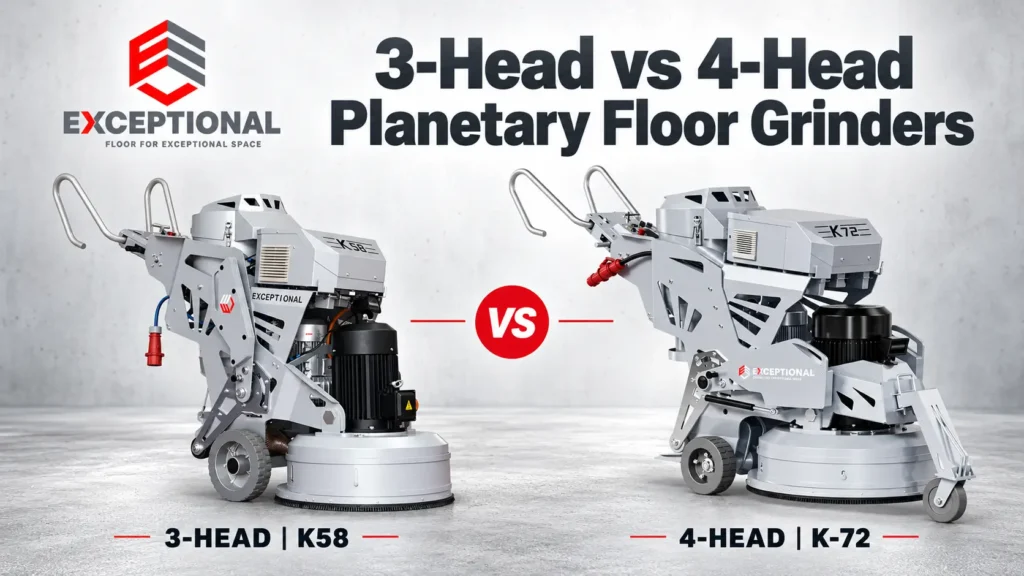
Both three-head and four-head planetary floor grinders can grind and polish concrete. The right choice depends on the whole machine, your floor, and the result you need. Head count alone does not tell you which grinder will cut faster, cost less, or leave a better finish.
Start with your jobs. Check working width, grinding power, tool contact, available electricity, and transport limits. Then compare tooling costs and service support. For rental fleets, add ease of training and repair to that list.
This guide compares 3-head vs 4-head planetary floor grinders so you can choose a machine that earns its place in your fleet.
3-Head vs 4-Head Planetary Floor Grinders at a Glance
A three-head grinder has three satellite grinding heads. A four-head grinder has four. Each head can carry several diamond tools or a polishing pad assembly.
Here is what that difference does, and does not, tell you.
| Factor | 3-head planetary grinder | 4-head planetary grinder |
|---|---|---|
| Head layout | Three satellite heads within a planetary system | Four satellite heads within a planetary system |
| Working width | Check the model; three heads do not mean a small machine | Check the model; four heads do not guarantee a wider path |
| Grinding load | Depends on head loading, weights, and tool contact | Depends on the same factors, spread through a different layout |
| Handling | Rotation and drive controls affect steering effort | Some opposed-rotation designs balance torque; confirm the design |
| Polished finish | Can support a complete polishing sequence | Can also support a complete polishing sequence |
| Diamond tools | Count tool positions and check mounting details | Do the same; head count is not the tool-set count |
| Operating cost | Measure cost to achieve the specified result | Compare at the same result, not just the same run time |
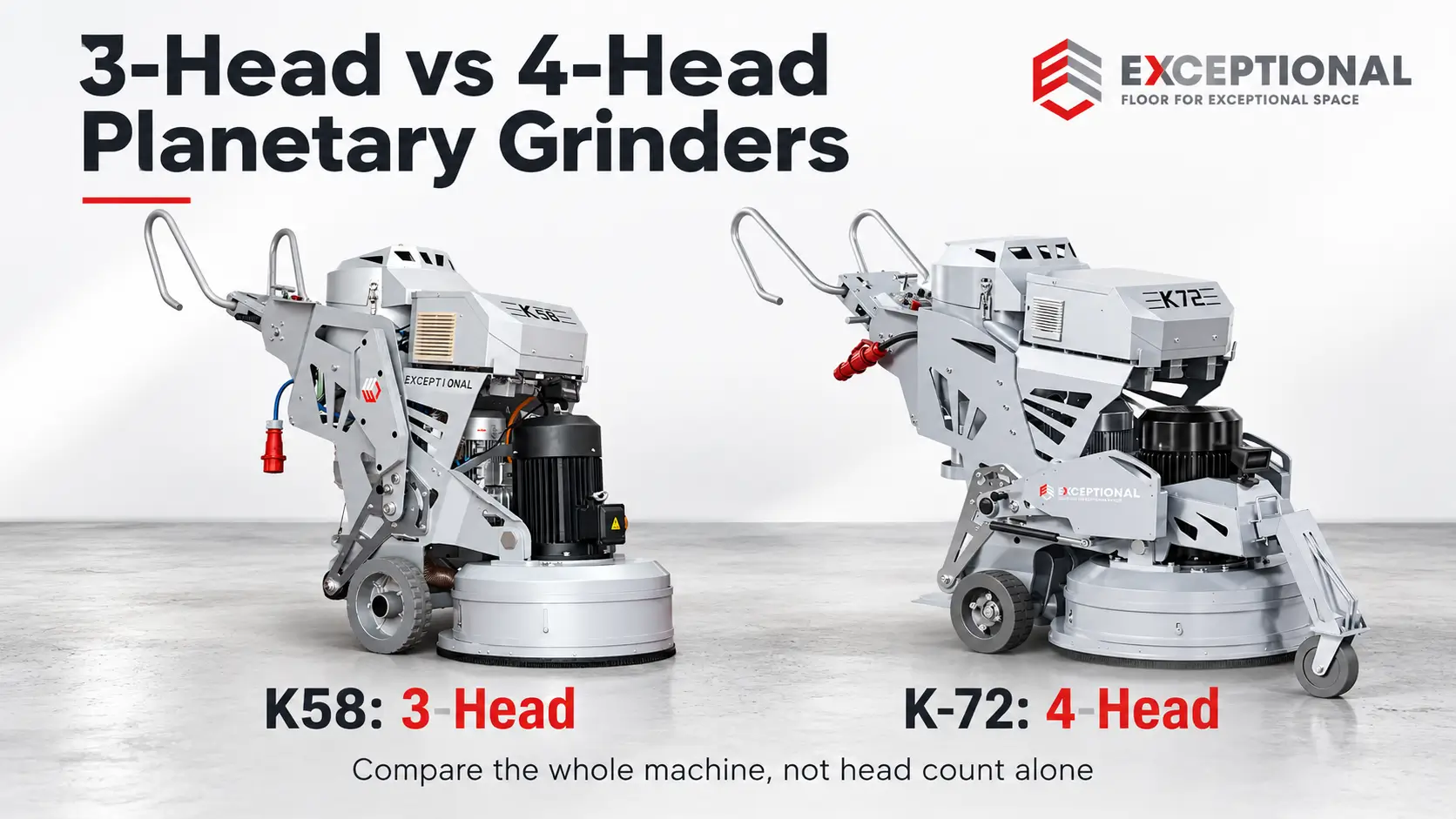
Buy by job requirements first. Use head count to understand the design, not to replace a full comparison.
How Three-Head and Four-Head Planetary Systems Work
A planetary grinder combines two movements. Each grinding head rotates on its own axis. A larger carrier also turns and moves those heads around the center of the machine. This creates overlapping tool paths across the floor.
The carrier, satellite heads, tool holders, diamond shoes, and abrasive segments are different parts. A three-head grinder may carry several shoes on each head. Three heads therefore do not mean three diamonds.
Drive systems also differ. Some link head movement to carrier movement. Others allow separate speed or direction control. Husqvarna, for example, distinguishes conventional three-disc systems, three-disc Dual Drive Technology, and four-disc technology.
Do not assume every head turns in the same direction, or that all heads turn opposite the carrier. Ask for a diagram of the actual machine.
Four fixed, counter-rotating heads are not the same mechanism as four heads moving within a rotating planetary carrier. Confirm the movement before comparing two machines sold under similar names.
Three-Head Planetary Grinders: Strengths and Limits
A three-head planetary grinder can be a strong all-round machine for concrete preparation, coating removal, and polishing. Its value depends on the drive, loading, tooling, and controls.
Some models offer a smaller footprint and simpler transport. Others are heavy production machines. The three-head label does not establish weight, power, or price.
A useful example is the Exceptional K58. Its published specifications list three 252 mm tool holders, a 580 mm working width, a 7.5 kW grinding motor, and a 430 kg machine weight.[2] That makes it narrower than Exceptional’s 700 mm range, but it is still substantial industrial equipment.
For a contractor, the strengths of a suitable three-head model may include a workable path through the site, compatible tools already in stock, and enough control for several flooring tasks. Those are practical savings.
The limits are also practical. A machine can be too large for access, too demanding for the power supply, or too slow for the required schedule. Check those limits against the model, rather than assuming three heads will solve them.
Four-Head Planetary Grinders: Strengths and Limits
A four-head layout gives the manufacturer another way to arrange tool contact and rotation. In some designs, heads rotating in opposite directions help balance torque. That can improve handling, but the benefit belongs to the drive arrangement, not the number four alone.
Exceptional’s K-72 provides a concrete example. It has four 252 mm tool holders, a 700 mm working width, a 15 kW grinding motor, and a 670 kg machine weight.
Compared with the K58, the K-72 offers a wider grinding path and a larger motor. It is also heavier. Those differences all matter. Any job-output difference between them would reflect more than head count.
For large open floors, evaluate a four-head model with suitable width, loading, power, and tooling. For rental use, check how easily customers can learn its controls and how your staff will load and service it.
A wider, heavier machine is useful only if your sites and fleet can support it.
Grinding Performance, Floor Flatness, and Polished Finish
The best machine reaches the required floor condition at an acceptable cost. Define that condition before you compare grinders.
| Job objective | What you need to evaluate |
|---|---|
| Remove epoxy or adhesive | Removal tools, coating thickness, substrate condition, and extraction |
| Reduce high spots | Controlled removal and measured changes in floor height |
| Prepare for a coating | A sound, clean substrate with the specified surface profile |
| Expose aggregate | The required depth and consistency of exposure |
| Polish concrete | Removal of earlier scratches and the specified final appearance |
High gloss does not prove a floor is flat. An even scratch pattern does not prove the surface is ready for epoxy. These are separate results.
For coating work, follow the coating system’s preparation requirements. The International Concrete Repair Institute, or ICRI, provides Concrete Surface Profile benchmarks to help specify and assess prepared surfaces.[4] A diamond grit number does not automatically establish a particular CSP.
Grinding load and tool contact
Total machine weight is not the same as load on the abrasive tools. Wheels, frame balance, adjustable weights, and head design affect how that weight is distributed to the floor.
Head diameter and active segment area matter too. Dividing machine weight by three or four gives an incomplete picture of cutting pressure.
Ask the supplier for grinding-load information and approved weight settings. Then test suitable tooling on the floor.
Uneven floors and high-spot removal
A tool system that follows a wavy floor may maintain contact well. Yet your aim may be to remove high spots, rather than follow the waves.
Head articulation, flexible tool holders, and machine settings affect that behavior. The idea that three points define a plane does not prove a three-head grinder will maintain better abrasive contact on every slab.
Define the required correction and measure it. Where major material removal is needed, compare grinding with scarifying or another suitable process.
Scratch patterns and polishing
Both configurations can leave a polished floor when the machine and tools suit the work. Deep scratches, damaged pads, poor overlap, or skipped stages can spoil the finish with either layout.
Inspect the floor between stages. Confirm that the next step removes the scratches from the previous one. Do not expect an extra grinding head to fix the wrong grit sequence.
Diamond Tooling Requirements and Compatibility
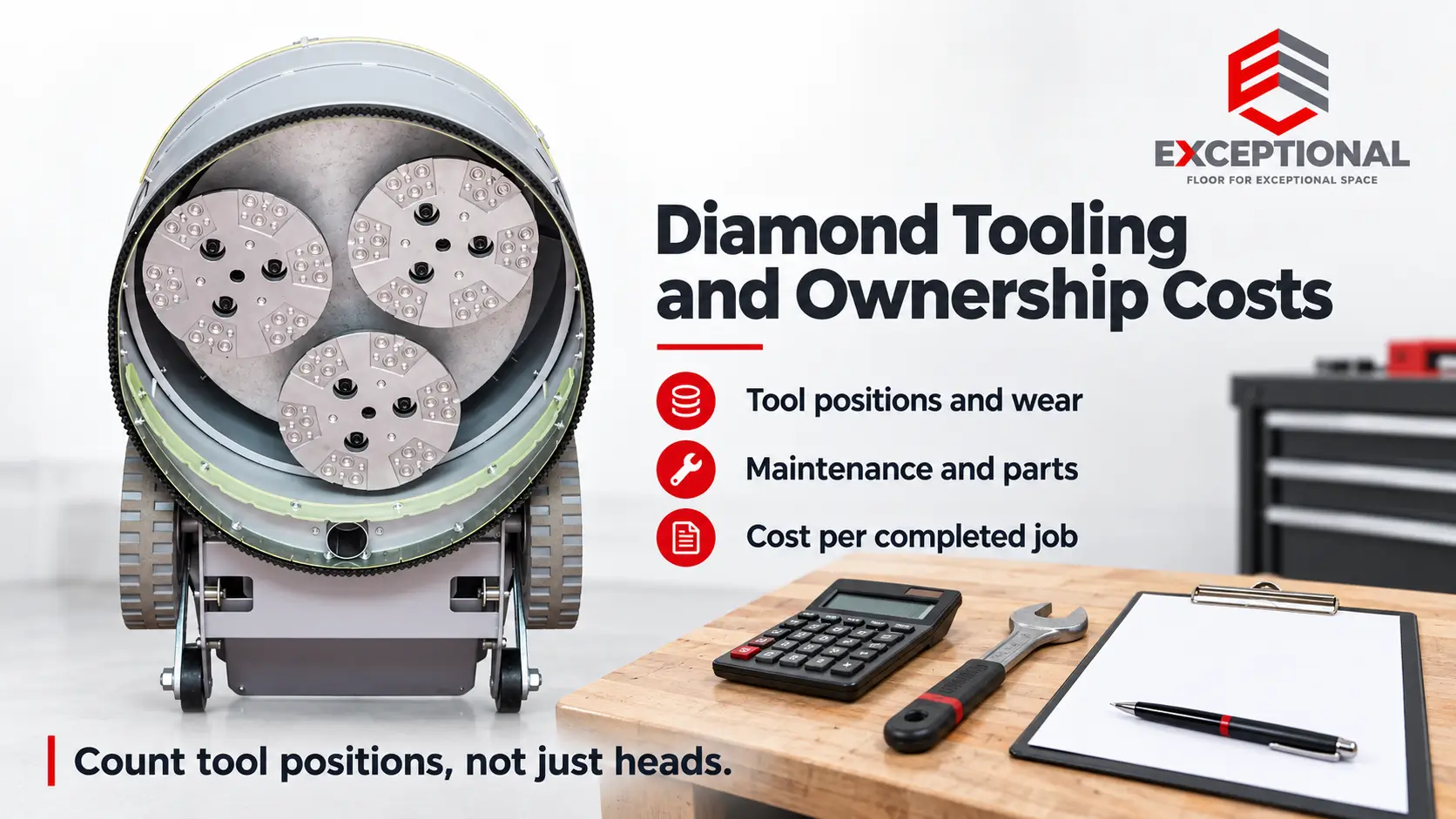
Tooling is where a machine purchase becomes a repeat operating cost. Check it before you order the grinder.
Metal-bond diamond shoes are commonly used for initial concrete grinding. Resin-bond pads refine the surface during polishing. Transition tools can bridge those stages. PCD, or polycrystalline diamond, tools may suit coating or adhesive removal when approved for the machine and floor.
Bond selection matters. Hard concrete often needs a softer metal bond to expose fresh diamonds. Soft, abrasive concrete often needs a harder bond to control wear. Superabrasive identifies glazing on hard concrete and early wear on soft concrete as common results of unsuitable bonds.
Check the actual mounting system. A tool with the right grit can still have the wrong connector, bolt spacing, diameter, or rotation requirement.
Some PCD cutters and scrapers are direction-specific. Superabrasive’s L19S7, for example, specifies clockwise heads and matching removal tools.[6] Confirm the correct tool arrangement for every head on your machine.
Ask for a complete tooling list: shoes per head, full-set quantity, pad sizes, holders, and adapters. Then compare cost per completed area. A cheaper tool set that wears out early may cost more per job.
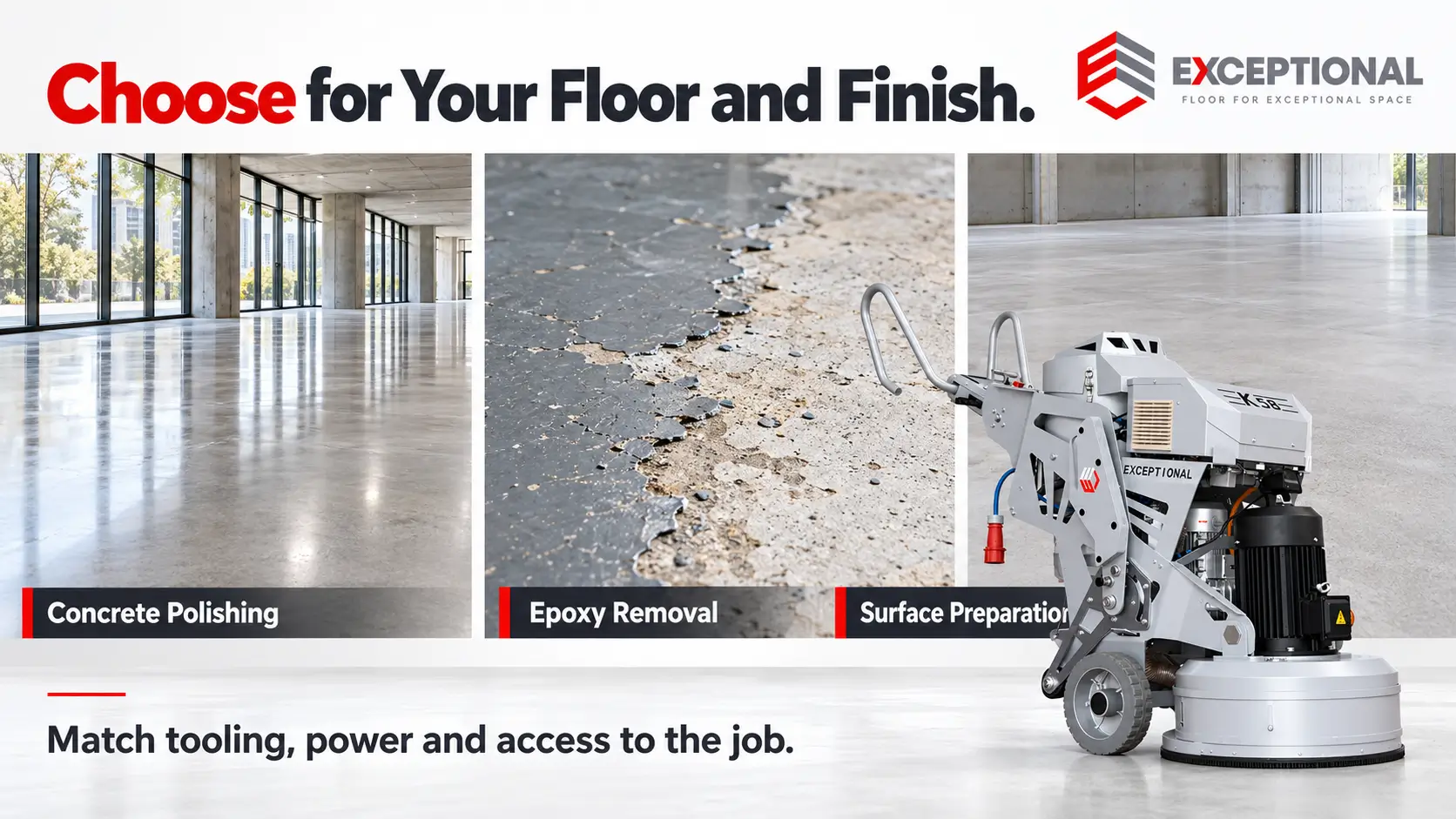
Choosing a Grinder for Your Flooring Applications
Your job mix should guide the purchase. A machine that excels on one large slab may be awkward on the next site.
| Application | Main buying criteria | Practical approach |
|---|---|---|
| Concrete polishing | Tool contact, speed control, scratch removal, and compatible pads | Test the full process to the required finish |
| Epoxy and glue removal | Suitable removal tools, substrate damage limits, and dust control | Trial the actual coating before estimating production |
| Terrazzo restoration | Material type, loading, pad sequence, and finish requirement | Confirm tools for the specific terrazzo system |
| Preparation before coatings | Required CSP, clean substrate, and process consistency | Work from the coating specification |
| Old or uneven slabs | Required correction and removal limits | Assess whether grinding is the right process |
| Large warehouse floors | Production, width, power supply, and site logistics | Compare complete packages and operating costs |
| Small rooms and edges | Access, turning space, perimeter work, and transport | Consider a compact grinder plus a dedicated edge machine |
Neither configuration replaces every surface-preparation tool. A scraper may suit a bonded floor covering. A scarifier may suit deeper removal. A dedicated edge grinder may reach areas a large planetary machine cannot.
Keep the full job in view. Your fleet should cover the main floor, edges, extraction, and the required finishing stages.
Comparing Productivity Without Misleading Numbers
Treat a square-meters-per-hour claim as incomplete until you know the test conditions.
Removing a thin sealer is different from removing a thick coating. One grinding pass is different from a completed polishing process. Even floors within the same building can respond differently.
Ask for the following details when comparing output:
| Test detail | Why it matters |
|---|---|
| Machine width, power, and weight | Shows what else differs besides head count |
| Floor hardness and coating condition | Defines the resistance to cutting |
| Tool bond, grit, and wear condition | Helps explain cutting speed and tool life |
| Settings, weights, and extraction | Shows how the machine was operated |
| Area, passes, and achieved result | Establishes whether the work is comparable |
| Turning, tool changes, and servicing | Shows how productive the whole workflow was |
Run a trial to the same removal depth or finish. Record tool wear and total crew time. A faster pass is less useful if it leaves extra work for the next stage.
Published specifications help shortlist machines. A relevant trial helps you decide what they can do on your work.
Purchase Price and Total Cost of Ownership
Ask for itemized quotations. The initial machine price tells you only part of the cost.
| Cost group | Include in the comparison |
|---|---|
| Initial purchase | Grinder, tooling, extraction, accessories, packaging, and delivery |
| Job operation | Labor, abrasive wear, energy, filters, and servicing |
| Fleet ownership | Equipment allocation, maintenance, downtime, training, and parts supply |
For a simple job comparison, divide the relevant costs by the area completed to the same specification.
Cost per m² = total job costs ÷ completed area
The example below illustrates budgeting. It is not a price quote or a test of three-head versus four-head machines.
| Illustrative cost for 1,000 m² | Option A | Option B |
|---|---|---|
| Labor at $30 per crew-hour | 20 hours: $600 | 15 hours: $450 |
| Tooling wear | $250 | $300 |
| Energy and filter consumables | $50 | $60 |
| Equipment and maintenance allocation | $100 | $90 |
| Total | $1,000 | $900 |
| Cost per m² | $1.00 | $0.90 |
Option B uses more tooling but costs less overall in this example. The lesson is to compare the complete job. Replace these figures with your own measured costs.
For rental buyers, include utilization, cleaning between hires, customer training, repair time, and collection costs. A machine sitting in the workshop earns no rental income.
Power, Dust Extraction, Transport, and Maintenance
A grinder can fit the application and still fail the site requirements.
Check voltage, phase, frequency, and the required supply current. If extraction is built in, account for both grinding and vacuum loads. Confirm the exact electrical version rather than assuming an inverter makes every supply suitable.
Match dust control to the machine and operating method. The shroud, hose, filter condition, and cleaning system affect capture. Maximum airflow alone does not prove performance under load. Follow the equipment instructions and applicable jobsite requirements.
Compare the machine’s full dimensions with doorways, ramps, lifts, and vehicle loading limits. Working width is not transport width. Check lifting arrangements and packed weight before ordering overseas.
For service, ask for the maintenance schedule, parts list, lead times, and warranty terms. Inspect tool mounts, head seals, filters, cables, and controls as the manufacturer specifies. Follow safe isolation procedures before servicing or changing tools.
Rental fleets also need a clear handover routine. Staff should explain tool selection, extraction, controls, shutdown, and the limits of the intended task.
Common Myths About Three-Head and Four-Head Grinders
| Myth | What to check instead |
|---|---|
| More heads always grind faster | Completed output, width, power, tooling, and floor condition |
| Three heads always follow uneven floors better | Head articulation, tool contact, and actual floor shape |
| Four heads always produce better polish | Scratch removal, pad condition, settings, and process |
| Machine weight determines cutting pressure | Grinding load and active abrasive contact area |
| Four heads always cost more to tool | Full tool layout, prices, wear, and completed-job cost |
| All planetary drives work the same way | Carrier movement, head rotation, and speed controls |
These shortcuts are easy to remember. They are less useful than a specification sheet and a well-run trial.
Exceptional Planetary Floor Grinders Compared
Exceptional Grinder offers both three-head and four-head options. The table below uses published product specifications checked in October 2026.
| Specification | K58 | K-72 | K-72X |
|---|---|---|---|
| Grinding heads/tool holders | 3 × 252 mm | 4 × 252 mm | 4 × 252 mm |
| Working width | 580 mm | 700 mm | 700 mm |
| Grinding motor | 7.5 kW / 10 HP | 15 kW / 20 HP | 15 kW / 20 HP |
| Listed machine weight | 430 kg | 670 kg | 670 kg |
| Listed tool-holder speed range | 0–1,500 rpm | 0–1,500 rpm | 0–1,500 rpm |
| Integrated extraction motor | 2.55 kW | 3 kW | 3 kW |
| Wireless remote control | Not listed | No | Yes |
Confirm the electrical version, operating speed for your tools, dimensions, and included accessories in the quotation. A listed speed range is not an instruction to run every tool at its maximum.
The K58 is worth considering when its narrower grinding path suits your access and workload. The K-72 offers the wider 700 mm platform with standard controls. The K-72X adds remote control, LCD monitoring, and a laser width guide.
K-72 and K-72X share the listed width, power, weight, and tool-holder count. Their comparison helps separate control features from the mechanical platform. K58 versus K-72 changes several mechanical specifications at once, so it cannot isolate the effect of head count.
A five-step buyer checklist
- Define the result. State the coating to remove, the correction needed, the surface profile, or the final finish.
- Check the site. Confirm power, access, extraction, loading, and working space.
- Compare complete configurations. Include tools, holders, weights, controls, and accessories.
- Review evidence and costs. Ask for relevant demonstrations and estimate cost per completed job.
- Confirm support. Get documentation, parts availability, warranty terms, and quotation inclusions in writing.
For contractors, buy around the jobs you perform most often. For rental fleets, buy around your customers, their sites, and your ability to keep the equipment ready for hire.
Frequently Asked Questions
Is a three-head or four-head planetary grinder better for polishing concrete?
Both can produce polished concrete when matched with suitable tooling and a sound process. Compare tool contact, speed control, scratch removal, and the required finish. A four-head machine doesn’t automatically polish better, and a three-head machine doesn’t automatically suit every uneven floor.
Do four-head planetary grinders grind faster?
Not always. Output depends on width, power, grinding load, tools, floor condition, and the result required. Compare machines on the same task, including extra passes and downtime. A higher one-pass coverage figure may not mean a lower completed-job cost.
Which configuration is better for uneven concrete floors?
Check the actual head design and the job’s purpose. Following contours and removing high spots are different tasks. Head articulation, tool-holder flexibility, loading, and settings affect both. Assess the slab and required correction before choosing a machine by head count.
Does a four-head grinder need more diamond tools?
It may, but count the tool positions. Shoes per head, pad sizes, mounting systems, and approved layouts vary. Ask for a complete set list for each grinding stage. Compare replacement cost and wear per completed area rather than assuming a fixed cost increase.
Can the same diamond tools fit three-head and four-head machines?
Sometimes, if the mounting system, dimensions, rotation requirements, and operating limits match. Head count does not establish compatibility. Send the supplier your machine model, mounting photographs, and tool details. Confirm fit before ordering a bulk tooling set.
Is head count more important than motor power or weight?
No single specification decides performance. Power, drive design, grinding load, width, tools, and floor condition work together. A large motor cannot correct unsuitable tooling. Extra weight is also not useful unless the machine and tools can use that load for the intended task.
What size planetary grinder suits a 2,000 or 10,000 sq ft job?
Area is only the starting point. A 2,000 sq ft open room may suit a different machine from the same area divided into small spaces. Check access, floor condition, power, required finish, and schedule. For 10,000 sq ft, evaluate production and logistics together.
Which configuration is suitable for epoxy removal?
Either may work with compatible coating-removal tools. Check epoxy thickness, bond to the slab, tool rotation, and the finish needed afterward. Run a test patch. Thick coverings or major removal may call for a scraper, scarifier, or a combined workflow.
Is remote control worth considering?
It can be useful where long passes and frequent production work justify it. Compare operator workload, controls, service support, and cost. Remote operation still needs a trained operator. Assess its value separately from whether the grinder has three or four heads.
What should rental companies confirm before buying?
Confirm site power needs, transport arrangements, training, compatible tools, spare parts, and repair support. Include cleaning and servicing between hires in the cost model. Choose a machine your customers can use for approved tasks, and your team can keep ready for the next booking.
Get a Planetary Grinder Recommendation for Your Work
Tell Exceptional Grinder about your floor material, coating condition, project area, required finish, available power, destination, and order quantity. We can help you compare planetary grinders with suitable diamond tooling and dust-control options.
For rental fleets and bulk purchases, include your typical customer jobs and service requirements. Request an itemized package covering the machine, tooling, accessories, and support terms.
Explore Exceptional planetary floor grinders or contact our team for model selection and a factory quotation.