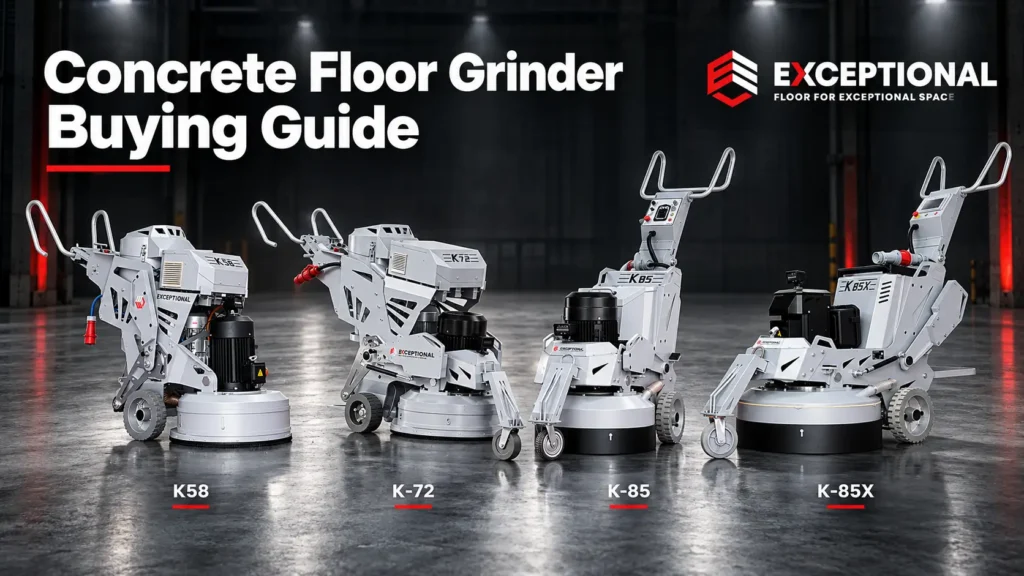
This may be the best concrete floor grinder buying guide in 2026, where you can choose a concrete floor grinder based on your typical jobs, floor condition, available power, and required finish. Then compare working width, diamond tooling, dust extraction, transport, and service support.
The right machine must fit your sites and complete the work at a cost your business can support. Compare the complete setup because head count, weight, and motor power each tell only part of the story.
This concrete floor grinder buying guide helps contractors, procurement managers, rental companies, and distributors compare complete working packages. Buy around the jobs you expect to win and repeat, not the largest project you might encounter.
Concrete Floor Grinder Selection at a Glance
Start with your regular workload because a warehouse polishing company and a garage coating contractor can need different equipment for concrete grinding.
| Buyer or workload | Main buying priorities | Check before choosing |
|---|---|---|
| Garage and smaller coating projects | Access, handling, power, removal tools | Doorways, circuits, loading, edge work |
| Commercial floor preparation | Surface profile, output, extraction, reliability | Coating specification and full-job time |
| Concrete polishing company | Tooling sequence, speed control, scratch refinement | Aggregate exposure and finish acceptance |
| Large industrial projects | Production capacity, transport, power, uptime | Open working space and backup equipment |
| Rental fleet | Simple operation, durability, service access | Customer power supply and training |
| Distributor or bulk buyer | Consistent configurations, documents, parts | Market requirements and delivered cost |
Treat this table as a starting point because two projects with the same floor area can have different access and finish requirements.
Define Your Applications and Inspect the Floor
A concrete floor grinder uses rotating abrasive tools to remove or refine the slab surface. Contractors use it for coating removal, surface preparation, high-spot correction, aggregate exposure, and polishing.
Define the result before discussing machine size because epoxy removal and concrete polishing require different tools and acceptance checks.
| Job objective | Information to collect |
|---|---|
| Epoxy or adhesive removal | Material, thickness, bond, and substrate condition |
| Preparation for a new coating | Required concrete surface profile and cleanliness |
| High-spot correction | Surveyed heights, removal limits, and tolerances |
| Aggregate exposure | Required exposure depth and appearance |
| Concrete polishing | Scratch refinement, appearance, and specified finish |
A machine can follow an uneven slab and leave a smooth surface without correcting its overall elevation. Check your finish requirements because smoothness, flatness, and level describe different floor conditions.
For coatings, follow the flooring-system supplier’s preparation specification. ICRI’s Concrete Surface Profile, or CSP, comparators help describe and assess surface texture. A diamond grit number alone does not establish the resulting CSP.[1]
Inspect hardness, abrasiveness, cracks, weak surface material, and contamination. A Mohs scratch test helps assess surface hardness, but it does not measure compressive strength or describe every grinding condition.
Grinding cannot solve every moisture or structural problem, so arrange suitable assessment when the floor lacks reliable records. Establish whether the material needs special handling before a test grind.
Compare Concrete Grinder Types and Drive Systems
Machine categories overlap because walk-behind describes how an operator handles the machine, while planetary describes the grinding mechanism.
| Equipment type | Work to evaluate | Main limitation to check |
|---|---|---|
| Handheld grinder | Edges, stairs, repairs, tight areas | Operator workload and broad-floor productivity |
| Dedicated edge grinder | Perimeters and detail work | Reach, access, and finish blending |
| Single-disc walk-behind | Preparation and localized correction | Control and required coverage |
| Dual-head or other multi-head system | Tasks supported by its head arrangement | Actual movement, tooling, and operating limits |
| Planetary floor grinder | Preparation and multi-stage polishing | Power, access, transport, and tooling system |
| Ride-on grinding system | Large open-floor workloads | Logistics and utilization |
A planetary carrier moves satellite heads around the machine’s center while those heads rotate. Ask how the actual model works because manufacturers use different drive and rotation arrangements.
Count the diamond shoes on each holder because three grinding heads do not mean the machine uses three tools. Our three-head vs four-head planetary floor grinder comparison explains that distinction.
Compare belt and gear drives through their maintenance needs, sealing, service access, and parts supply. Neither design removes the need for inspection or suitable operating practices.
A scarifier, scraper, or shot blaster may better suit the initial removal or profile requirement. Compare the required result before assuming a grinder should perform every stage.
Choose Working Width and Plan Edge Work
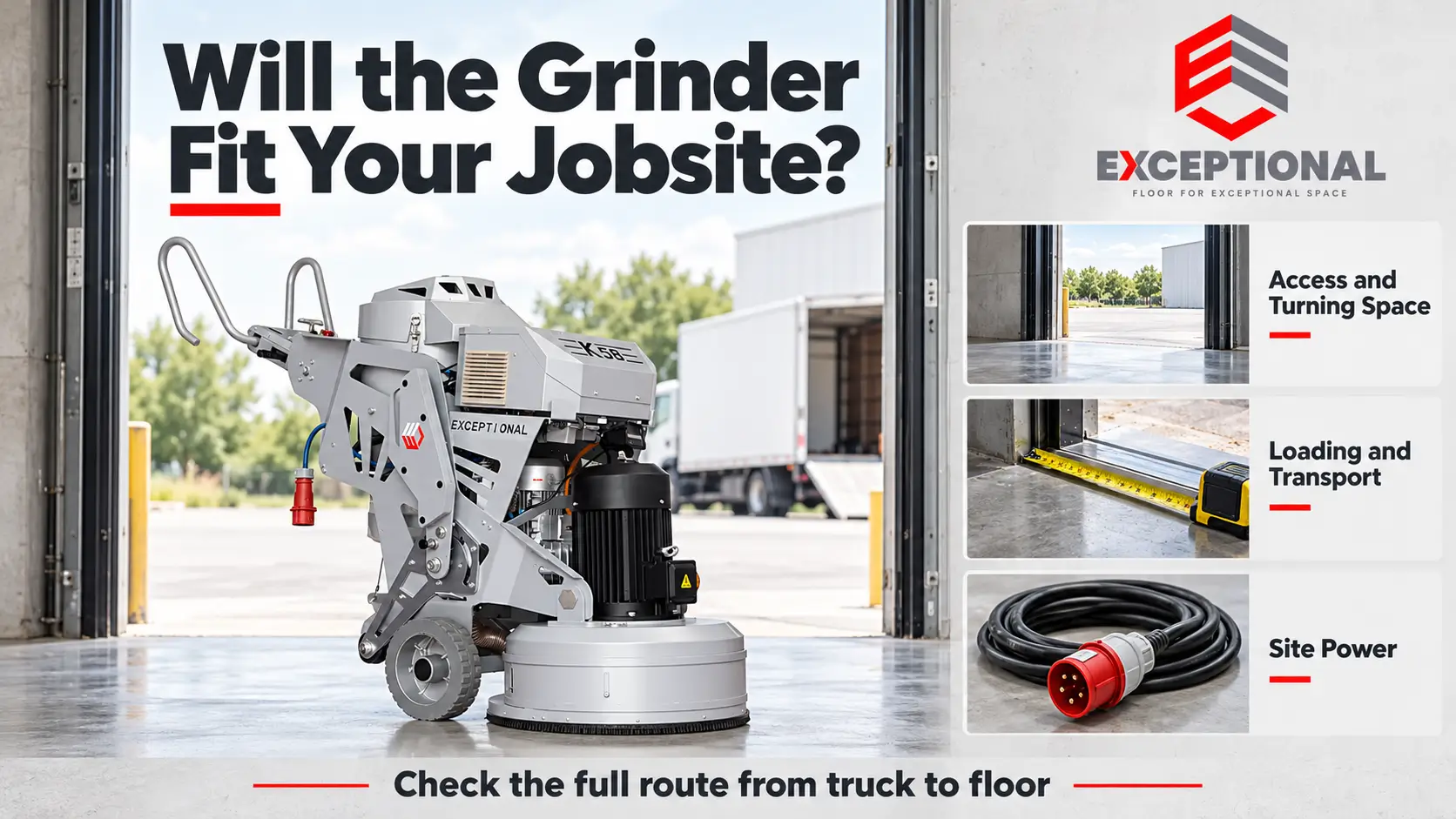
A wider machine covers a larger path but can require more turning space and create loading or access problems.
Measure the complete route from the vehicle to the floor and check every narrow opening and loading restriction.
| Dimension or load | Buying check |
|---|---|
| Grinding width | Coverage across the main floor |
| Overall machine width | Clearance through the narrowest opening |
| Length and turning space | Movement around walls, racks, and columns |
| Operating and transport weight | Vehicle, ramp, lift, and floor limits |
| Approved lifting points | Suitable loading equipment and procedure |
| Removable sections | Manufacturer-approved transport arrangement |
Include the extractor, tools, and power accessories in your transport plan, along with the grinder and its loading equipment.
A main-floor machine will not reach every corner or perimeter. Plan a handheld or dedicated edge grinder for walls, drains, thresholds, and columns.
Choose edge tooling that matches the main floor, and include the required labor hours in your project estimate. Fast open-floor grinding cannot recover time lost to an undersized edge setup.
Check Power, Speed Control, and Grinding Load
Check site power before selecting the motor and record the supply details alongside circuit capacity and connection requirements.
Confirm the electrical configuration on the quotation and nameplate because a 220 V rating does not establish single-phase compatibility.
For example, Exceptional Grinder lists the K58 with a 7.5 kW grinding motor and a separate 2.55 kW extraction motor. The grinding motor rating alone does not describe the whole machine’s electrical demand.[2]
| Specification | What it tells you |
|---|---|
| Motor power, kW or HP | Rated motor capacity |
| Voltage and phase | Required supply configuration |
| Amperage | Current requirement for the stated version |
| Tool-holder RPM | Speed of the working heads |
| Carrier speed | Movement of the planetary assembly |
| VFD and control options | Available adjustment within operating limits |
| Grinding load | Load the machine applies to its tooling |
Ask the manufacturer for generator requirements and have a qualified electrical professional check the supply and protection arrangements. Do not size a generator from grinding motor power alone.
A variable-frequency drive, or VFD, lets the operator adjust motor speed within the machine’s limits. Match settings to the tooling and task because maximum RPM does not guarantee the fastest completed job.
Wheels and chassis geometry carry part of the machine’s mass, so total weight does not equal grinding load. Tool contact area changes how that load reaches the floor and affects the working load on each segment.
Adjustable weights help operators change cutting load, but excessive load can overload tools or make the machine harder to handle. Follow the machine and tooling instructions.
Before choosing propane equipment, review its exhaust and fuel requirements alongside ventilation arrangements and the site’s operating restrictions. For battery features, confirm whether the battery supports grinding, travel, or backup functions.
Evaluate Handling and Operator Workload
Judge the machine across a complete shift. Operators steer, turn, change tools, move hoses, empty bags, and load equipment between jobs.
Check handle adjustment, vibration, control layout, visibility, and access to service points. Test how the machine behaves with the proposed tooling and load.
Self-propelled travel or remote control can reduce some handling demands. Those features do not remove the operator’s duty to monitor the floor, equipment, and surrounding work area.
Check emergency stops and training requirements alongside the crew’s plan for managing cords and hoses during operation. Confirm which functions the model provides because remote control does not establish autonomous operation or remove operator responsibilities.
Select Diamond Tooling and Recognize Wear Problems
The grinder supplies motion and load, while diamond tooling determines how that energy cuts or refines the floor.
Start with the material and required result before selecting the diamond bond and the machine’s approved tool arrangement.
| Tool type | Typical role | Compatibility check |
|---|---|---|
| Metal-bond diamond shoes | Concrete grinding and surface preparation | Bond, grit, mounting, and load |
| PCD removal tools | Suitable coatings and adhesives | Rotation, cutter design, and substrate impact |
| Transitional tools | Refining scratches between stages | Approved sequence and application |
| Resin polishing pads | Finer surface refinement | Holder, speed, and wet or dry rating |
| Diamond cup wheels | Compatible handheld and edge equipment | Diameter, arbor, guard, and speed rating |
Hard concrete often needs a softer bond to expose fresh diamonds. Soft, abrasive concrete often needs a harder bond to control wear. Test the floor rather than choosing a bond from color alone.[3]
Review diamond grinding and coating-removal tools alongside the grinder quotation. Confirm the number of tools per stage and the cost of a complete replacement set.
| Observation | What to investigate |
|---|---|
| Slow cutting or glazed segments | Bond, floor condition, settings, tool condition |
| Rapid diamond wear | Abrasiveness, bond, load, tool arrangement |
| Uneven scratches | Wear, installation, machine condition, operating method |
| Deep scratches during polishing | Earlier stages and incomplete scratch removal |
Use these signs to guide inspection, not to assume they prove a single cause for the cutting problem. Investigate changes before adding pressure because the wrong adjustment can increase tooling cost or create more rework.
Quick-change tools can reduce changeover time, but mounting systems and operating limits differ between machines and tooling suppliers. Verify the actual fit and approved use rather than treating the word universal as proof of compatibility.
Track tooling cost per accepted completed area because a cheap set can cost more through wear and extra passes.
Match Dust Extraction and Choose Wet or Dry Grinding
Plan dust control before ordering because concrete grinding can release respirable crystalline silica into the surrounding work area. Check the complete control system rather than treating a vacuum connection as proof of suitable dust management.
For US construction work, OSHA Table 1 provides a dry collection option for walk-behind floor grinders. It calls for manufacturer-recommended airflow or greater, filtration efficiency of at least 99%, and a filter-cleaning mechanism. Indoor work also requires a HEPA-filtered vacuum for loose dust between passes.[4]
Follow the full applicable requirements and equipment instructions rather than applying the handheld-grinder airflow rule to every walk-behind machine.
| Workflow | Equipment and costs to check |
|---|---|
| Dry grinding | Shroud, hoses, airflow, filters, cleaning, collection bags |
| Wet grinding | Approved water supply, electrical arrangements, slurry collection and disposal |
| Integrated extraction | Onboard capacity, filtration, cleaning, service access |
| Separate extraction | Matching requirements, transport space, hoses, power |
Inspect hoses and filters alongside the shroud and collection bags because restrictions can reduce airflow at the grinding point.
Wet grinding introduces water and slurry into the workflow. Confirm that the machine and tools support the method. Budget for collection and cleanup before the slurry dries.
Review industrial dust extractors as part of the working package. Confirm the complete configuration rather than selecting by motor wattage alone.
Test Productivity and Approve the Result
Ask what a production figure measures because one pass and a completed polished floor represent different amounts of work.
Use a representative test area, record enough detail to explain the result, and repeat the comparison.
| Test item | Record |
|---|---|
| Floor | Condition, coating, hardness assessment, area |
| Machine | Model, weights, power, extraction, settings |
| Tools | Type, bond, grit, quantity, condition |
| Time | Grinding, passes, tool changes, edging, cleanup |
| Result | Removal depth, profile, exposure, or finish |
| Wear | Tools and consumables used |
Use the equipment purchase demonstration to check machine fit and the project test patch to confirm the client’s accepted surface result.
For estimating, use:
Job time = Area ÷ Measured production rate for the defined task + Additional time outside that rate
Add setup, edging, cleanup, and downtime only when the measured rate excludes them. Do not count the same time twice.
Compare machines against the same finish requirement because a faster first pass can leave scratches that increase later work.
Compare Complete Purchase and Operating Costs
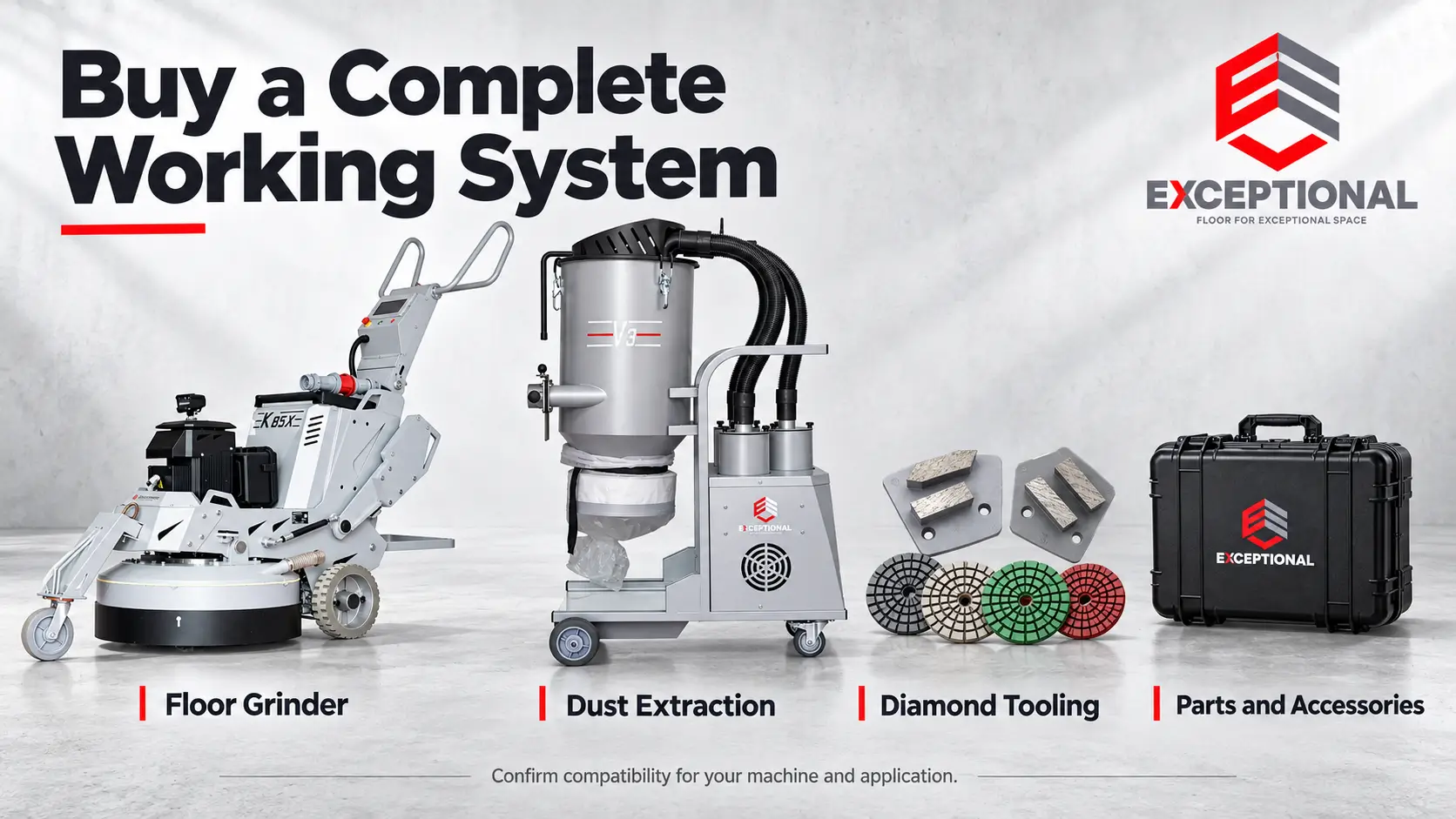
Compare complete packages over the same period, rather than matching a bare-machine price with a ready-to-work rental package.
| Cost group | Items to include |
|---|---|
| Purchase and setup | Grinder, tooling, extraction, power accessories, training |
| Job support | Edge equipment, transport, loading, cleanup equipment |
| Delivered cost | Freight, handling, duties, applicable taxes |
| Operating costs | Tool wear, filters, bags, energy, maintenance |
| Ownership costs | Storage, insurance, financing, downtime, resale |
Use dated quotes that identify the currency and configuration, then check the included accessories and spare parts.
Completed-job cost per unit area = Total defined job cost ÷ Accepted completed area
For example, an illustrative job costing $1,200 across 600 m² costs $2 per m². This is arithmetic, not a grinding rate or market-price estimate.
Define whether your total includes labor, transport, tooling, extraction, cleanup, and an equipment allocation. Do not add the entire machine purchase price to every job.
Decide Whether to Buy, Rent, or Upgrade
Buy when repeat work supports ownership and leaves enough cash for wages, materials, and repairs. Rent when demand remains uncertain or a project needs equipment you seldom use.
Our buy vs rent concrete floor grinder guide explains annual break-even, cash payback, and equipment ROI. Twelve days per year represents one set of assumptions, not a rule for every contractor.
Before upgrading, identify the production bottleneck.
| Problem | Review before buying a larger machine |
|---|---|
| Slow open-floor work | Width, power, tooling, required passes |
| Slow project completion | Edge work, setup, cleanup, crew workflow |
| Frequent extraction stops | Filters, capacity, cleaning, collection method |
| Missed working days | Repairs, parts, backup arrangements |
| Overlapping projects | Scheduling and additional capacity |
Compare the upgrade with changes to tooling and workflow because a larger grinder may not offer the lowest-cost solution.
For used equipment, inspect its service history and check the grinding assembly and electrical condition before comparing prices. Confirm parts supply and arrange a test under load when the inspection and seller’s facilities allow it.
For financing, compare the full term and final ownership because a low monthly payment does not establish a low total cost.
Check Maintenance, Training, and Supplier Support
Ask for the model’s maintenance schedule and confirm its inspection tasks and service access before placing an order.
| Supplier question | Why it affects the purchase |
|---|---|
| Which parts should we stock? | Reduces avoidable waiting time |
| Which manuals and diagrams do you supply? | Helps operators and service staff |
| What training does the package include? | Clarifies handover and setup |
| What does the warranty cover? | Defines defects, exclusions, and claims |
| Who pays repair labor and freight? | Reveals the buyer’s remaining costs |
| How do you supply critical parts? | Supports a realistic downtime plan |
Don’t apply one generic service interval to every motor or drive because components and maintenance requirements differ. Carbon-brush replacement applies to motors that use brushes, so confirm whether that task applies to the actual model.
Verify certificates against the exact model and destination because a brand-level claim does not confirm every ordered version.
Compare Exceptional Grinder Models
Exceptional Grinder supplies planetary concrete floor grinders for contractors, rental fleets, and equipment distributors. Compare the following published configurations against your site and job requirements.[2][5][6][7][8]
| Model | Working width | Grinding motor | Head arrangement | Weight | Controls | Dust configuration |
|---|---|---|---|---|---|---|
| K58 | 580 mm | 7.5 kW | 3 × 252 mm holders | 430 kg | Standard controls | Integrated extraction |
| K-72 | 700 mm | 15 kW | 4 × 252 mm holders | 670 kg | Standard controls | Integrated extraction |
| K-72X | 700 mm | 15 kW | 4 × 252 mm holders | 670 kg | Remote control, LCD, laser guide | Integrated extraction |
| K-85 | 850 mm | 20.5 kW | 4 × 298 mm holders | 625 kg | Remote control | External extractor connection |
| K-85X | 850 mm | 21.5 kW servo motor | 4 × 298 mm holders | 645 kg | Remote control, servo system | External extractor connection |
The K58 has the narrowest working path in this comparison, but its 430 kg weight requires an industrial loading plan.
The K-72 and K-72X share the listed width, motor power, and weight. Compare their controls and operating requirements rather than assuming remote control increases the mechanical grinding capacity.
Include an external extractor in the system budget when comparing the published 850 mm K-85 and K-85X configurations.
All five models list three-phase electrical configurations. Confirm the exact voltage, frequency, amperage, and plug for your order. A voltage range does not mean one machine accepts every supply without configuration changes.
Confirm the final technical sheet and quotation before purchase because published specifications do not establish measured job output.
Confirm Rental-Fleet and Bulk-Order Requirements
Rental buyers need equipment that customers can move, power, and operate for approved tasks. Include cleaning, inspection, training, and service between hires in the investment plan.
Distributors should compare configurations across the order because consistent tooling and components can simplify stock and technical support.
| Order detail | Confirm in writing |
|---|---|
| Electrical version | Voltage, phase, frequency, current, plug |
| Machine configuration | Model, controls, weights, included features |
| Tools and accessories | Mounting, quantities, grits, hoses, filters |
| Documentation | Manuals, diagrams, relevant conformity documents |
| Commercial terms | Quantity, lead time, payment, shipping term |
| Packing and loading | Dimensions, weights, protection, handling points |
| Acceptance | Inspection, functional checks, accessory count |
| Support | Warranty process, spare parts, repair responsibilities |
For OEM orders, agree on branding, labels, manuals, and packaging before production. Check the destination’s requirements for the exact equipment version.
Arrange pre-shipment inspection against the order and check the electrical setup and accessories alongside the machine’s functional test.
Complete the Pre-Purchase Checklist
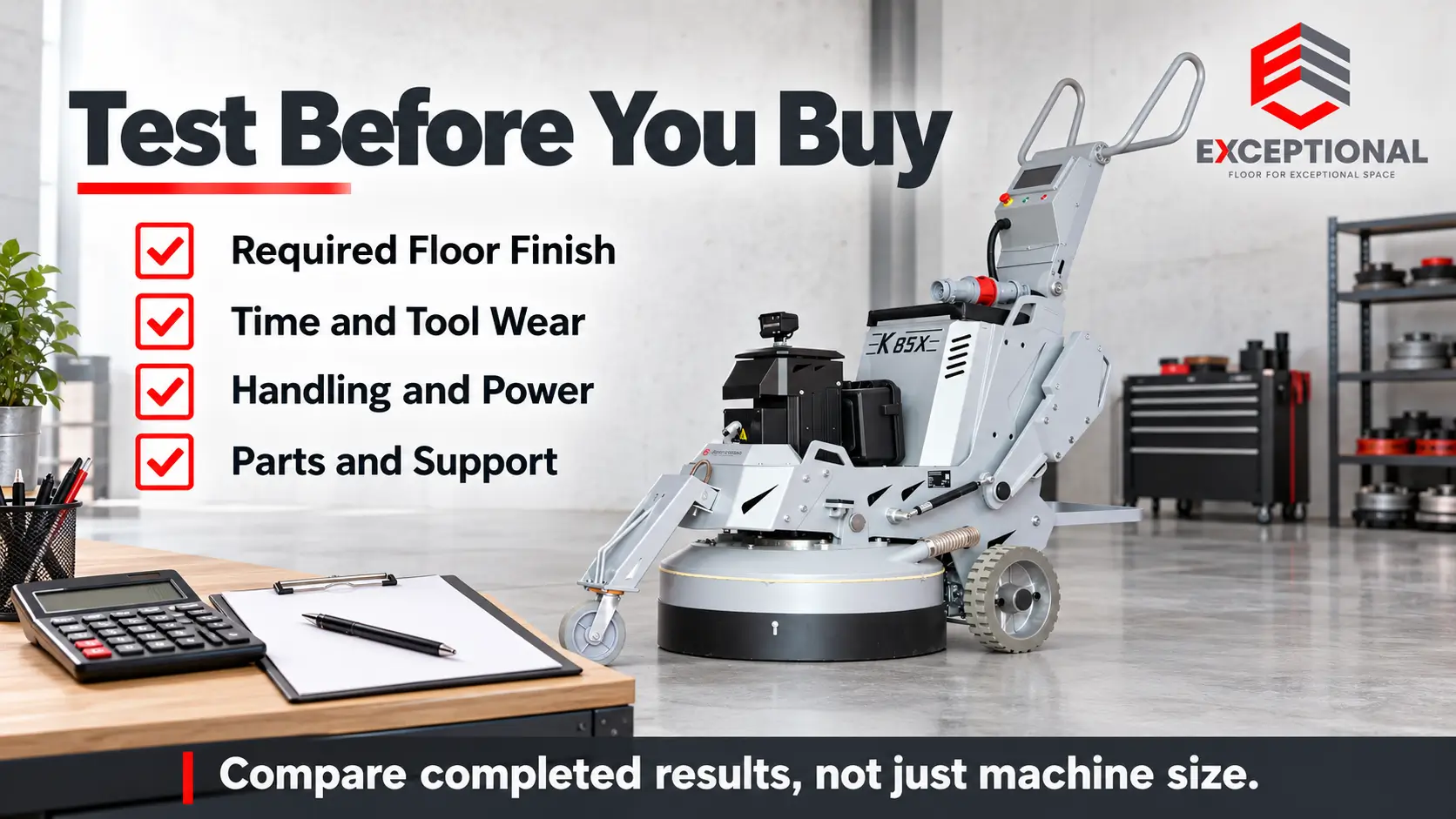
Use this checklist with your quotation and technical review to resolve gaps before paying for the final configuration.
| Check | Evidence to keep |
|---|---|
| Job fit | Application, floor condition, required finish |
| Site fit | Access measurements, power details, loading plan |
| Complete system | Main grinder, edging, tools, extraction |
| Performance | Representative demonstration and accepted result |
| Cost | Itemized quote and ownership assumptions |
| Support | Manuals, training, warranty, parts plan |
| Delivery | Final configuration and acceptance checklist |
Check how the complete setup supports your regular work, rather than choosing by price or a single machine specification.
Frequently Asked Questions
What size concrete floor grinder should I buy?
Choose working width alongside access and finish requirements because open areas and divided rooms can demand different setups. Check the full project workflow before choosing based on floor area alone.
Is a planetary grinder better than a single-disc grinder?
Planetary systems combine carrier and satellite-head movement for overlapping tool paths, but neither design wins every job. Single-disc machines can suit prep work or localized jobs. Compare the actual machine, tooling, and the finish it produces.
Is a three-head or four-head grinder better?
Compare head count alongside the machine’s width and load because tooling and floor conditions also affect the result. Compare completed-job performance rather than assuming four heads cut faster or three heads handle every uneven floor better.
Can a standard angle grinder replace a floor grinder?
A suitable angle grinder can handle some repairs and detail work with compatible concrete tooling, guards, and dust controls. It rarely replaces a floor grinder’s production role across large areas. Confirm the manufacturer’s approved applications and setup.
Do I need a separate grinder for edges and corners?
Check how close the main grinder can work to walls and columns before deciding whether your project needs separate detail equipment. Price the edge tooling and labor needed to match the main floor’s finish.
Can one machine remove epoxy and polish concrete?
Some machines support both tasks with suitable tooling and settings. Confirm the coating and mounting system because removal may require PCD tools while polishing needs a planned refinement sequence.
Can I run a concrete floor grinder on single-phase power?
Check the exact model’s voltage and phase, along with its current demand, because some machines require three-phase power. Do not assume that every 220 V grinder runs from a single-phase outlet.
How much floor can a grinder complete per hour?
Ask whether the quoted rate measures one pass or the full process because different tasks require different tooling and passes. Use a representative demonstration to estimate your own workload.
Why do diamond tools glaze or wear out quickly?
Glazing or rapid wear can indicate a mismatch among bond, floor condition, loading, and settings. Inspect the tools and review the setup before changing pressure or speed. Use the supplier’s guidance and a test area to check adjustments.
How long do diamond grinding tools last?
Concrete abrasiveness and operating conditions change tool wear, so no fixed replacement area applies to every tool and floor. Track tool consumption against accepted completed area to estimate replacement costs for similar jobs.
Is wet or dry grinding more suitable?
Choose the workflow that suits your equipment and tools, then include site controls and cleanup in the cost comparison. Dry grinding needs effective extraction, while wet grinding needs suitable water delivery and arrangements for collecting the slurry.
What dust extractor does my grinder require?
Start with the grinder manufacturer’s requirements and confirm the complete extraction setup against the applicable task controls. Verify the complete setup rather than choosing from vacuum motor power or hose-port size alone.
When should I upgrade to a larger grinder?
Upgrade when the current machine limits suitable repeat work and a larger setup solves that limit. Check tooling, edge work, extraction, staffing, and downtime first. More width will not fix every production problem.
Should I buy new, buy used, or rent?
Compare workload and total costs alongside service support because new and used purchases create different inspection and repair risks. Rental can suit occasional work or a trial, but use the same equipment scope and comparison period for the math.
What should I check during a machine demonstration?
Use floor conditions that represent your work and compare the required result alongside total time and tooling wear. Record the settings and include the extra passes or cleanup needed to reach acceptance.
What should an overseas buyer confirm before ordering?
Confirm the exact electrical version, machine configuration, tooling, documents, packing, lead time, and shipping term. Agree on inspection and warranty responsibilities. Keep an itemized order record that both parties can check before shipment.
Request a Grinder Configuration for Your Business
Choose equipment around the jobs your business performs and compare complete setups that your crew can support.
Send Exceptional Grinder your application, typical project size, floor condition, required finish, available power, destination, and order quantity. Include your tooling and dust-control needs.
Request a grinder configuration and itemized quotation or compare our planetary floor grinders before your next equipment purchase.