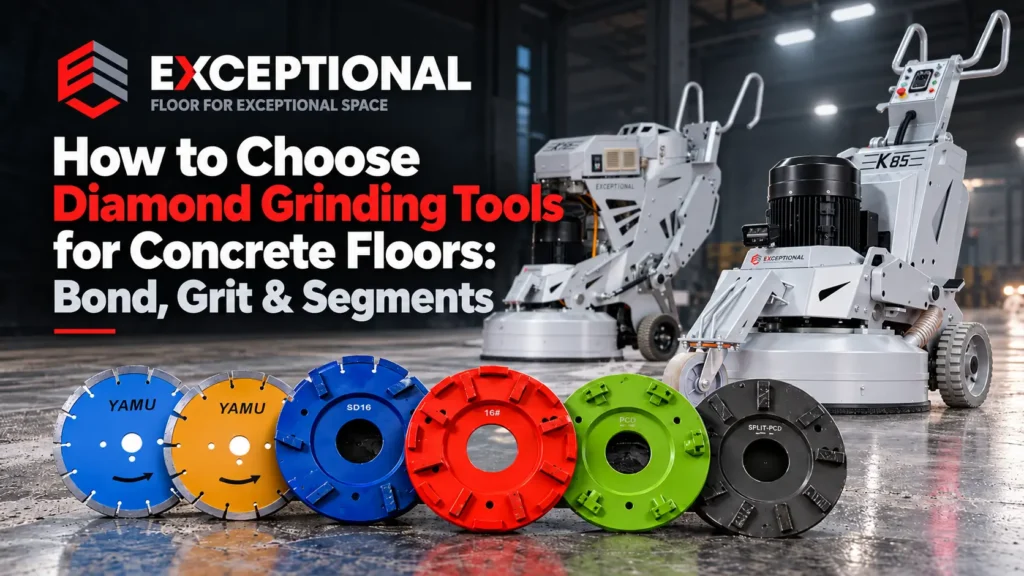
Choosing the right diamond grinding tools for concrete floors starts with matching the tool to the concrete hardness, grinding application, and floor grinder. Hard concrete generally requires softer-bond diamond segments to maintain cutting performance, while soft or abrasive concrete needs harder bonds to reduce premature wear. Coarse metal-bond diamonds are used for leveling and surface preparation, resin-bond pads for polishing, and PCD tools for removing many types of floor coatings.
However, bond hardness and grit are only part of the selection process. Segment shape, grinding head speed, machine weight, mounting compatibility, and the required surface finish also affect performance.
This guide explains how to select concrete grinding diamonds for different floor conditions, compare metal-bond and resin-bond tools, match diamond tooling with planetary and rotary floor grinders, and avoid common grinding problems.
Quick Diamond Grinding Tool Selection Chart for Concrete Floors
The best diamond grinding tool depends on the floor material, surface condition, and required result. The following chart provides a starting point for professional concrete flooring contractors.
| Floor Condition or Application | Recommended Diamond Tool | Typical Starting Grit | Main Purpose |
|---|---|---|---|
| Hard, dense concrete | Soft-bond metal diamond segments | 16–30 | Maintain cutting action on hard surfaces |
| Medium-hard concrete | Medium-bond metal grinding shoes | 30–50 | General concrete grinding |
| Soft or abrasive concrete | Hard-bond metal grinding shoes | 30–50 | Reduce premature segment wear |
| Uneven concrete floor | Coarse metal-bond diamond segments | 16–30 | Remove high spots and level surfaces |
| Concrete surface preparation | Metal-bond diamond grinding shoes | 30–80 | Remove laitance and prepare the substrate |
| Thin epoxy or paint coatings | Metal-bond grinding shoes or suitable coating-removal tools | 16–30 | Remove thin coatings and residues |
| Medium or thick epoxy coatings | PCD grinding tools | Not applicable | Remove existing resin coatings |
| Fine concrete grinding | Fine metal-bond or transitional tools | 80–150 | Reduce coarse grinding scratches |
| Concrete polishing | Hybrid and resin-bond polishing pads | 100–3000 | Refine the surface and increase gloss |
| Old concrete restoration | Metal-bond diamonds followed by polishing pads | Depends on damage | Restore worn concrete surfaces |
| Wear-resistant aggregate flooring | Bond selected for the actual surface hardness | 30–100 | Refine hard industrial floor toppings |
Note: These are general starting recommendations. Actual tool selection depends on the concrete’s hardness and abrasiveness, coating condition, machine design, and manufacturer specifications.
A practical selection process follows five steps:
- Identify the concrete hardness and floor condition.
- Select the correct diamond bond hardness.
- Choose the grit and segment configuration for the application.
- Confirm compatibility with the floor grinder.
- Test the setup and adjust it according to cutting performance and tool wear.
What Are Diamond Grinding Tools for Concrete Floors?
Diamond grinding tools are industrial abrasives used to grind, level, prepare, polish, and restore concrete surfaces. They are installed on concrete floor grinders, planetary grinding machines, rotary floor grinders, or handheld edge grinders.
Most concrete grinding diamonds consist of industrial diamond particles held within a bonding material. As the tool moves across the concrete, exposed diamonds cut the surface. The bond gradually wears and releases worn diamond particles, exposing fresh cutting edges.
This controlled wearing process allows diamond tools to maintain their grinding performance.
However, different applications require different bonding materials and cutting structures. A tool designed for aggressive concrete removal will not necessarily produce a smooth polished finish. Similarly, a resin polishing pad cannot replace a coarse metal-bond grinding shoe for heavy floor leveling.
What Are the Main Types of Concrete Grinding Diamond Tools?
Four major types are commonly used in professional floor grinding.
| Diamond Tool Type | Primary Function | Typical Applications |
|---|---|---|
| Metal-bond diamond grinding shoes | Aggressive grinding and material removal | Concrete leveling, surface preparation, initial grinding |
| Hybrid or transitional diamond tools | Scratch refinement between grinding stages | Transition from metal grinding to polishing |
| Resin-bond diamond polishing pads | Fine grinding and polishing | Polished concrete, terrazzo, decorative floors |
| PCD grinding tools | Coating removal | Epoxy, polyurethane, adhesives, and other removable coatings |
Metal-bond grinding shoes are commonly used during the initial stages of concrete preparation. Hybrid and resin-bond abrasives then refine the surface when polishing is required.
PCD tools work differently. Instead of relying on a conventional abrasive grit progression, their cutting edges break, scrape, or lift suitable coating materials from the concrete.
Exceptional Grinder supplies diamond grinding tools for floor grinders, including metal-bond grinding shoes, fan-shaped segments, arrow segments, PCD coating-removal tools, and polishing accessories.
How Does Concrete Hardness Affect Diamond Tool Selection?
Concrete hardness is one of the most important factors in choosing diamond grinding shoes.
Hard and soft concrete behave differently during grinding. Dense concrete can make diamond segments glaze, while soft or highly abrasive concrete can wear the bonding matrix too quickly.
The right diamond bond helps balance cutting speed and tool life.
How to Identify Hard, Medium, and Soft Concrete
Several factors influence concrete hardness, including cement paste, aggregate composition, curing conditions, surface finishing, and previous chemical treatments.
A power-troweled industrial floor may develop a dense surface that is difficult to grind. An older or poorly consolidated concrete floor may be much softer and more abrasive.
Contractors can evaluate the floor through:
- Mohs scratch hardness testing.
- Visual inspection of the concrete and exposed aggregates.
- Checking for densifiers, coatings, or surface hardeners.
- Trial grinding with a known diamond bond and grit.
A Mohs hardness testing kit provides useful information about the surface. However, the hardness of a scratched aggregate or surface area does not represent every component of the concrete.
Concrete compressive strength is also different from surface hardness. A C30 concrete specification, for example, does not automatically tell a contractor which diamond bond to use.
The most reliable practical approach is to combine surface evaluation with a test grind.
Why Does Hard Concrete Need a Softer Diamond Bond?
Hard concrete generally requires a softer metal bond because dense surfaces tend to wear the diamond’s bonding matrix more slowly.
If the bond is too hard, exposed diamonds may become dull while remaining trapped in the matrix. The segments develop a smooth or shiny surface, a condition known as diamond glazing.
Glazed diamond grinding shoes may slide across the floor with little material removal.
A softer bond wears more readily and helps expose fresh diamond particles. This maintains cutting action on hard concrete.
For example, if a contractor is grinding a dense, steel-troweled warehouse floor and the grinder is removing very little material, a softer-bond metal diamond segment may improve performance.
However, check grinding head pressure, speed, grit, and machine configuration before changing the tool.
Why Does Soft Concrete Need a Harder Diamond Bond?
Soft or abrasive concrete can wear diamond segments rapidly.
As the grinder cuts the surface, loose or abrasive particles accelerate the loss of bonding material. If you use a soft-bond tool, the segment may wear away before the embedded diamonds deliver their full service life.
A harder bond holds the diamonds longer and helps control the wear rate.
This is especially important when preparing old, porous, or abrasive industrial floors.
Diamond Bond Hardness Selection Chart
| Concrete Surface Condition | Starting Bond Selection | Main Concern |
|---|---|---|
| Very hard or highly dense concrete | Extra-soft or soft bond | Prevent diamond glazing |
| Hard concrete | Soft bond | Maintain consistent cutting |
| Medium-hard concrete | Medium bond | Balance cutting rate and tool life |
| Soft concrete | Hard bond | Reduce rapid segment wear |
| Very soft or highly abrasive concrete | Extra-hard bond | Control excessive bond wear |
The relationship is easy to remember:
Hard concrete → Softer diamond bond
Soft concrete → Harder diamond bond
Diamond bond grades are not standardized across every manufacturer. A soft-bond tool from one supplier may behave differently from a similarly labeled product from another.
For bulk diamond tooling purchases, request samples and confirm performance on representative flooring materials.
Metal-Bond vs. Resin-Bond vs. Hybrid vs. PCD Diamond Tools
Choosing the correct type of diamond tool is just as important as selecting the bond hardness.
Different tool families are designed for different stages of concrete grinding and floor preparation.
Metal-Bond Diamond Grinding Shoes
Metal-bond grinding shoes contain diamond particles within a sintered metal matrix. They are widely used for aggressive material removal and the initial stages of concrete grinding.
Common applications include:
- Concrete floor leveling and surface opening.
- Removing weak surface layers and cement laitance.
- Grinding high spots and irregularities.
- Preparing concrete before epoxy coatings.
- Initial grinding before concrete polishing.
- Renovating old industrial concrete floors.
Metal-bond diamond tools are available in different grit sizes, bond hardness levels, segment shapes, and mounting configurations.
Coarse grits such as 16, 20, and 30 are commonly selected for aggressive grinding. Finer metal-bond diamonds, including 60, 80, 100, and 120 grit, can be used for surface refinement.
Their effectiveness depends on selecting a bond appropriate for the concrete.
Resin-Bond Diamond Polishing Pads
Resin-bond diamond pads use diamond particles embedded in a resin matrix.
They are generally less aggressive than metal-bond grinding shoes and are used to refine scratches, smooth concrete surfaces, and produce decorative polished finishes.
Typical applications include polished concrete floors, terrazzo floors, commercial showrooms, and decorative flooring.
Common resin-bond grit stages include 100, 200, 400, 800, 1500, and 3000, although complete polishing systems vary by manufacturer.
Unlike aggressive metal-grinding shoes, resin polishing pads are designed for surface refinement rather than removing large amounts of concrete.
Hybrid or Transitional Diamond Tools
Hybrid diamond tools combine characteristics of metal-bond and resin-bond abrasives.
Their main purpose is to help remove the scratches left by metal-bond grinding shoes before switching to finer resin polishing pads.
For example, a floor polished directly with fine resin pads after an aggressive metal-bond pass may retain visible scratches.
Using suitable transitional diamonds can reduce these scratches and improve finish consistency.
Not every polishing system requires a separate hybrid stage. The correct sequence depends on the tooling system, floor condition, and required finish.
PCD Grinding Tools for Epoxy and Coating Removal
PCD stands for polycrystalline diamond.
PCD grinding tools use hard cutting edges to break and remove suitable coatings instead of gradually abrading them with conventional diamond grit.
These tools are commonly used for:
- Epoxy coating removal.
- Polyurethane coating removal.
- Adhesive and resin residue removal.
- Self-leveling compound removal.
- Thick paint and coating removal.
PCD tools are particularly useful when existing coatings clog conventional diamond grinding segments.
Some PCD tools include protective or sacrificial segments to help control cutting depth and reduce damage to the underlying concrete.
However, aggressive PCD tooling can gouge the substrate if you use the wrong configuration or operating method.
PCD cutters normally do not have conventional grinding grit numbers such as 30 or 50 grit. Their performance depends on cutter geometry, cutter quantity, orientation, and machine configuration.
Comparison of Concrete Floor Diamond Tool Types
| Feature | Metal Bond | Hybrid | Resin Bond | PCD |
|---|---|---|---|---|
| Main operation | Grinding | Transitional refinement | Polishing | Coating removal |
| Material removal | Medium to high | Low to medium | Low | High on suitable coatings |
| Typical grit | 16–150 | System-specific | 100–3000 | Not applicable |
| Main surface | Bare concrete | Ground concrete | Prepared concrete | Coated concrete |
| Primary advantage | Controlled material removal | Scratch refinement | Smooth and polished finish | Fast coating removal |
| Main limitation | May leave visible scratches | Not intended for heavy removal | Ineffective for heavy leveling | May damage exposed concrete |
For projects that require both coating removal and polishing, contractors may use all four tool families at different stages.
How to Choose the Right Diamond Grit for Concrete Grinding
Diamond grit determines the approximate size of the abrasive particles and influences grinding aggressiveness and surface finish.
Lower grit numbers generally indicate larger, coarser abrasive particles. Higher grit numbers indicate finer particles that produce a smoother surface.
However, a 100-grit metal-bond tool is not necessarily equivalent in cutting behavior to a 100-grit resin polishing pad.
Bond material, abrasive distribution, and tool design also influence performance.
Coarse Diamond Grits: 16–30
Coarse diamond grinding segments are used when substantial material removal is required.
A 16- or 20-grit metal-bond tool may be suitable for heavy surface opening, aggressive leveling, or exposing concrete aggregates.
A 30-grit metal-bond tool is a common starting point for industrial concrete grinding.
These tools can leave deep scratches, so you’ll need additional grinding stages if the final floor must be smooth or polished.
Medium Diamond Grits: 40–80
Medium diamond grits are commonly used for general concrete grinding and surface preparation.
Typical tasks include removing scratches from previous grinding stages, refining uneven concrete, and preparing a surface for the next flooring operation.
For example, a contractor may use a 30-grit metal-bond grinding shoe for initial cutting, followed by 60- or 80-grit tooling to refine the surface.
Choose the final grit based on the required surface profile rather than simply selecting the finest available abrasive.
Fine Metal-Bond Diamond Grits: 100–150
Fine metal-bond tools reduce scratches and prepare the surface for further refinement.
They are particularly useful when a polished concrete finish is required.
Depending on the polishing system, contractors may transition from 100- or 150-grit metal-bond diamonds to hybrid abrasives or resin-bond pads.
Resin Diamond Grits: 200–3000
Resin polishing pads progressively refine concrete surfaces.
As the grit becomes finer, visible grinding scratches are reduced and the surface can develop greater reflectivity.
The exact result depends on concrete density, aggregate exposure, densifier treatment, equipment, and polishing technique.
Concrete Grinding and Polishing Grit Chart
| Grit Range | Tool Type | Main Grinding Stage | Expected Purpose |
|---|---|---|---|
| 16–20 | Metal bond | Heavy grinding | Aggressive removal and leveling |
| 30–50 | Metal bond | Coarse grinding | Surface opening and initial preparation |
| 60–80 | Metal bond | Medium grinding | Reduce coarse scratches |
| 100–150 | Metal bond | Fine grinding | Prepare for transitional abrasives |
| System-specific | Hybrid | Transitional grinding | Reduce metal-bond scratch patterns |
| 100–200 | Resin bond | Initial polishing | Begin fine surface refinement |
| 400 | Resin bond | Honing | Produce a smoother finish |
| 800 | Resin bond | Fine polishing | Develop surface reflectivity |
| 1500 | Resin bond | High-gloss polishing | Increase clarity and gloss |
| 3000 | Resin bond | Final polishing | Produce a higher-gloss finish where specified |
This chart illustrates common grit stages. It is not a mandatory sequence and does not require every listed abrasive.
A typical professional polishing system may follow a progression such as:
30 metal → 80 metal → 150 metal → transitional tooling → 200 resin → 400 resin → 800 resin → 1500 or 3000 resin.
The actual starting grit and intermediate steps should follow the manufacturer’s system and the required finish.
Can You Skip Diamond Grit Steps?
Skipping an abrasive stage can save time, but it may leave scratches that finer polishing pads cannot remove efficiently.
For example, switching directly from an aggressive 30-grit metal diamond to a fine 400-grit resin pad can leave visible grinding marks.
Each stage should remove the scratches left by the previous stage before progressing.
Some engineered polishing systems use fewer steps with specially designed abrasives. These shorter sequences can work when supported by the manufacturer and verified on a test area.
The goal is not to make the most passes. It is to achieve the required finish using the correct progression.
Which Diamond Grinding Segment Design Should You Choose?
Diamond grinding segments are available in different shapes, sizes, and configurations.
Segment geometry affects contact area, grinding aggressiveness, stability, and tool wear.
The best design depends on the machine, concrete condition, and required material removal rate.
Single-Segment vs. Double-Segment Diamond Grinding Shoes
Single-segment grinding shoes have one primary diamond segment. Double-segment shoes have two.
With the same overall grinding load and otherwise comparable tooling, a single-segment design generally has a smaller contact area. This can increase effective contact pressure and produce more aggressive cutting.
Double-segment tools distribute contact across a larger area and can provide steadier grinding and longer wear life in suitable applications.
| Feature | Single-Segment Tool | Double-Segment Tool |
|---|---|---|
| Contact area | Smaller | Larger |
| Effective contact pressure | Generally higher | Generally lower |
| Cutting action | Often more aggressive | Often more controlled |
| Grinding stability | Depends on machine and geometry | Often smoother |
| Typical use | Heavy grinding and surface opening | General grinding and surface refinement |
| Wear behavior | May wear faster under comparable conditions | May offer longer service life |
The number of segments alone does not determine performance. Consider diamond bond, grit, segment dimensions, and grinder configuration.
Fan-Shaped Diamond Grinding Segments
Fan-shaped diamond segments, also called wing-shaped segments, are commonly used in professional concrete floor grinding.
Their curved design provides a practical balance between cutting action, stability, and contact area.
They can be manufactured with different bond hardness levels and grit sizes for hard, medium, or soft concrete.
Exceptional Grinder offers standard fan-shaped diamond grinding shoes in single- and double-segment configurations.
These tools can be selected for surface opening, concrete grinding, floor refinement, and industrial floor preparation.
Arrow-Shaped Diamond Grinding Segments
Arrow-shaped grinding segments have a directional cutting design that is useful for aggressive surface preparation.
They are commonly used to remove surface contamination, prepare rough concrete, and remove certain coatings or residues.
However, an arrow-shaped segment is not automatically suitable for every coating.
Thick, flexible, or adhesive coatings may require PCD cutters or another dedicated removal system.
Trapezoid Grinding Shoes
Trapezoid grinding shoes are widely used with commercial floor grinders.
The term often describes the shape of the metal mounting shoe rather than the precise shape of its diamond cutting segment.
A trapezoid grinding shoe may carry rectangular, fan-shaped, arrow-shaped, or other segment designs.
Different manufacturers use bolt-on, magnetic, slide-on, and proprietary quick-change mounting systems.
Therefore, contractors must confirm the mounting dimensions and attachment style before purchasing replacement diamond grinding shoes.
How Do Segment Height and Diamond Concentration Affect Performance?
Segment height influences the available wear material and potential service life.
Taller diamond segments may provide a longer usable life when the bond, diamond quality, and working conditions are suitable.
However, greater segment height does not automatically produce faster grinding.
Diamond concentration also affects the tool’s cutting behavior and wear characteristics.
A higher diamond concentration may distribute the working load across more abrasive particles, while a lower concentration may change the cutting pressure on individual diamonds.
These factors must be balanced with bond hardness, segment geometry, and machine pressure.
For professional contractors and bulk buyers, the best choice is the configuration that delivers reliable cutting performance and acceptable tooling cost across the intended application.
How to Match Diamond Grinding Tools with Your Floor Grinder
Even a well-designed diamond grinding shoe may perform poorly if it is installed on an unsuitable machine.
Floor grinder compatibility involves more than whether the tool physically fits the grinding plate.
Grinding motion, head speed, operating weight, tool quantity, and mounting design can all influence the result.
Planetary vs. Rotary Concrete Floor Grinders
Planetary floor grinders use multiple tool heads rotating within a larger planetary grinding system.
This overlapping grinding motion helps provide controlled surface contact and consistent scratch patterns.
They are widely used for concrete leveling, surface preparation, and multi-stage polishing.
Rotary concrete floor grinders use a different grinding motion and may suit aggressive floor preparation, coating removal, and general grinding tasks.
Tool selection must account for the machine’s actual grinding motion and manufacturer-approved attachments.
For a more detailed comparison, read our guide to planetary vs. rotary concrete floor grinders.
How Does Floor Grinder RPM Affect Diamond Grinding Performance?
RPM means revolutions per minute. It describes rotational speed, but the relevant speed measurement depends on the machine’s design.
A planetary grinder may have a motor, a planetary carrier, and individual tool holders rotating at different speeds.
Therefore, motor RPM, planetary carrier RPM, and tool-holder RPM are not interchangeable.
Grinding speed influences abrasive contact, heat generation, surface finish, and cutting behavior.
An unsuitable speed may contribute to glazing, coating smearing, vibration, or poor grinding results.
The technical selection materials used for this guide provide the following example settings for certain coating-removal configurations.
| Existing Coating Thickness | Example Tool Configuration | Reference Speed in the Supplied Technical Material |
|---|---|---|
| Thin coating, up to 0.5 mm | 30-grit metal-bond diamond tool | 100–150 rpm |
| Medium coating, 0.5–2 mm | Double-cutter PCD tool | 150–200 rpm |
| Thick coating, above 2 mm | Single-cutter PCD with suitable follow-up tooling | 150–200 rpm |
Important: These are reference values from a specific technical selection scheme, not universal operating speeds for all floor grinders. Before applying them, confirm which rotating component the RPM refers to and follow the actual grinder and tooling manufacturer’s operating limits.
Coating chemistry, adhesion, cutter design, and machine pressure can be more important than coating thickness alone.
Increasing speed does not always improve grinding efficiency. A properly matched tool operating under controlled conditions may outperform an unsuitable tool running faster.
How Do Grinder Weight and Grinding Pressure Affect Diamond Tools?
The effective pressure applied to the grinding head affects diamond cutting performance.
A heavier machine, or one with adjustable grinding pressure, can increase the contact load on the diamond segments.
Greater pressure may improve material removal in some conditions. However, excessive pressure can also cause vibration, deep scratches, overheating, or premature tool wear.
Segment quantity also affects load distribution.
For example, replacing a double-segment grinding shoe with a single-segment tool may increase effective contact pressure under otherwise similar conditions.
The final selection should balance grinding efficiency, surface quality, and tool life.
Are Diamond Grinding Shoes Compatible with Every Floor Grinder?
No. Different floor grinders use different tooling and mounting systems.
Before purchasing diamond grinding shoes, check the following specifications:
| Compatibility Factor | What to Verify |
|---|---|
| Grinder brand and model | Exact machine identification |
| Grinding head design | Number and diameter of tool holders |
| Mounting system | Magnetic, bolt-on, slide-on, or proprietary attachment |
| Mounting dimensions | Bolt spacing, plate shape, and adapter requirements |
| Rotation direction | Compatibility with directional cutting tools |
| Operating speed | Approved RPM range for the tool |
| Grinding pressure | Machine weight and adjustable loading |
| Tool quantity | Number of grinding shoes required per set |
| Operating method | Wet or dry tool suitability |
For example, Exceptional Grinder’s K-72 heavy-duty planetary concrete floor grinder uses a four-head planetary grinding platform and a magnetic tooling system.
You can match different metal-bond grinding segments, coating-removal tools, and polishing consumables to the intended application.
However, you must still check replacement tools against the actual mounting structure and machine specifications.
Exceptional Grinder also offers a range of planetary concrete floor grinders for professional grinding and polishing projects.
Wet vs. Dry Concrete Grinding
Both wet and dry grinding can be effective when the machine and diamond tools are designed for the selected method.
Wet grinding uses water to help control dust, cool the contact area, and carry grinding debris away from the tool.
However, it produces slurry that must be collected and disposed of correctly.
Dry grinding avoids slurry but requires suitable dust control. It also makes heat management and debris removal important.
Not every polishing pad or grinding segment suits both methods.
Always confirm the manufacturer’s wet/dry rating before operation.
How to Select Diamond Tools for Different Concrete Floor Applications
Different flooring operations require different tool combinations.
The following applications cover common industrial, commercial, and concrete restoration projects.
1. Diamond Tools for Concrete Floor Leveling
Concrete floor leveling involves removing raised areas, surface irregularities, weak cement layers, or uneven material before additional flooring work.
Coarse metal-bond diamond tools are generally used for this operation.
A 16- to 30-grit grinding shoe may suit aggressive leveling. A 30- to 50-grit tool may provide a more controlled initial cut when the floor requires less removal.
The bond must still match the concrete hardness.
For example, a soft, abrasive floor may require a harder-bond 30-grit tool, while dense concrete may need a softer-bond version of the same grit.
Floor leveling should follow the required flatness and levelness specifications. Grinding can remove raised material, but low areas may require suitable repair or leveling compounds.
2. Diamond Tools for Concrete Surface Preparation Before Epoxy
Concrete surface preparation is essential before applying epoxy, polyurethane, or other resin flooring systems.
The goal is to remove contaminants, weak laitance, and unsuitable materials while creating the required surface profile.
Metal-bond grinding shoes are widely used for this operation.
However, concrete surface preparation is not the same as polishing.
An epoxy coating generally requires a sound, clean surface with the appropriate texture for adhesion. Grinding the concrete too smoothly may reduce the mechanical profile needed by the coating system.
The International Concrete Repair Institute (ICRI) uses the Concrete Surface Profile (CSP) system to describe prepared concrete textures.
The required CSP depends on the coating or overlay manufacturer’s specification. Grinding often produces relatively light profiles, and some systems require more aggressive preparation methods.
Always verify the required surface profile and other substrate conditions before applying a coating.
3. Diamond Tools for Epoxy Coating Removal
Existing epoxy coatings can be difficult to remove using conventional grinding diamonds.
Coatings may soften, smear, or clog abrasive segments, especially when they are thick or flexible.
PCD cutters are commonly selected for these applications because they remove suitable coatings through a more aggressive cutting action.
The following thickness categories provide a useful starting point.
| Epoxy Coating Condition | Potential Tool Selection | Main Consideration |
|---|---|---|
| Thin coating, up to 0.5 mm | Coarse metal-bond tool or suitable removal tool | Control cutting depth and check adhesion |
| Medium coating, 0.5–2 mm | PCD coating-removal tool | Balance removal rate and substrate protection |
| Thick coating, above 2 mm | Aggressive PCD configuration | Avoid gouging and excessive loading |
These thickness ranges are planning categories, not fixed rules.
A hard, brittle coating may respond differently from a flexible polyurethane system. A thin but strongly bonded coating may also require more aggressive tooling than expected.
After coating removal, you can clear residual material using suitable metal-bond grinding shoes.
The surface can then be prepared for a new coating or further ground and polished.
4. Diamond Tools for Concrete Floor Polishing
Concrete polishing involves several grinding and refinement stages.
A typical process begins with metal-bond diamond grinding shoes and progresses through transitional and resin-bond abrasives.
The starting grit depends on the desired aggregate exposure.
A cream polish aims to preserve much of the original cement paste surface. Salt-and-pepper finishes expose fine aggregate, while deeper grinding reveals larger aggregates.
The floor may also receive a concrete densifier during polishing, according to the system manufacturer’s instructions.
A typical polishing progression may include:
30/40 metal → 80 metal → 150 metal → transitional abrasive → 200 resin → 400 resin → 800 resin → 1500/3000 resin.
The goal is to remove scratches progressively and achieve the required finish without unnecessary grinding passes.
5. Diamond Tools for Old Concrete Floor Restoration
Old industrial floors often develop dusting, surface wear, scratches, minor spalling, and damaged coatings.
Grinding can restore suitable concrete surfaces without complete replacement.
For a lightly worn concrete floor, contractors may begin with a moderate metal-bond grinding stage and move to finer abrasives.
For example, a restoration process might use 100-grit metal-bond tools for light initial refinement, followed by suitable transitional and resin-bond stages.
Severely damaged surfaces require a different approach.
Existing coatings may need removal first, while cracks, holes, and weak concrete must be evaluated and repaired using appropriate materials.
Grinding alone cannot restore the structural integrity of unsound concrete.
6. Diamond Tools for Dry-Shake Hardener and Wear-Resistant Floors
Industrial floors sometimes contain dry-shake hardeners or wear-resistant mineral aggregates.
Factories, warehouses, workshops, parking garages, and other areas exposed to heavy traffic commonly use these.
Such floors may be called carborundum floors, dry-shake hardener floors, or wear-resistant aggregate concrete floors, although the actual hardener composition varies.
Some toppings contain hard mineral particles that make grinding more difficult.
Therefore, select the bond based on the actual surface hardness and abrasive behavior, rather than assuming all hardened floors have the same Mohs hardness.
For light refurbishment, a finer metal-bond diamond may help remove worn surface material without unnecessarily cutting through the topping.
A test patch is particularly important because excessive grinding can reduce the remaining thickness of the wear-resistant layer.
7. Diamond Tools for Floor Edges and Corners
Large concrete floor grinders cannot always reach walls, columns, or equipment bases.
Handheld edge grinders and suitable diamond cup wheels can prepare these areas.
The edge tooling should produce a surface condition consistent with the main floor.
For coating preparation, avoid leaving smooth edges next to a properly profiled central area.
For polished concrete, use a compatible progression of edge-grinding and polishing abrasives to reduce visible finish differences.
Contractors should also use appropriate guards, dust controls, and safe operating methods.
Common Diamond Grinding Problems and How to Fix Them
Selecting the correct tooling does not eliminate every grinding problem.
Concrete varies across a project, and machine settings can change tool performance.
The following troubleshooting guide covers common issues.
| Grinding Problem | Possible Cause | Recommended Action |
|---|---|---|
| Diamond segments stop cutting | Bond is too hard; diamonds have glazed | Inspect the tool and consider a softer bond |
| Segments wear too quickly | Concrete is abrasive; bond is too soft | Try a harder bond |
| Grinding speed is too slow | Wrong grit, bond, or machine setup | Recheck the floor and test another configuration |
| Deep scratches remain | Aggressive tooling or incomplete grit progression | Refine with suitable intermediate abrasives |
| Grinder vibrates excessively | Uneven tool wear, mounting, or unsuitable loading | Inspect all tooling and machine components |
| Coating smears during removal | Coating/tool incompatibility or unsuitable operation | Test appropriate coating-removal tooling |
| Tools become excessively hot | High friction, unsuitable loading, or incorrect operating method | Stop and inspect the setup |
| Uneven floor appearance | Inconsistent grinding passes or changing surface hardness | Adjust the grinding pattern and inspect progress |
Why Are My Diamond Grinding Tools Not Cutting Concrete?
A common reason is diamond glazing.
If the metal bond is too hard for dense concrete, the bonding matrix may not wear quickly enough to expose fresh diamonds.
The segments become smooth, and cutting performance falls.
Before replacing the tooling, inspect the diamond segments and verify the grinder’s operating conditions.
If the tools are glazed, a softer-bond diamond grinding shoe may improve performance.
Why Are My Diamond Grinding Segments Wearing Too Quickly?
Excessive segment wear often occurs when the bond is too soft for abrasive concrete.
Loose particles can rapidly remove the bonding material and release usable diamonds too early.
A harder bond may improve wear resistance.
Also review machine pressure, operating speed, and segment contact area.
Why Do Deep Grinding Scratches Remain on the Concrete?
Deep scratches usually come from aggressive grinding tools, unsuitable grit progression, or incomplete removal of previous grinding marks.
Switching to a finer pad before removing the previous scratch pattern can leave defects visible after polishing.
Inspect the floor under suitable lighting between stages.
Use the abrasive progression recommended for the tooling system and confirm each stage has completed its purpose.
Why Does My Floor Grinder Vibrate?
Excessive vibration can result from uneven diamond wear, damaged segments, loose mounting plates, incorrect tooling installation, or mechanical problems.
Stop the machine and inspect it according to the manufacturer’s instructions before continuing.
Do not compensate for abnormal vibration simply by increasing machine speed or grinding pressure.
How to Test Diamond Grinding Tools Before Starting a Large Project
Testing a small area is one of the most effective ways to reduce tooling mistakes.
This is particularly important for unfamiliar concrete, existing coatings, or large industrial floors.
Step 1: Inspect the Floor
Identify whether the substrate is bare concrete, coated concrete, polished concrete, or wear-resistant flooring.
Check for cracks, uneven areas, surface contamination, previous repairs, and existing coatings.
Step 2: Evaluate the Concrete Hardness
Use appropriate scratch testing and inspect the concrete’s behavior during trial grinding.
Determine whether the floor appears dense and difficult to cut or soft and abrasive.
Step 3: Select the Starting Bond and Grit
Choose the initial tool based on floor hardness and the required operation.
For example, consider a softer-bond metal diamond for dense concrete or a harder-bond tool for abrasive concrete.
Select the grit according to the amount of material that must be removed.
Step 4: Confirm Machine Compatibility
Check the tool mounting system, grinding head configuration, rotation direction, approved operating speed, and wet/dry requirements.
Step 5: Grind a Small Test Area
Operate the machine according to its approved settings and observe the cutting behavior.
Check whether the tool removes material efficiently, produces the intended surface texture, and operates without abnormal vibration.
Step 6: Inspect the Tool and Surface
After grinding, check:
- Whether the diamonds are cutting or glazing.
- Whether the segment wear is normal.
- Whether the removal rate is acceptable.
- Whether the scratch pattern meets the next stage’s requirements.
- Whether the underlying concrete remains sound.
Adjust the bond, grit, or tooling configuration if necessary before proceeding across the entire floor.
How Long Do Diamond Grinding Tools Last?
Diamond grinding tool life depends on the concrete hardness, abrasiveness, bond formulation, segment dimensions, machine pressure, and operating method.
A metal-bond grinding shoe may last considerably longer on a suitable concrete surface than on an abrasive floor where the bond wears too quickly.
Tool life should therefore be evaluated based on the actual work completed, rather than using a single expected service-life figure for every project.
Professional contractors can record the floor area each tooling set processes to compare performance.
What Affects the Cost of Diamond Grinding Tools?
Several factors influence diamond grinding tool prices:
- Diamond quality and concentration.
- Metal-bond formulation.
- Segment height and dimensions.
- Number and shape of grinding segments.
- Steel mounting plate design.
- Manufacturing consistency.
- Custom specifications and order quantity.
However, the lowest purchase price does not always produce the lowest operating cost.
A low-cost grinding shoe that wears rapidly or removes concrete slowly may increase both consumable expenses and labor time.
Why Is Tooling Cost per Square Meter Important?
For contractors handling large projects, cost per square meter is often more useful than the price of one grinding shoe.
The basic calculation is:
Tooling Cost per m² = Total Diamond Tooling Cost ÷ Floor Area Processed
For example, consider two hypothetical grinding tool sets used under comparable conditions.
| Cost Factor | Tool Set A | Tool Set B |
|---|---|---|
| Purchase cost | $120 | $180 |
| Floor area processed | 400 m² | 900 m² |
| Tooling cost per m² | $0.30 | $0.20 |
Although Tool Set B costs more initially, it provides a lower tooling cost per square meter in this example.
These figures are illustrative, not measured performance data for Exceptional Grinder products.
For a complete project cost comparison, contractors should also consider labor, productivity, machine operating costs, and downtime.
What Should Bulk Buyers Check Before Purchasing Diamond Grinding Tools?
Flooring contractors, rental equipment companies, and international distributors often purchase diamond tooling in larger quantities.
For these buyers, consistent product quality and compatibility are important.
Before placing a bulk order, confirm the required bond grades, grit sizes, segment configurations, mounting systems, and intended flooring applications.
Ask the supplier whether it can provide samples for testing and maintain consistent specifications across repeat orders.
For private-label and OEM applications, buyers may also require customized segment shapes, steel mounting plates, packaging, or other product configurations.
Whenever possible, provide the floor grinder model, photographs of the current grinding shoes, and the expected flooring applications.
This helps the manufacturer identify suitable tooling and reduces the risk of incompatible orders.
Concrete Grinding Safety and Dust Control
Concrete grinding can generate respirable crystalline silica dust, which presents serious health risks when inhaled.
Suitable dust-control methods are essential, especially when dry grinding indoors.
The U.S. Occupational Safety and Health Administration (OSHA) provides specific guidance for walk-behind milling machines and floor grinders under its respirable crystalline silica requirements.
Depending on the task and applicable requirements, control methods may include integrated water delivery or a manufacturer-recommended dust collection system.
Dry grinding systems must use suitable filtration, airflow, and dust collection methods in accordance with the applicable regulations and equipment instructions.
Contractors should also inspect tools before use, follow electrical and mechanical safety procedures, and wear the required personal protective equipment.
Old coatings and flooring materials may contain hazardous substances. Where their composition is uncertain, arrange appropriate assessment before disturbing them.
Exceptional Grinder offers industrial dust extractors for concrete grinding that match suitable floor preparation equipment.
For more information, refer to OSHA’s Control of Silica Dust in Construction: Walk-Behind Milling Machines and Floor Grinders.
Frequently Asked Questions About Diamond Grinding Tools for Concrete Floors
What Are the Best Diamond Grinding Tools for Concrete Floors?
The best diamond grinding tools depend on concrete hardness, the required material removal, and the floor grinder. Metal-bond diamond grinding shoes are commonly used for leveling and surface preparation. Resin-bond pads are used for polishing, while PCD cutters suit removing many existing coatings. Select the bond, grit, and segment design for the actual floor rather than relying on one tool for every application.
Should I Use a Hard or Soft Diamond Bond for Concrete?
Hard concrete generally requires a softer diamond bond, while soft or abrasive concrete needs a harder bond. A softer bond releases worn material more readily, helping expose fresh diamonds on dense surfaces. A harder bond resists excessive wear on abrasive concrete. Always confirm the selection through a test grind because concrete composition and surface conditions vary.
What Diamond Grit Should I Start With for Concrete Grinding?
For aggressive concrete leveling, contractors often begin with 16- to 30-grit metal-bond diamond tools. General surface preparation may start with 30- to 80-grit tooling. For lighter refinement, a finer grit may be suitable. The correct starting grit depends on the existing surface and the required finish, especially when preparing floors for epoxy coatings or polished concrete.
What Is the Difference Between Metal-Bond and Resin-Bond Diamond Tools?
Metal-bond diamond tools use diamonds embedded in a metal matrix and are designed mainly for concrete grinding and material removal. Resin-bond tools use a resin matrix and are generally intended for finer surface refinement and polishing. Many polished concrete systems use metal-bond diamonds first, followed by transitional abrasives and resin polishing pads.
What Is the Difference Between PCD and Diamond Grinding Segments?
PCD tools use polycrystalline diamond cutting edges to remove coatings such as epoxy, polyurethane, and certain adhesives. Conventional metal-bond diamond segments use abrasive particles to grind the concrete surface. PCD tools are often more effective for removing suitable thick or flexible coatings, while metal-bond tools are used for general concrete grinding, leveling, and surface preparation.
Can the Same Diamond Grinding Shoes Be Used on Different Floor Grinders?
You can share diamond grinding shoes between different floor grinders only when the mounting system and operating requirements match. Grinder brands may use different magnetic, bolt-on, slide-on, or proprietary tool holders. Confirm the mounting dimensions, rotation direction, approved speed, and tool quantity before installing a grinding shoe on another machine.
How Do I Know If My Diamond Grinding Segments Are Worn Out?
Inspect the remaining segment height, cutting performance, and condition of the working surface. Replace segments that have reached the manufacturer’s minimum usable height. Glazed segments may still have usable material but cut poorly. Do not use cracked, damaged, loose, or excessively worn tools.
Why Are My Diamond Grinding Tools Glazing on Hard Concrete?
Diamond glazing occurs when the exposed cutting diamonds become dull and the bonding matrix does not wear fast enough to reveal fresh diamonds. This often happens when the bond is too hard for dense concrete. A softer-bond segment may improve cutting performance. Also check grinder pressure, speed, grit, and operating conditions.
Can I Use Diamond Grinding Tools for Both Wet and Dry Grinding?
Some diamond grinding tools support both wet and dry operation, but others are designed for one method only. Wet grinding helps manage dust and heat but creates slurry. Dry grinding requires suitable dust extraction and heat management. Always follow the manufacturer’s operating instructions for the specific grinding shoes or polishing pads.
How Many Diamond Grinding Segments Do I Need for a Planetary Floor Grinder?
The required quantity depends on the number of grinding heads, the mounting plates, and the selected tooling configuration. A four-head planetary grinder does not necessarily require only four individual diamond segments. Each head may accept one or more grinding shoes or an integrated plate. Check the machine specifications and use a balanced, manufacturer-approved tooling arrangement.
Why Choose Exceptional Grinder for Concrete Grinding Diamond Tools?
Exceptional Grinder is a professional concrete floor grinding equipment manufacturer in China, providing floor grinders, diamond grinding tools, coating-removal accessories, and industrial dust-control equipment for contractors, distributors, and international buyers.
Our diamond tooling range includes metal-bond grinding shoes, fan-shaped diamond segments, arrow segments, PCD coating-removal tools, and polishing accessories.
We offer different bond hardness levels, grit sizes, and segment configurations to support concrete floor leveling, industrial surface preparation, epoxy removal, and floor restoration.
For customers requiring special tooling configurations, Exceptional Grinder also supports customized segment designs, mounting plates, mold fabrication, sample production, and bulk supply.
Because we supply both grinding machines and diamond tooling, customers can discuss their floor preparation requirements as a complete equipment and consumables solution.
Explore our Diamond Tools and Concrete Floor Grinders to compare available product options.
Need Help Choosing Diamond Grinding Tools for Your Concrete Floor Grinder?
Selecting the correct diamond tool can improve grinding efficiency, reduce premature segment wear, and help achieve the required floor finish.
Whether you need metal-bond diamond grinding shoes for industrial concrete, PCD tools for epoxy removal, or custom tooling for a planetary floor grinder, Exceptional Grinder can help you find the right options for your project.
To receive a tooling recommendation, send us the following information:
- Concrete or flooring material and its current condition.
- Required application: leveling, grinding, coating removal, or polishing.
- Floor grinder brand and model.
- Existing coating type and approximate thickness, if applicable.
- Required final finish and estimated project area.
Contact Exceptional Grinder to request diamond tooling specifications, samples, compatibility assistance, and a factory quotation.
Conclusion: Choose Diamond Grinding Tools Based on the Floor, Application, and Machine
The right diamond grinding tools for concrete floors must match the concrete hardness, bond type, grit size, segment design, and grinding equipment.
Hard concrete usually needs a softer bond, while soft or abrasive concrete requires a harder bond. Coarse metal-bond diamonds handle material removal, transitional and resin abrasives refine the surface, and PCD tools are useful for many coating-removal applications.
Before starting a large project, inspect the floor, confirm machine compatibility, and test the selected tooling.
For contractors and bulk equipment buyers, choosing the correct diamond tools can improve productivity, extend consumable life, and reduce overall grinding costs.
Exceptional Grinder provides professional concrete grinding machines and diamond tooling solutions for a wide range of industrial and commercial flooring applications.
Technical References
- Exceptional Grinder — Diamond Tools Manufacturer in China. Product types, grinding shoe configurations, bond options, and tool applications.