Concrete floor surface preparation standards help contractors create clean, sound, and suitable surfaces for epoxy coatings, polyurethane flooring, polymer overlays, and concrete repairs. The main standards come from ICRI, ASTM International, AMPP, ACI, ISO, and European standards organizations.
ICRI 310.2R provides one of the industry’s most recognized references for concrete surface profiles (CSP 1–10). AMPP SSPC-SP 13/NACE No. 6 sets requirements for concrete preparation before protective coatings. ASTM standards cover cleaning, abrasion, moisture testing, surface profile measurement, and coating adhesion.
This guide explains the major standards, their history, technical parameters, and practical applications. It also shows contractors how to choose the right references for each flooring project.
What Are Concrete Floor Surface Preparation Standards?
Concrete surface preparation standards establish common methods for preparing, inspecting, and testing concrete before installing floor finishes.
They help contractors remove weak surface layers, contaminants, old coatings, and other materials that may affect bonding. They also provide methods for checking surface profile, moisture, strength, and flatness.
Without clear standards, two contractors may prepare the same floor differently and get different results.
What Do Concrete Surface Preparation Standards Cover?
Different standards address different surface properties.
| Surface property | What contractors check | Common reference |
|---|---|---|
| Surface profile | Roughness and texture | ICRI 310.2R |
| Surface cleaning | Dust, grease, dirt, and loose material | ASTM D4258 |
| Mechanical abrasion | Removal of weak concrete and surface laitance | ASTM D4259 |
| Protective coating preparation | Cleanliness, strength, profile, and substrate condition | AMPP SSPC-SP 13 |
| Profile measurement | Surface profile depth | ASTM D8271 |
| Moisture condition | Internal RH and moisture vapor emission | ASTM F2170, F1869 |
| Surface pH | Acidity or alkalinity after chemical preparation | ASTM D4262 |
| Coating adhesion | Pull-off strength and failure mode | ASTM D7234 |
| Substrate tensile strength | Near-surface concrete strength | ASTM C1583 |
| Floor flatness | FF and FL floor profile numbers | ASTM E1155 |
Each standard addresses a specific part of floor preparation. No single test confirms every property.
Standards, Guidelines, Test Methods, and Regulations
These terms have different meanings.
A standard specification defines requirements for a material, process, or finished condition. A test method explains how to measure a property. A technical guideline provides recommended practices.
A regulation creates legal duties within its jurisdiction.
For example, ICRI 310.2R guides surface preparation selection. ASTM D7234 describes how to measure coating pull-off strength. OSHA 29 CFR 1926.1153 sets enforceable rules for respirable crystalline silica exposure in applicable U.S. construction work.
Are Concrete Surface Preparation Standards Mandatory?
Not every standard carries legal force.
Project owners, engineers, coating manufacturers, and contractors often make standards binding through construction specifications and contracts.
For example, a project specification might require CSP 3 per ICRI 310.2R and moisture testing per ASTM F2170.
The contractor must follow the specified requirements and applicable regulations. A standard does not automatically override the coating manufacturer’s installation instructions.
History and Development of Concrete Surface Preparation Standards
Concrete surface preparation standards grew from the need to improve coating performance, concrete repairs, and construction quality.
Early construction practices relied heavily on visual inspections and contractor experience. Modern specifications use established test methods and measurable acceptance criteria.
ICRI: Development of the Concrete Surface Profile System
The International Concrete Repair Institute (ICRI) develops technical guidance for concrete repair and rehabilitation.
Its surface preparation guidelines helped establish the Concrete Surface Profile system, commonly called CSP.
The 2013 edition of ICRI 310.2R expanded its coverage of preparation methods and added CSP 10 for more aggressive concrete repair applications.
Today, contractors use CSP terminology to communicate target surface roughness before applying coatings, overlays, and repair materials.
ASTM International: Standardized Testing
ASTM International develops standards for construction materials, industrial products, and testing procedures.
Its concrete-related standards cover surface cleaning, abrasion, moisture measurement, adhesion, strength, and floor geometry.
ASTM test methods allow different contractors and inspectors to follow consistent testing procedures. The methods do not always define whether a result passes or fails.
SSPC, NACE, and AMPP: Protective Coating Requirements
SSPC and NACE developed specifications for protective coatings and corrosion control.
The two organizations later combined to form the Association for Materials Protection and Performance (AMPP).
Their concrete preparation standard, SSPC-SP 13/NACE No. 6, addresses substrate conditions before contractors apply protective coatings and linings.
AMPP issued an updated edition in 2024.
ACI, European EN, and ISO Standards
The American Concrete Institute (ACI) develops guidance for concrete design, construction, and performance.
European EN standards cover concrete protection, repair, testing, and flooring materials. British Standards (BS) provide additional guidance for floor construction and synthetic resin flooring.
ISO develops international standards, including the ISO 9607 series for protective coatings on concrete structures.
Complete List of Concrete Floor Surface Preparation Standards
The following directory covers major standards and related technical guidance that contractors may encounter in concrete flooring projects.
Surface Preparation and Surface Profile Standards
| Standard | Edition | Main function |
|---|---|---|
| ICRI 310.2R | 2013 | Selecting concrete preparation methods and CSP profiles |
| ICRI 310.1R | 2008 | Preparing corrosion-damaged concrete for repair |
| ICRI 310.3R | 2014 | Hydrodemolition preparation methods |
| AMPP SSPC-SP 13/NACE No. 6 | 2024 | Concrete preparation for protective coatings and linings |
| AMPP SP21513 | 2026 | Verifying concrete surface profile requirements |
| ASTM D4258 | 2023 | Cleaning concrete before coating |
| ASTM D4259 | 2024 | Preparing concrete by abrasion |
| ASTM D4260 | 2023 | Liquid and gelled acid etching |
| ASTM D7682 | 2017 (2022 reapproval) | Replicating and measuring profiles with putty |
| ASTM D8271 | 2026 | Direct surface profile depth measurement |
Moisture, Adhesion, Strength, and Floor Quality Standards
| Standard | Edition | Main function |
|---|---|---|
| ASTM F2170 | 2019a | Internal relative humidity testing |
| ASTM F1869 | 2023 | Moisture vapor emission testing |
| ASTM D4263 | 2024 | Plastic sheet moisture indication |
| ASTM D4262 | 2005 (2024 reapproval) | Surface pH after chemical preparation |
| ASTM D7234 | 2022 | Coating pull-off adhesion testing |
| ASTM C1583/C1583M | 2025 | Concrete tensile and repair bond strength |
| ASTM E1155/E1155M | 2023 | Floor flatness and levelness measurement |
| ASTM F710 | 2026 | Concrete preparation for resilient flooring |
| ICRI 210.3R | 2022 | In-situ tensile pull-off testing for repairs and overlays |
International and Related Standards
| Standard | Region | Main application |
|---|---|---|
| ACI PRC-302.1-15 | USA | Concrete floor and slab construction |
| EN 1504-10:2017 | Europe | Concrete repair application and site quality control |
| EN 1504-2:2004 | Europe | Surface protection systems for concrete |
| EN 1542:1999 | Europe | Pull-off bond strength measurement |
| EN 13813:2002 | Europe | Screed material properties and requirements |
| BS 8204-6:2008+A1:2010 | UK | Synthetic resin flooring installation |
| ISO 9607-1:2024 | International | Protective coatings for concrete structures |
| OSHA 29 CFR 1926.1153 | USA | Respirable crystalline silica exposure controls |
These references serve different purposes. Some specify surface preparation requirements, while others govern testing, product performance, installation, or worker safety.
ICRI Concrete Surface Profile Standards: CSP 1–10 Explained
ICRI 310.2R-2013 is one of the most recognized references for specifying concrete surface roughness.
Its full title is Selecting and Specifying Concrete Surface Preparation for Sealers, Coatings, Polymer Overlays, and Concrete Repair.
The guideline describes preparation methods, equipment capabilities, operating requirements, and limitations.
It also provides benchmark concrete surface profiles to support specifications and inspections.
What Is Concrete Surface Profile (CSP)?
Concrete Surface Profile describes the texture of a prepared concrete surface.
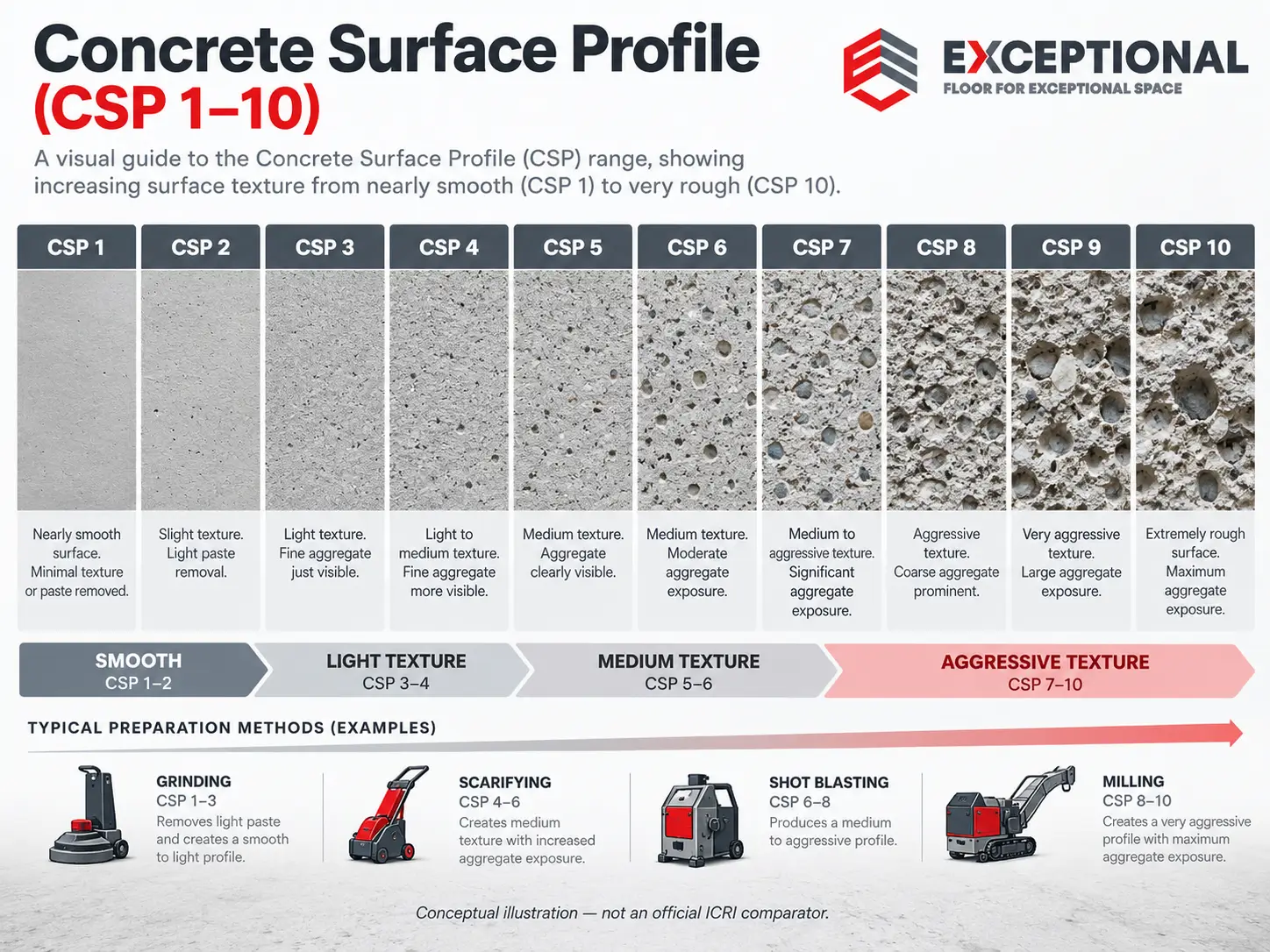
ICRI uses ten visual and tactile comparator levels, from CSP 1 to CSP 10.
CSP 1 represents a nearly smooth surface. CSP 10 represents a highly aggressive profile with substantial surface irregularity.
Contractors compare the prepared floor against ICRI’s reference chips to assess surface texture.
CSP 1–10: Surface Characteristics and Applications
| CSP level | General surface character | Common application considerations |
|---|---|---|
| CSP 1 | Nearly smooth | Thin sealers and selected coating systems |
| CSP 2 | Light surface texture | Thin-film coatings and primers |
| CSP 3 | Defined fine texture | Many epoxy coating applications |
| CSP 4 | Moderate roughness | High-build coatings and selected toppings |
| CSP 5 | Pronounced texture | Thicker resin systems and overlays |
| CSP 6 | Coarse surface profile | Heavy-duty overlays and repair systems |
| CSP 7 | Aggressive roughness | Concrete repairs and thicker overlays |
| CSP 8 | Very rough surface | Substantial concrete repair work |
| CSP 9 | Highly aggressive profile | Deep surface removal and repair |
| CSP 10 | Extreme surface texture | Heavy concrete repair and reconstruction interfaces |
This table illustrates general application relationships. It does not establish mandatory CSP values for particular coating systems.
The flooring manufacturer and project specification must define the target profile.
A coating also needs enough thickness to cover the peaks of the prepared surface. Excessive roughness may increase material consumption or leave coating defects.
Concrete Surface Profile and Preparation Equipment
Different machines create different surface textures.
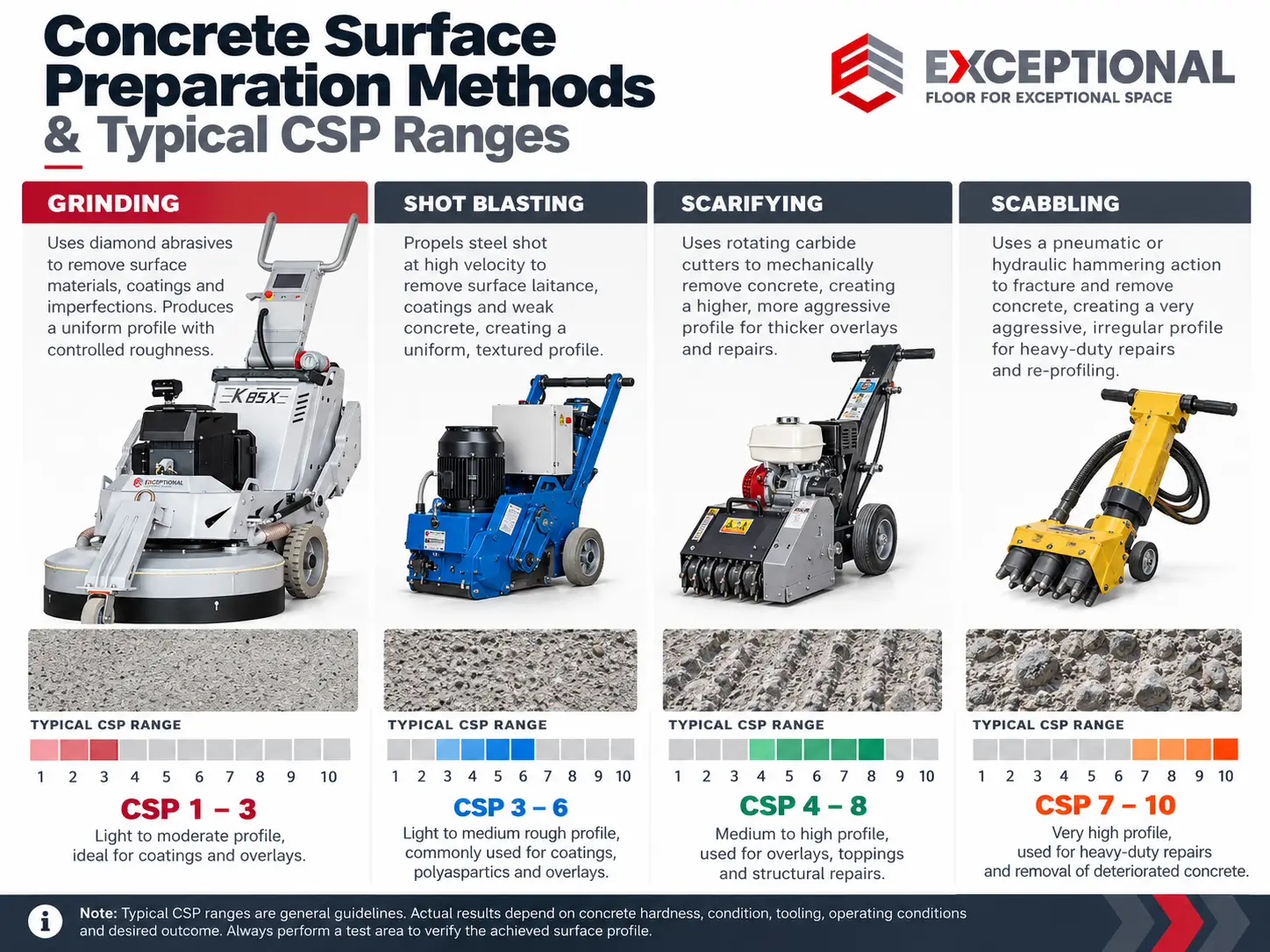
AMPP SSPC-SP 13/NACE No. 6-2024 lists the following profile ranges for several preparation methods.
| Preparation method | AMPP method class | Listed CSP range |
|---|---|---|
| Dry grinding | M-GRD | CSP 1–2 |
| Wet grinding | M-GRW | CSP 1–2 |
| Acid etching | W-AE | CSP 1–3 |
| Dry abrasive blasting | M-ABD | CSP 3–7 |
| Wet abrasive blasting | M-ABW | CSP 3–7 |
| Shot blasting | M-SB | CSP 3–9 |
| Scarifying | M-SC | CSP 4–7 |
| Waterjetting | W-WJ | CSP 3–10 |
These ranges come from AMPP’s preparation-method classification. They describe potential method capabilities, not guaranteed results.
Concrete strength, aggregate, diamond tooling, machine settings, and removal depth affect the finished profile.
For concrete floor grinding, contractors often use planetary or rotary machines with metal-bond diamond tools.
Shot blasters propel abrasive media against the surface. Scarifiers use rotating cutters to remove concrete and create a more aggressive texture.
Contractors should prepare a test area and compare the result with the specified profile before working across the entire floor.
AMPP/SSPC Standards for Concrete Surface Preparation
AMPP standards provide a technical framework for concrete surfaces that will receive industrial protective coatings and linings.
These specifications help project owners, coating manufacturers, contractors, and inspectors agree on the required substrate condition.
SSPC-SP 13/NACE No. 6: Surface Preparation of Concrete
The current 2024 edition addresses mechanical and chemical preparation methods for concrete.
The standard covers several key requirements.
| Requirement | What contractors must evaluate |
|---|---|
| Surface cleanliness | Dust, laitance, loose concrete, and contaminants |
| Surface profile | Texture required for coating adhesion |
| Surface tensile strength | Soundness of the prepared substrate |
| Moisture condition | Suitability for the coating system |
| Surface pH | Chemical condition when relevant |
| Surface defects | Cracks, voids, damage, and weak concrete |
| Acceptance criteria | Compliance with the specified preparation class and project requirements |
The standard also identifies preparation methods and associated surface profile ranges.
The owner or specifier must choose the preparation class that suits the coating system and service conditions.
Industrial facilities, chemical processing plants, warehouses, and other coating projects may use this standard when the coating must resist chemical exposure, moisture, or mechanical wear.
AMPP SP21513-2026: Concrete Surface Profile Verification
AMPP SP21513-2026 is titled Procedure for Determining Conformance to Concrete Surface Profile Requirements.
This standard helps inspectors determine whether the prepared concrete meets the specified profile.
It addresses measurement locations and three main assessment methods.
| Method | Reference | How it works |
|---|---|---|
| Depth micrometer | ASTM D8271 | Measures surface profile depth on concrete |
| CSP comparator chips | ICRI 310.2R | Compares surface texture with reference profiles |
| Replica putty | ASTM D7682 | Creates a surface replica for visual or depth assessment |
This standard does not create one universal CSP requirement.
The project specification still defines the acceptable surface profile. AMPP SP21513 provides procedures for checking conformance.
ASTM Concrete Surface Cleaning and Abrasion Standards
ASTM standards give contractors consistent procedures for preparing and evaluating concrete.
The following standards relate closely to mechanical floor grinding, cleaning, and surface profiling.
ASTM D4258-23: Surface Cleaning Concrete for Coating
ASTM D4258 covers cleaning methods that remove grease, dirt, dust, and loose material before coating.
Its cleaning procedures include vacuum cleaning, water cleaning, detergent cleaning, and other suitable methods.
The practice does not aim to change the concrete surface profile.
Contractors may use it for light-duty coating preparation or as one part of a wider preparation process.
ASTM D4259-24: Preparation by Abrasion
ASTM D4259 covers abrasive preparation of concrete before applying a coating.
It removes foreign materials and weak surface laitance while creating a surface profile.
Contractors may achieve this through suitable mechanical abrasion methods.
For floor grinding projects, choosing the right diamond grinding tools matters. Abrasive bond, grit, machine weight, and concrete hardness all affect material removal and surface texture.
For more information about equipment selection, read our Concrete Floor Grinder Buying Guide.
ASTM D4260-23: Liquid and Gelled Acid Etching
ASTM D4260 covers chemical etching methods used to prepare concrete before applying a coating.
Acid etching can alter surface texture and help remove weak surface material.
However, the process introduces chemical handling, rinsing, waste disposal, and moisture concerns.
Many industrial flooring projects favor mechanical preparation because it allows contractors to control material removal and work without introducing acid.
Contractors must follow the coating manufacturer’s requirements before selecting chemical etching.
ASTM D7682 and D8271: Measuring Surface Profile
Both standards address concrete surface roughness, but they use different methods.
ASTM D7682-17(2022) uses replica putty to capture the prepared surface texture. Contractors can compare the replica visually or measure its profile depth.
ASTM D8271-26 measures profile depth directly from the prepared concrete using a depth micrometer.
| Feature | ASTM D7682 | ASTM D8271 |
|---|---|---|
| Method | Replica putty | Direct depth measurement |
| Measurement target | Reproduced surface texture | Actual concrete surface |
| Main result | Visual profile comparison or profile depth | Quantitative profile depth |
| Permanent replica | Yes | No |
| Main application | Profile documentation and measurement | Direct field or laboratory profile measurement |
ICRI CSP numbers and measured profile depth are related concepts, but they are not interchangeable units.
A project may specify a CSP range, a quantitative profile depth, or both.
Concrete Moisture and Surface pH Testing Standards
Moisture creates serious problems for many resin flooring and adhesive systems.
A concrete floor may look dry while moisture remains inside the slab.
Contractors need suitable tests before installing moisture-sensitive coatings, adhesives, and floor coverings.
ASTM F2170-19a: Internal Relative Humidity Testing
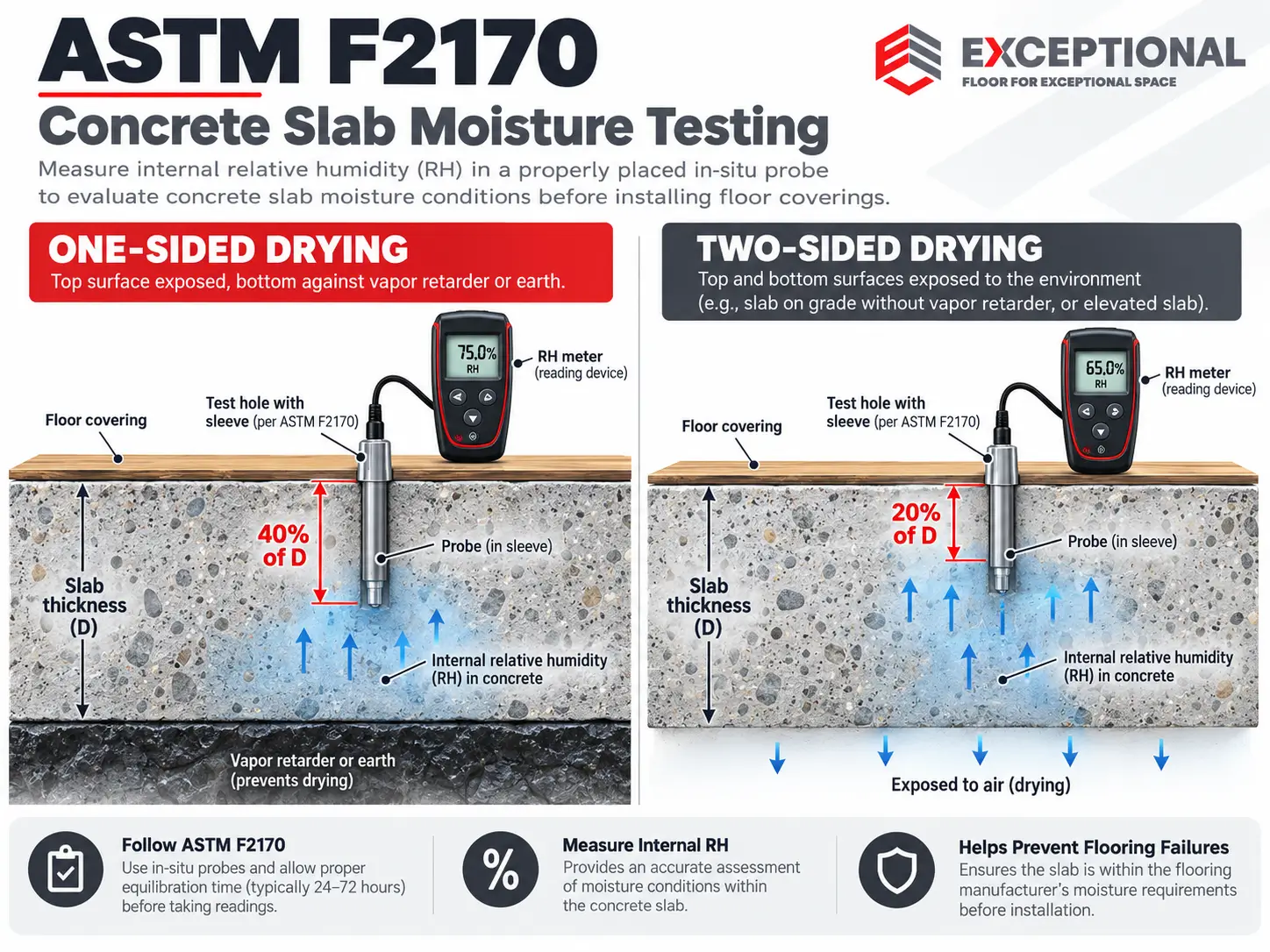
ASTM F2170 measures relative humidity inside concrete floor slabs using in-situ probes.
Contractors drill test holes, install probes, allow the required equilibration period, and record internal relative humidity.
The result is expressed as relative humidity (%), or % RH.
The standard specifies different test depths depending on how the slab dries.
| Slab drying condition | Probe depth |
|---|---|
| Drying from one side | 40% of slab thickness |
| Drying from two sides | 20% of slab thickness |
For example, a 150 mm slab drying from the top requires a test depth of 60 mm from the exposed surface.
ASTM F2170 also calls for three test locations within the first 1,000 sq ft (about 100 m²) and at least one additional location for each additional 1,000 sq ft.
The procedure requires a 24-hour equilibration period for the test holes.
The standard defines how to measure moisture. The flooring manufacturer determines the acceptable RH limit for its system.
ASTM F1869-23: Moisture Vapor Emission Rate
ASTM F1869 measures moisture vapor emission from concrete subfloors using anhydrous calcium chloride.
The test reports the moisture vapor emission rate (MVER).
| Property | Description |
|---|---|
| Test material | Anhydrous calcium chloride |
| Main measurement | Moisture vapor emission |
| Common reporting unit | lb/1,000 sq ft/24 hours |
| Primary application | Concrete subfloor evaluation for resilient flooring |
ASTM F1869 evaluates moisture emission at the test surface. It does not measure internal slab RH.
F2170 and F1869 therefore measure different moisture properties.
Contractors must choose the method that the project specification or flooring manufacturer requires.
ASTM D4263-24: Plastic Sheet Moisture Test
ASTM D4263 uses a plastic sheet to indicate capillary moisture in concrete.
The method provides a simple moisture indication before coating work.
It does not provide a numerical internal RH value or moisture vapor emission rate.
A negative plastic sheet test does not prove that the concrete meets a flooring manufacturer’s moisture limits.
ASTM D4262-05(2024): Concrete Surface pH
ASTM D4262 measures the acidity or alkalinity of chemically cleaned or etched concrete surfaces.
The test helps contractors identify residual chemical conditions after cleaning and rinsing.
Residual acid or other chemicals may affect coating adhesion and performance.
A pH test does not replace moisture testing or surface profile inspection.
Concrete Coating Adhesion, Surface Strength, and Floor Flatness Standards
A prepared floor needs more than the right surface texture.
Weak concrete can fail beneath a coating. Poor adhesion can cause coating separation. Floor geometry may also affect the finished flooring system.
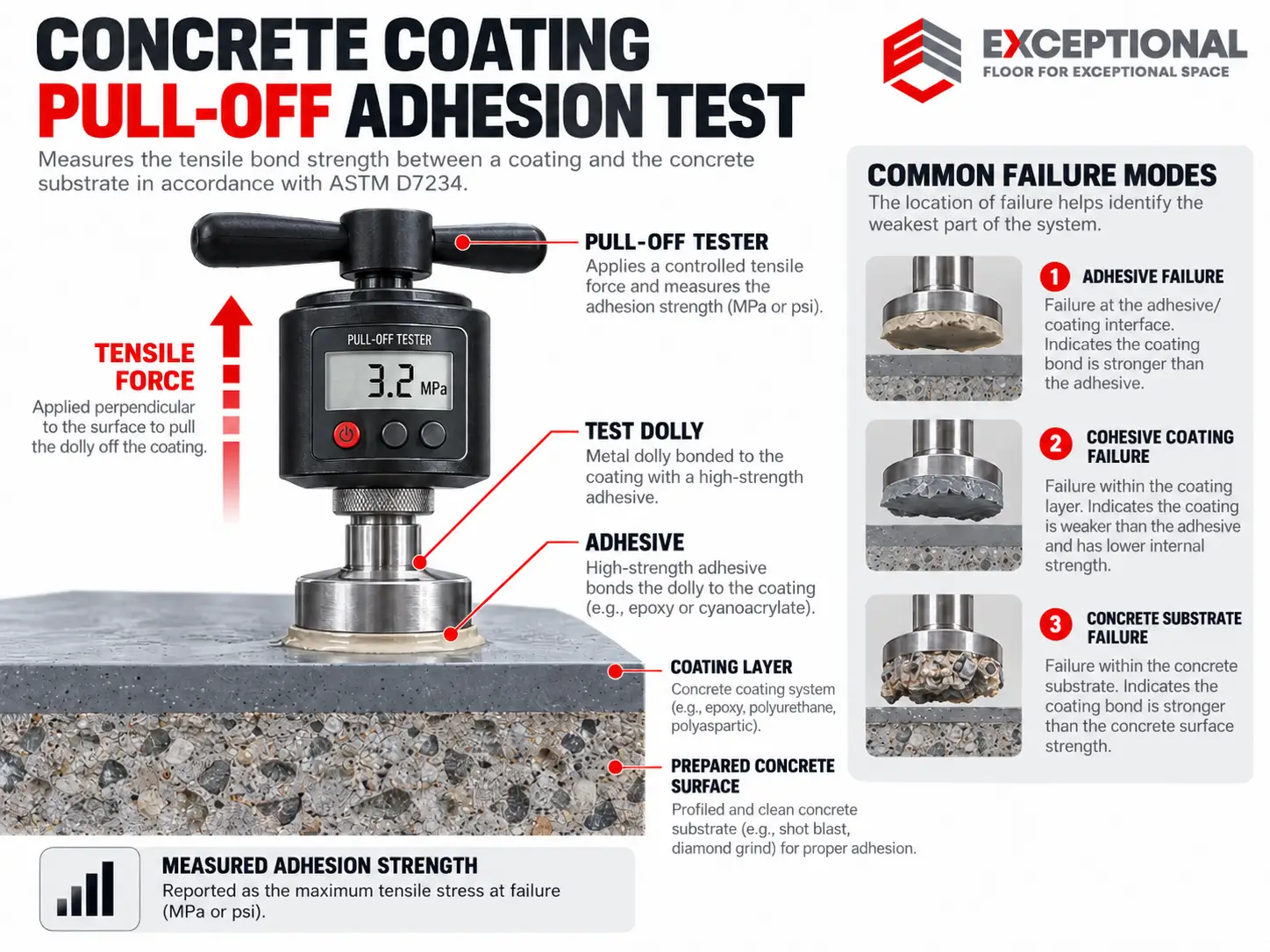
ASTM D7234-22: Pull-Off Strength of Coatings on Concrete
ASTM D7234 provides a procedure for testing the pull-off strength of coatings on concrete.
The test uses a portable adhesion tester to apply tensile force perpendicular to the surface.
The tester records the force or stress at failure.
Contractors and inspectors also record the failure location and type.
| Failure mode | What it means |
|---|---|
| Adhesive failure | Separation occurs at an interface |
| Cohesive coating failure | The coating breaks within its own layer |
| Concrete substrate failure | Concrete breaks beneath the coating |
| Glue failure | The test adhesive fails before other parts of the system |
A high test value alone does not explain the entire result. The failure mode shows which part of the system failed.
ASTM D7234 does not establish one universal minimum adhesion strength for all coatings.
The project specification must define the required value and acceptable failure conditions.
ASTM C1583/C1583M-25: Concrete Tensile Strength
ASTM C1583 measures near-surface concrete tensile strength and the bond or tensile strength of repair and overlay materials.
The test uses a direct tensile pull-off procedure.
Contractors can use this method to evaluate the condition of a prepared concrete substrate before applying repairs or overlays.
The result helps determine whether the near-surface concrete can support the intended system.
Like coating adhesion testing, the project must establish the required acceptance criteria.
ICRI 210.3R-2022 provides related guidance for using in-situ tensile pull-off tests on concrete repairs and bonded overlays.
ASTM E1155/E1155M-23: Floor Flatness and Levelness
ASTM E1155 measures concrete floor geometry using floor flatness and floor levelness numbers.
FF indicates floor flatness. FL indicates floor levelness.
| Parameter | Main purpose |
|---|---|
| FF | Evaluates local floor surface flatness |
| FL | Evaluates floor elevation changes |
| CSP | Evaluates microscopic to macroscopic surface roughness for bonding |
FF, FL, and CSP measure different surface properties.
A floor can meet CSP 2 and still have uneven joints, high spots, or low areas.
ASTM E1155 provides measurement methods for floor profile numbers. The project specifications set the required tolerances.
For floors that need correction, contractors may use concrete grinding equipment to remove selected high spots. Grinding does not guarantee that the entire floor will meet a specified FF or FL value.
International Concrete Surface Preparation Standards: ISO, EN, BS, and ACI
Different markets use different technical references.
International flooring contractors and equipment distributors should understand each standards organization’s role.
EN 1504: Concrete Protection and Repair
The EN 1504 series covers products and systems for protecting and repairing concrete structures.
Two parts are directly relevant to surface preparation projects.
EN 1504-2:2004 addresses surface protection systems for concrete, including coatings and impregnation systems.
EN 1504-10:2017 covers site application and quality control for protection and repair work. It includes substrate conditions, preparation, application, and inspection.
These standards mainly apply to concrete protection and repair. They do not replace the installation requirements for every flooring product.
EN 1542: Pull-Off Bond Strength
EN 1542:1999 provides a method for measuring tensile bond strength through pull-off testing.
The standard applies to concrete repair products and surface protection systems within its defined scope.
Contractors may encounter this reference when working on European concrete protection or repair projects.
EN 13813: Screed Materials
EN 13813:2002 covers screed material properties and performance requirements.
It addresses materials used to form floor screeds rather than serving as a general mechanical grinding standard.
Contractors may need this reference when installing cementitious or resin-based screed systems.
BS 8204-6: Synthetic Resin Flooring
BS 8204-6:2008+A1:2010 provides guidance for the design and installation of synthetic resin flooring.
It covers systems installed over concrete slabs, screeds, and existing concrete floors.
The guidance supports contractors working with epoxy, polyurethane, and related resin floor systems in the UK.
Substrate condition, preparation, moisture, and installation practices all affect resin flooring performance.
ACI PRC-302.1-15: Concrete Floor and Slab Construction
ACI PRC-302.1-15 is titled Guide to Concrete Floor and Slab Construction.
It covers concrete floor construction practices, finishing, curing, joints, and floor quality.
Unlike ICRI 310.2R, ACI 302.1 focuses on floor and slab construction rather than serving as a CSP classification guide.
Flooring contractors may use it to understand the original slab condition and construction practices that affect later floor preparation.
ISO 9607: Protective Coatings for Concrete Structures
ISO 9607 covers protective coatings for concrete structures.
ISO 9607-1:2024, the published introductory part, establishes the general framework for the series.
Several additional parts remained under development as of October 2026.
| ISO document | Subject | Status |
|---|---|---|
| ISO 9607-1:2024 | General introduction | Published |
| ISO/DIS 9607-2 | Classification of environments | Draft |
| ISO/DIS 9607-3 | Requirements of the substrate | Draft |
| ISO/DIS 9607-4 | Types of surfaces and surface preparation | Draft |
Contractors should not treat draft ISO documents as published requirements.
The ISO 9607 series may become an important international reference as its remaining parts move through development and publication.
Concrete Grinding Safety: OSHA Silica Requirements
Concrete grinding can release respirable crystalline silica.
In the United States, OSHA 29 CFR 1926.1153 regulates construction worker exposure to respirable crystalline silica.
The regulation sets a permissible exposure limit of 50 micrograms per cubic meter of air (50 µg/m³) as an eight-hour time-weighted average.
OSHA also establishes specified exposure-control methods for certain equipment and tasks.
Contractors must select the applicable compliance approach and follow its dust-control and respiratory protection requirements.
Industrial concrete floor grinders often work with dust shrouds and compatible dust extractors. Contractors should match extraction airflow, filtration, hoses, and other controls to the equipment and applicable safety requirements.
A dust extractor alone does not guarantee OSHA compliance. Employers must evaluate the task, working conditions, and required exposure controls.
Which Standards Apply to Different Concrete Flooring Systems?
No single standard fits every flooring application.
Contractors should start with the coating or flooring manufacturer’s technical data sheet. The project specification then identifies the required surface conditions and test methods.
| Flooring application | Relevant standards | Main preparation concerns |
|---|---|---|
| Thin-film epoxy coatings | ICRI 310.2R, ASTM D4259, F2170 | Surface texture, adhesion, moisture |
| High-build protective coatings | AMPP SSPC-SP 13, ASTM D8271, D7234 | Profile, cleanliness, coating adhesion |
| Polyurethane resin floors | BS 8204-6, ASTM F2170 | Substrate condition, moisture, bonding |
| Cementitious overlays | ICRI 310.2R, ASTM C1583 | Profile, substrate tensile strength |
| Concrete repairs | ICRI 310.1R, 310.3R, EN 1504-10 | Damaged concrete removal and repair preparation |
| Resilient flooring | ASTM F710, F2170, F1869 | Moisture, smoothness, substrate suitability |
| New industrial slabs | ACI 302.1, ASTM E1155 | Floor construction, flatness, levelness |
These standards form a starting point for selecting references. They do not create one universal specification for every system.
Which Standard Is the Most Commonly Referenced?
For concrete surface profile selection, ICRI 310.2R is one of the most recognized industry guidelines.
For industrial protective coatings, contractors often use AMPP SSPC-SP 13/NACE No. 6.
For concrete testing, ASTM provides many of the established methods.
However, no reliable global ranking identifies one standard as the most widely adopted across every country and flooring application.
The most relevant standard depends on surface properties, the flooring system, and project requirements.
Concrete Surface Preparation Equipment and Standard Compliance
Surface preparation equipment helps contractors achieve the required condition. The standard defines the target or testing method.
The right machine depends on the work scope, concrete condition, and intended floor finish.
Planetary Concrete Floor Grinders
Planetary grinders use multiple rotating grinding heads to remove surface material and create a controlled finish.
Contractors use them for coating removal, floor preparation, leveling work, and concrete polishing.
Diamond tooling determines much of the cutting performance. Bond hardness, segment design, and grit affect how the machine interacts with the concrete.
Planetary grinders work well where projects require uniform mechanical preparation over large floor areas.
Rotary Concrete Floor Grinders
Rotary grinders use a direct-drive grinding arrangement rather than the same planetary motion.
They offer a different grinding action and may suit selected coating removal or concrete preparation tasks.
Machine weight, tooling, head speed, and floor condition influence the finished surface.
Read our guide to Planetary vs. Rotary Concrete Floor Grinders for a detailed equipment comparison.
Floor Scarifiers and Shot Blasters
Floor scarifiers use rotating cutting drums to remove concrete or existing floor materials.
They suit applications that require greater removal depth or an aggressive surface texture.
Shot blasting machines propel abrasive media against concrete. The process removes surface material and creates a textured profile.
When selecting equipment, contractors must match machine capability with the target CSP, project area, coating requirements, and environmental controls.
Diamond Grinding Tools and Dust Extractors
Diamond grinding tools affect surface cutting, profile consistency, and production speed.
Hard concrete may require a softer-bond diamond tool. Soft or abrasive concrete often calls for a harder bond to control tool wear.
Dust extraction also affects the grinding process. Poor dust control reduces visibility, creates cleanup work, and may increase worker exposure.
Professional contractors should evaluate grinders, diamond tooling, and dust collection as one preparation system.
How to Inspect and Verify a Prepared Concrete Floor
A good inspection process starts before the grinding machine enters the job site.
Contractors should review the flooring specification, inspect the existing surface, and agree on the acceptance criteria.
The inspection should cover surface profile, cleanliness, defects, moisture, strength, and other properties that affect installation.
Concrete Surface Preparation Inspection Checklist
| Inspection item | Recommended action | Reference |
|---|---|---|
| Surface condition | Identify cracks, contamination, coatings, and weak concrete | AMPP SSPC-SP 13 |
| Surface profile | Compare the floor against specified CSP or depth requirements | ICRI 310.2R, AMPP SP21513 |
| Surface cleanliness | Check dust and other contaminants | ASTM D4258 |
| Internal moisture | Measure slab RH when required | ASTM F2170 |
| Moisture vapor emission | Test when the flooring specification requires it | ASTM F1869 |
| Surface pH | Check chemical condition when applicable | ASTM D4262 |
| Concrete strength | Conduct pull-off testing when specified | ASTM C1583 |
| Coating adhesion | Test the installed coating when required | ASTM D7234 |
| Floor flatness | Measure FF and FL where specified | ASTM E1155 |
The contractor should document the test location, date, equipment, method, results, and acceptance limits.
If the results fall outside the specified range, the team should identify the cause before proceeding.
Common Concrete Surface Preparation Mistakes
Many flooring failures start with poor substrate evaluation, not the coating itself.
| Common mistake | Potential result |
|---|---|
| Ignoring surface moisture | Blistering, debonding, or flooring failure |
| Using the wrong CSP | Weak adhesion or excessive coating consumption |
| Leaving surface dust | Poor coating-to-substrate contact |
| Failing to remove weak laitance | Separation at the concrete surface |
| Ignoring cracks and damaged areas | Cracking or failure in the flooring system |
| Skipping adhesion testing when specified | Undetected substrate or coating weaknesses |
| Using unsuitable diamond tooling | Low productivity or inconsistent preparation |
A small test area can help contractors verify grinding performance and surface profile before full-scale preparation.
Frequently Asked Questions About Concrete Surface Preparation Standards
Concrete flooring contractors often need to identify the correct standard before choosing preparation methods or testing equipment. The following answers cover common questions about ICRI, ASTM, AMPP, surface profiles, moisture testing, and coating requirements.
1. What Is the Most Commonly Referenced Concrete Surface Preparation Standard?
ICRI 310.2R is one of the most widely recognized guidelines for selecting concrete surface profiles. Its CSP 1–10 system helps contractors specify surface roughness for coatings, overlays, and repairs.
For industrial protective coating specifications, AMPP SSPC-SP 13/NACE No. 6 is another major reference.
2. What Is the Difference Between ICRI and ASTM Concrete Standards?
ICRI 310.2R provides guidance on surface preparation methods and CSP classification.
ASTM publishes specific testing and preparation procedures. Examples include ASTM D4259 for abrasion, F2170 for moisture testing, and D7234 for coating adhesion.
3. What Does CSP 1–10 Mean?
CSP stands for Concrete Surface Profile.
The ICRI system classifies surface texture from CSP 1, which represents a nearly smooth surface, to CSP 10, which represents an extremely rough surface.
Contractors use CSP to communicate surface preparation requirements.
4. What CSP Is Recommended for Epoxy Floor Coatings?
Many thin-film epoxy systems call for a relatively light surface profile, such as CSP 2 or CSP 3.
Thicker industrial coatings and overlays may require more aggressive preparation.
The epoxy manufacturer’s technical data sheet and project specification determine the correct CSP.
5. Does ASTM D4259 Require a Specific Floor Grinder?
No. ASTM D4259 covers preparing concrete through abrasion before applying a coating.
It does not require every contractor to use one specific grinding machine.
Contractors must choose suitable equipment and verify that the preparation meets the project requirements.
6. What Is the Difference Between ASTM F2170 and ASTM F1869?
ASTM F2170 measures internal relative humidity inside concrete slabs using in-situ probes.
ASTM F1869 measures moisture vapor emission from the concrete surface using calcium chloride.
The methods measure different properties and are not direct substitutes.
7. What Is the Difference Between ASTM D7234 and ASTM C1583?
ASTM D7234 measures the pull-off strength of coatings on concrete.
ASTM C1583 measures near-surface tensile strength in concrete and the bond or tensile strength of repair and overlay materials.
The correct method depends on what the project needs to evaluate.
8. Are Concrete Surface Preparation Standards Mandatory?
Not all standards are mandatory on their own.
Contracts, project specifications, and applicable laws determine which requirements contractors must follow.
Coating manufacturers also set installation conditions that contractors must meet.
9. Are European EN Standards Equivalent to ASTM Standards?
Not necessarily.
EN and ASTM standards may address similar properties, but their methods, scope, and acceptance requirements can differ.
Contractors should check the exact standard that the project specifies rather than assume equivalence.
10. What Is the Latest ISO Standard for Concrete Surface Preparation?
ISO 9607-1:2024 provides the published general introduction to the ISO 9607 protective coating series.
As of October 2026, ISO/DIS 9607-2, ISO/DIS 9607-3, and ISO/DIS 9607-4 remained under development.
The draft parts address environmental classification, substrate requirements, and surface preparation.
Choosing the Right Concrete Surface Preparation Standard
Concrete floor surface preparation requires more than selecting a grinder or removing an old coating.
Contractors need to understand the required surface profile, moisture condition, substrate strength, cleanliness, and floor geometry.
ICRI 310.2R provides a common language for surface roughness. AMPP establishes preparation requirements for protective coatings. ASTM supplies test methods, while ACI, EN, BS, and ISO address related construction and flooring requirements.
The right combination depends on the flooring system and project specification.
At Exceptional Grinder, we manufacture concrete floor grinding equipment for professional contractors, equipment distributors, and industrial floor preparation businesses. Our planetary and rotary grinders support mechanical surface preparation, coating removal, and floor renovation work.
Explore our Concrete Floor Grinder Buying Guide to learn how machine configuration, diamond tooling, working width, power, and dust extraction affect equipment selection.
Official Standards and Technical References
The following organizations publish the original documents and supporting technical information. Consult the full standards for mandatory procedures, detailed test conditions, and acceptance requirements.
| Organization | Standard or resource | Official source |
|---|---|---|
| ICRI | 310.2R-2013 | Concrete Surface Preparation Guideline |
| ICRI | 310.3R-2014 | Hydrodemolition Guideline |
| ICRI | 210.3R-2022 | In-Situ Tensile Pull-Off Testing Guide |
| AMPP | SSPC-SP 13/NACE No. 6-2024 | Surface Preparation of Concrete |
| ASTM | D4259-24 | Concrete Preparation by Abrasion |
| ASTM | D8271-26 | Direct Surface Profile Measurement |
| ASTM | F2170-19a | Concrete Relative Humidity Testing |
| ASTM | D7234-22 | Coating Pull-Off Strength Testing |
| ACI | PRC-302.1-15 | Concrete Floor and Slab Construction |
| BSI | BS 8204-6 | Synthetic Resin Flooring Standard |
| BSI | BS EN 1504-10 | Concrete Protection and Repair |
| ISO | ISO 9607-1:2024 | Protective Coatings for Concrete Structures |
| OSHA | 29 CFR 1926.1153 | Respirable Crystalline Silica Regulation |
Standards reviewed: October 2026. This article provides an educational overview. Standard editions, local requirements, and product specifications may change. Always consult the governing standard and the flooring manufacturer’s current technical instructions before starting work.