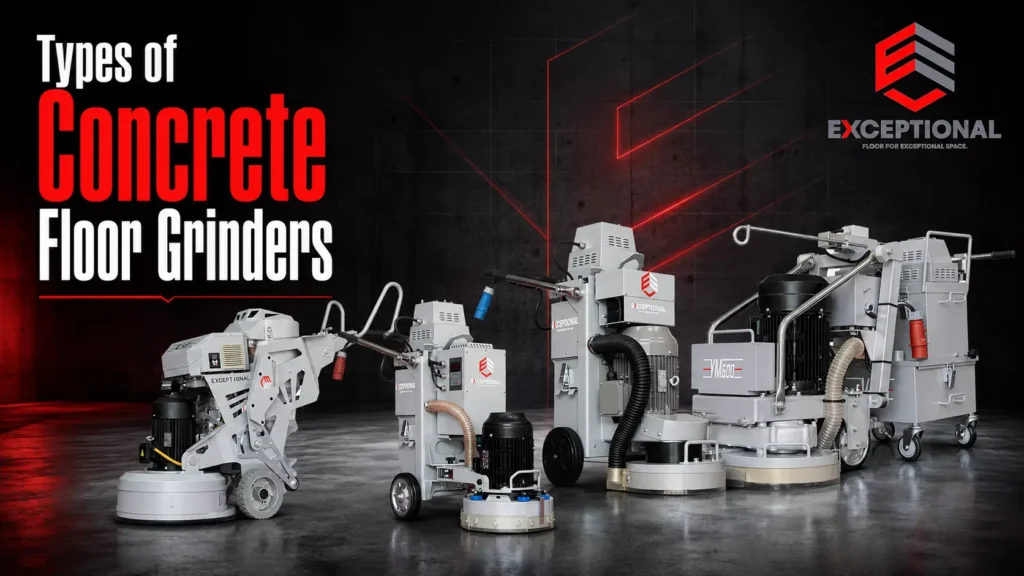
There is no single fixed number of types of concrete floor grinders. Professional floor grinders for concrete are classified along five overlapping axes: grinding-head movement, machine configuration, power source, operating method, and wet- or dry-capability. Identifying the right concrete grinder types is essential for projects involving polished concrete and complex surface preparation. These tools are essential for floor restoration and maintaining high-performance industrial flooring.
The principal grinding systems include single-disc, dual-disc, multi-head rotary, and planetary floor grinders. Specialized configurations range from handheld tools to remote-controlled machines. Understanding various floor grinding machines ensures that every substrate challenge has a mechanical solution. High-performance planetary floor grinders are frequently used in commercial flooring to achieve consistent results.
A single unit can belong to several categories at once, which is why selection demands more than picking a label from a list. Proper concrete floor grinding requires matching the equipment to the specific substrate conditions.
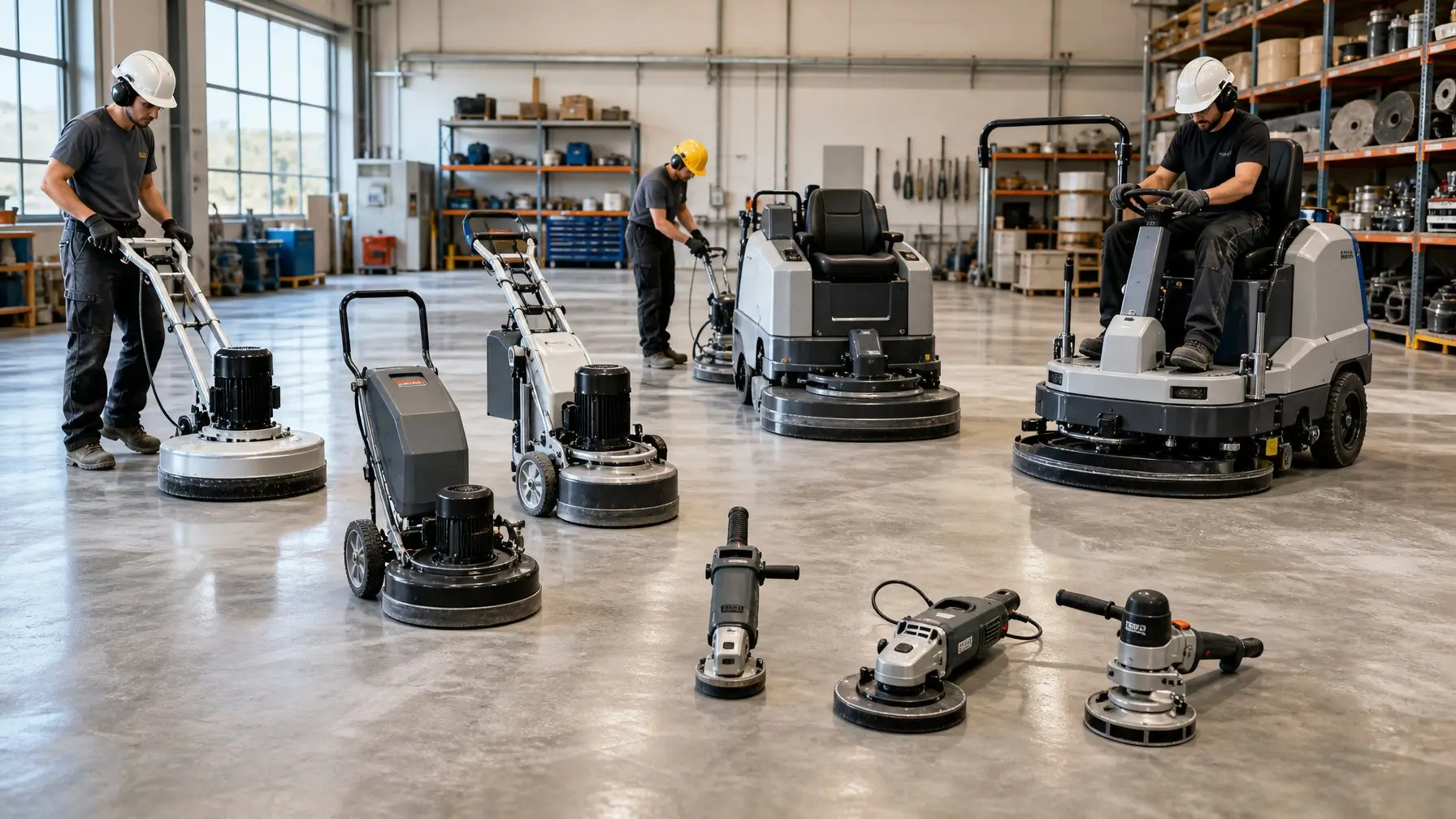
Choosing the right grinder directly affects your productivity, tooling cost, surface finish, and dust-control compliance. A machine that is too small for the floor area burns through diamond segments and labor hours. One that is too aggressive for the finish you need creates extra refinement steps. And a grinder mismatched to your jobsite power supply may not run at all.
The applications these machines serve overlap heavily. You might use the same planetary grinder for coating removal, concrete leveling, aggregate exposure, honing, and high-gloss polishing, changing only the diamond tooling, speed, and grinding pressure between stages. Other tasks, such as deep scarification or large-area shot blasting, call for entirely different equipment categories.
This article walks through each classification system in detail: head movement and disc layout, machine format and operator control, power source and electrical supply, wet versus dry operation, and application-specific setups. Along the way, you will find comparison tables, specification guidance, and practical selection logic. If you need help matching a grinder to your project or market, Exceptional Grinder offers machine recommendations, voltage customization, OEM solutions, and export support through direct factory access.
What Is a Concrete Floor Grinder?
A concrete floor grinder is a floor preparation machine that uses rotating diamond or abrasive tools to remove a controlled amount of material from a concrete surface. These machines range from small handheld units to large ride-on systems, and they serve as the backbone of concrete surface preparation equipment across residential, commercial, and industrial projects. Whether you call it a concrete surface grinder, a floor grinding machine, or a concrete flooring machine, the operating principle is the same. Professional concrete floor grinding utilizes abrasive contact under controlled pressure to reshape the floor for better surface prep.
A floor grinding machine is essential for various stages of surface prep, from initial cleaning to final refinement. This process is the foundation for achieving a high-quality surface finish.
How a Concrete Grinder Works
A motor or engine spins one or more rotating heads fitted with diamond tools or PCD tools. Those tools contact the concrete under the weight of the machine, sometimes supplemented by adjustable ballast. As the rotating heads spin, the diamond segments abrade the surface, removing thin layers of material with each pass.
You control the depth of cut by adjusting travel speed, grinding pressure, tool grit, and head RPM. Moving slowly removes more material per pass. Adding weight increases cutting aggressiveness. Finer diamond grits produce shallower, smoother scratches.
The operator guides the machine across the floor in overlapping passes, either pushing it manually, engaging powered drive wheels, or using a remote control. Dust or slurry is managed simultaneously through a shroud connected to a vacuum system or through water supplied to the grinding head.
Main Components
Every professional concrete floor grinder, whether industrial or commercial, shares a common set of functional components:
- Motor or combustion engine supplies rotational power to the grinding head. In an electric floor grinder, this motor provides consistent torque for refinement.
- Transmission or drive system transfers torque from the motor to the tool holders
- Grinding head houses the tool-holding mechanism and determines the disc layout
- Tool holders secure diamond segments, PCD tools, or other abrasives in position
- Diamond tools or PCD tools perform the actual cutting and abrasion
- Dust shroud encloses the grinding area to capture airborne particles and works with modern dust collection systems.
- Vacuum connection links the shroud to industrial HEPA vacuum systems or dust extractors
- Water tank or water connection supplies water for wet grinding when required
- Control panel provides speed adjustment, start/stop, and diagnostic functions
- Handle and drive wheels allow the operator to maneuver and transport the machine
- Additional weights increase grinding pressure for harder concrete or more aggressive removal
Not every machine includes all components. A handheld concrete grinder has no drive wheels or ballast system, for example, while a diamond floor grinder designed exclusively for dry use may lack a water connection.
Common Applications
A concrete floor preparation machine can handle a broad range of tasks depending on its configuration and tooling:
- Epoxy coating removal to remove epoxy and prepare for new finishes.
- Adhesive and glue removal including carpet glue and mastic.
- Floor leveling and surface leveling for flat substrates.
- Commercial flooring preparation for retail and industrial sites.
- Decorative concrete texturing and exposure.
- Surface cleaning and contamination removal
- Floor preparation for coatings, overlays, and membranes
- Aggregate exposure (cream finish, salt-and-pepper, full exposure)
- Honing and polishing concrete floors for high-traffic environments
- Comprehensive floor restoration on aging slabs
- Terrazzo grinding and natural-stone restoration
- Bush hammering and texturing for slip resistance or decorative effects
The versatility of a diamond grinding machine makes it the most frequently used piece of concrete surface preparation equipment on professional jobsites.
How Floor Grinders Differ From Polishers and Other Surface Preparation Machines
Floor grinders, polishers, scarifiers, shot blasters, and scrapers each use a different operating principle and produce a different surface result. Grinders occupy the middle ground: more controlled than scarifiers and shot blasters, more aggressive than polishers. The following comparison clarifies where each machine fits in the concrete surface preparation equipment landscape.
| Machine | Operating principle | Best use | Typical surface result |
|---|---|---|---|
| Floor grinder | Diamond or abrasive grinding | Preparation, leveling and polishing | Controlled, relatively smooth profile |
| Floor polisher | Fine diamond or resin polishing | Refining and increasing gloss | Smooth or high-gloss finish |
| Floor scarifier | Impact cutters on a rotating drum | Aggressive removal and profiling | Coarse, grooved profile |
| Shot blaster | High-speed steel shot | Cleaning and profiling | Textured, open surface |
| Floor scraper | Reciprocating or fixed blade | Removing floor coverings | Removes material above the substrate |
| Floor shaver | Cutting drum | Deep, controlled removal | Heavily cut surface |
Floor Grinder vs. Polisher
A planetary grinder with variable speed can serve as a polisher when used in polished concrete systems. These setups use resin polishing pads and run at higher speeds to effectively polish concrete floors. The difference is primarily one of tooling stage and operating parameters.
Dedicated polishing machines tend to run at higher RPM with lighter pressure. They use resin tools from 200 grit through 3,000 grit and above. A precise grit progression ensures a clear reflection. Grinding, by contrast, focuses on material removal and profile creation using metal-bond or PCD tools.
If you plan to grind and polish on the same project, a variable-speed planetary grinder that accepts both metal-bond and resin-bond tooling gives you the most flexibility.
Floor Grinder vs. Scarifier
A floor scarifier uses carbide or hardened-steel cutters mounted on a rotating drum that impacts the surface. Scarifiers remove material much faster than grinders but leave a coarse, ridged profile unsuitable for coatings that require a smooth substrate. You would typically choose a scarifier to remove thick coatings, level significant lippage, or create a deep mechanical profile, then follow with a grinder to refine the surface.
Grinders and scarifiers are complementary, not interchangeable.
Floor Grinder vs. Shot Blaster and Scraper
A shot blaster propels steel shot against the concrete at high velocity, cleaning and profiling the surface in one pass. The resulting texture is open and porous, which improves coating adhesion but is too rough for polishing. Shot blasters excel at large-area preparation where a specific ICRI concrete surface profile (CSP) is required.
A floor scraper or floor stripping machine uses a reciprocating or fixed blade to peel floor coverings, adhesives, or membranes from the substrate. Scrapers remove material sitting on top of the concrete rather than grinding into it. After scraping, you typically need a grinder to clean and profile the exposed surface.
How Grinders Are Classified
Understanding the types of concrete floor grinders requires recognizing that every machine sits at the intersection of five classification axes. These concrete grinding machine types are not mutually exclusive. A single machine can be described along every axis simultaneously.
Grinding-Head System
This axis defines how the grinding discs move: a single-head grinder, dual-disc, multi-head rotary, planetary, or dual-drive planetary. Head movement determines your scratch pattern, finish quality, and removal aggressiveness. It is the most important differentiator among floor grinding machine types.
Machine Configuration
Configuration describes the physical format: handheld, edge grinder, walk-behind (manual push or self-propelled), remote-controlled, autonomous, or ride-on. Your access constraints, operator workload, and project scale drive this choice.
Grinding Width and Project Size
The grinding width, typically measured in millimeters, sets the path per pass. A wider grinding width covers more area per hour but reduces maneuverability and requires more power. Different types of floor grinders range from roughly 100 mm handheld units to 1,000 mm or wider production machines.
Power Source and Electrical Supply
Concrete floor grinder types also differ by power source: single-phase electric, three-phase electric, gasoline, propane (LPG), or battery. Electric floor grinders are the industry standard for indoor renovation projects. A single-phase floor grinder connects to standard residential circuits, while a three-phase floor grinder requires industrial power. Power source affects where and how you can operate.
Operating Method and Grinding Environment
The final axis covers wet, dry, or wet-and-dry capability. A wet-and-dry floor grinder accepts both a water supply and a vacuum connection, giving you flexibility across different applications and jobsite conditions.
Example: A machine may be a three-head planetary, 650 mm, three-phase electric, remote-controlled, wet-and-dry floor grinder. Each descriptor comes from a different classification axis. This prevents you from assuming that concrete floor grinder types are simple, separate buckets.
Head Movement and Disc Layout Options
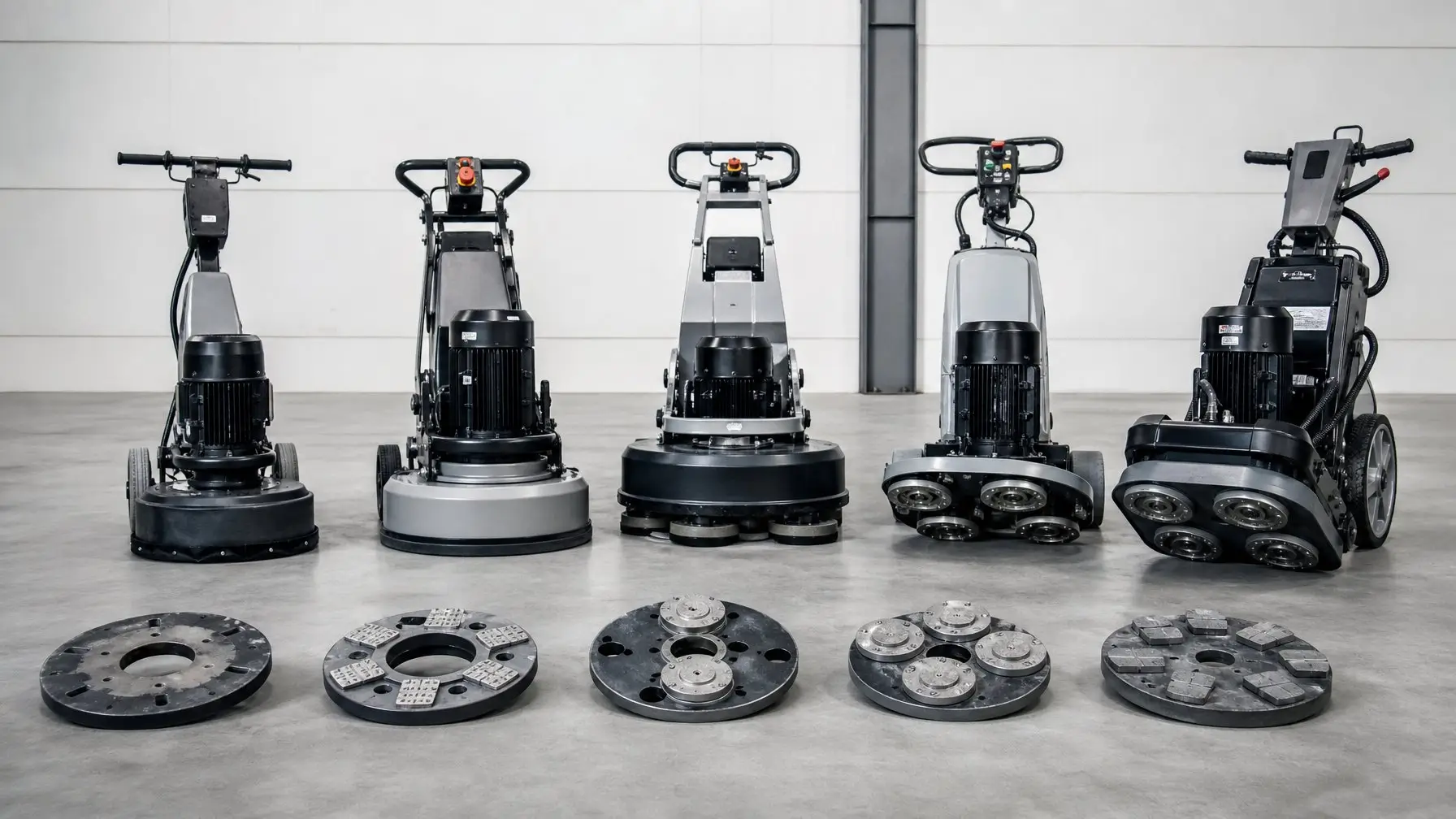
The grinding-head system is the single most consequential distinction among types of concrete grinders. It determines your scratch pattern, removal rate, finish uniformity, and tooling compatibility. The main categories are single-disc, dual-disc, multi-head rotary, and planetary, with dual-drive planetary as a further refinement. Each system has a specific set of strengths and trade-offs.
Single-Disc Systems
A single-disc floor grinder, also called a single-head grinder or single head grinder, uses one directly driven grinding disc rotating beneath the machine. This is the simplest direct-drive floor grinder design for targeted results.
Typical working width: 250–400 mm
Suitable tools: Metal-bond diamond segments, PCD grinding tools, carbide scraper tools, diamond cup wheels
Applications:
- Small-area surface preparation
- High-spot removal
- Paint and adhesive removal
- Garage and basement floors
- Localized repairs and surface leveling
- Coarse concrete grinding
Advantages:
- Simple, robust design
- Aggressive cutting under direct drive
- Lower initial cost than multi-head machines
- Compact for transportation and storage
- Easy, fast tool replacement
- Fits through standard doorways and into small spaces
Disadvantages:
- Lateral pull requires more operator control
- Single-disc rotary grinder leaves more pronounced swirl marks
- Lower productivity on large floors
- Less suitable for refined polishing
- Uneven tool wear if operator technique is inconsistent
Best for: Small contractors, rental businesses, repair specialists, and localized coating removal where a compact, aggressive floor grinder is the priority.
Dual-Disc Systems
A dual-disc floor grinder, also called a double-disc floor grinder, uses two grinding discs that normally rotate in opposite directions. This counter-rotating floor grinder design balances lateral force, reduces side pull, and increases the working width compared to a single-disc machine.
Typical working width: 400–650 mm
Suitable tools: Metal-bond diamond segments, PCD coating removal tools, diamond grinding shoes
Applications:
- Medium-sized floor preparation
- Coating and adhesive removal
- General concrete leveling
- Preparing concrete for epoxy or overlays
- Surface cleaning
Advantages:
- Better balance than single-disc grinders due to counter-rotating grinding heads
- Wider grinding path increases productivity
- Reduced side pull gives the operator more comfort
- Strong coating-removal performance with PCD or carbide tools
Disadvantages:
- Heavier to transport than single-disc machines
- Requires more tooling (two sets of segments)
- Cannot finish edges alone; needs an edge grinder
- May not polish as evenly as a planetary grinder
- Some counter-rotating systems need left-rotation and right-rotation tool sets
Best for: Medium-scale contractors and preparation specialists focused on coating removal, leveling, and surface preparation rather than high-gloss polishing.
Multi-Head Rotary Systems
A multi-head rotary grinder, also called a rotary concrete floor grinder, uses two or more grinding heads that rotate directly or counter-rotate without orbiting around a central planetary axis. The term “rotary” varies between manufacturers, so you need to confirm the actual head movement rather than relying on the label alone.
Typical working width: 400–700 mm
Suitable tools: PCD tools, metal-bond diamond segments, carbide scraper tools, diamond grinding shoes
Applications:
- Aggressive concrete removal
- Thick coating removal
- Adhesive and membrane removal
- Industrial floor renovation and commercial flooring prep
- Surface profiling
Advantages:
- High torque for aggressive removal
- Effective with PCD tools and carbide tools
- Durable mechanical construction
- Productive for heavy preparation work
Disadvantages:
- More aggressive scratch pattern than planetary systems
- Greater possibility of gouging on softer concrete
- Less suitable for high-gloss polishing
- Can require additional refinement steps before coating or polishing
- Terminology overlap with “planetary” confuses some buyers
Best for: Contractors tackling thick industrial coatings, heavy adhesive removal, or aggressive surface profiling where finish refinement will follow with a different machine or tooling stage.
Planetary Systems
A planetary floor grinder uses several smaller grinding heads that rotate individually (spin) while orbiting around the center of a larger rotating plate. This dual motion, comparable to planets orbiting a sun, creates a multi-directional scratch pattern that produces a flatter, more uniform finish than single-disc or direct-drive rotary systems.
Professional planetary floor grinders are highly versatile machines. Common configurations include:
- Three-head planetary grinder
- Four-head planetary grinder
- Fixed-drive planetary grinder (drum speed and head speed are mechanically linked)
Head count alone does not determine machine performance. The ratio between orbital speed and individual head speed, combined with grinding pressure, tooling selection, and working width, defines what a planetary grinding machine can do on a given floor.
Typical working width: 400–850 mm
Suitable tools: Metal-bond diamond segments, hybrid diamond tools, resin-bond diamond polishing pads, PCD tools, bush hammer tools
Applications:
- Concrete grinding and surface preparation
- Aggregate exposure (cream, salt-and-pepper, full)
- Honing and polishing concrete floors for high-traffic environments
- Comprehensive floor restoration on aging slabs
- Terrazzo and natural-stone restoration
- Light and medium coating removal
Advantages:
- Uniform, multi-directional scratch pattern
- Smooth, consistent finish across the floor
- Excellent for multi-step polishing sequences
- Stable operation with minimal side pull
- Wide tooling compatibility (metal, hybrid, resin, PCD)
- Available in many working widths
Disadvantages:
- Higher purchase cost than single-disc or dual-disc machines
- More components to maintain (bearings, belts, tool holders per head)
- Requires multiple diamond tools per stage
- Can be less aggressive than direct-drive rotary systems on heavy coatings
- Large models are difficult to transport through standard doorways
Best for: Professional floor contractors, polishing specialists, and terrazzo restoration crews who need a versatile, finish-quality machine across a wide range of projects.
Dual-Drive Planetary Systems
A dual-drive planetary grinder gives you independently adjustable speed and rotation direction for both the main drum and the individual grinding heads. This separates orbital speed from spin speed, allowing you to fine-tune aggressiveness, scratch pattern, and tool wear for different concrete hardness levels and application stages.
Applications:
- Heavy grinding on hard or soft concrete
- Controlled coating removal
- Aggregate exposure with precise profile control
- Polishing through the full grit sequence
- Projects requiring exact scratch-pattern management
Advantages:
- Greater process control than fixed-drive planetary grinders
- Adjustable grinding aggressiveness across a wide range
- Better adaptation to varying concrete hardness within the same floor
- Improved control of diamond tool wear rate
- Suitable from aggressive removal through high-gloss polishing
Disadvantages:
- Higher cost than fixed-drive planetary machines
- More complex controls and interface
- Greater operator training requirements
- More complicated electrical and mechanical systems
- Incorrect speed or direction settings can reduce performance or damage tooling
Best for: High-specification polishing contractors, large-project operators, and distributors serving markets where process control and finish consistency justify the added investment.
Choosing Between Direct Drive, Rotary, and Planetary Designs
| Factor | Single-disc | Dual-disc | Multi-head rotary | Planetary |
|---|---|---|---|---|
| Grinding action | Direct rotation | Counter-rotating discs | Direct or counter-rotating heads | Heads rotate and orbit |
| Aggressiveness | High | Medium to high | High | Adjustable |
| Finish uniformity | Moderate | Moderate | Moderate | High |
| Coating removal | Good | Very good | Very good | Good with correct tooling |
| Polishing capability | Limited | Limited to moderate | Limited | Excellent |
| Maneuverability | High | Moderate | Moderate | Depends on working width |
| Operator skill | Higher physical control | Moderate | Moderate | Generally stable |
| Typical project size | Small | Medium | Medium to large | Medium to large |
When comparing planetary vs rotary floor grinder performance, the planetary system typically produces a more refined finish, while the rotary system typically removes material faster in aggressive applications. A planetary vs single-disc grinder comparison shows the same trade-off: the single-disc is simpler and more aggressive but less capable of fine finishing. A planetary vs dual-disc grinder comparison falls between these extremes.
Your choice depends on the balance between removal aggressiveness and finish quality your projects demand most often.
Machine Formats for Access, Productivity, and Operator Control
Machine configuration determines where, how fast, and with what operator effort you can grind. Format choices range from a 5-inch handheld concrete grinder you hold in one hand to a ride-on concrete grinder that processes thousands of square feet per shift. Each format fills a specific gap in jobsite coverage.
Handheld and Edge Tools
Handheld concrete grinders typically use 4-to-9-inch diamond angle grinder discs or diamond cup wheels. You hold them with one or two hands to grind corners, stairs, vertical surfaces, wall edges, and small repair patches. A handheld floor grinder is portable, inexpensive, and indispensable on nearly every grinding project, but its productivity is low and operator fatigue is high.
A dust shroud connected to a HEPA vacuum is essential for OSHA silica regulatory compliance when dry grinding with a handheld concrete polisher or grinder. Without it, respirable crystalline silica exposure rises quickly in enclosed spaces.
Handheld grinders complement walk-behind machines; they do not replace them.
Concrete edge grinders are purpose-built for perimeter work along walls, columns, and obstacles. A floor edge grinder uses an offset or side-mounted grinding head to reach within a few millimeters of a vertical surface. Stand-up edge grinder models with adjustable handles reduce kneeling and manual labor compared to a handheld unit. A walk-behind edge grinder covers more linear footage per hour.
The goal with any corner concrete grinder or wall edge grinder is to match the edge scratch pattern with the field grinder. This ensures the surface finish looks consistent from wall to wall. Proper surface prep often requires a combination of different machine formats to reach every corner.
Advantages: Low cost, portability, access to tight spaces.
Disadvantages: Low productivity, high operator fatigue, limited open-floor capability.
Walk-Behind Models
Walk-behind concrete grinders are the workhorse category. They divide into several subcategories:
Manual push floor grinder: The operator pushes the machine across the floor by hand. Lower purchase cost, simple construction, and suitability for small-to-medium projects make these attractive to contractors entering the grinding market. The trade-off is greater operator fatigue, especially with heavy-duty walk-behind grinder models.
Self-propelled floor grinder: Powered drive wheels move the machine at a consistent travel speed. This matters on heavy machines where manual pushing would be exhausting and inconsistent. Self-propelled systems improve grinding consistency because the operator focuses on steering rather than pushing. Higher cost and additional drivetrain maintenance are the trade-offs.
Compact walk-behind grinder: Working widths of roughly 250–450 mm fit through standard doorways and work in restricted spaces. These are typical for flooring contractors working on residential and light-commercial projects. Many compact models run on single-phase power, making them usable on standard circuits.
Medium and heavy-duty walk-behind grinder: Working widths of 450–850 mm serve warehouses, factories, and large commercial floors. Wider paths and greater grinding pressure mean higher productivity, but you need three-phase power, heavier transport, and often a loading ramp or forklift.
Remote-Controlled and Autonomous Systems
A remote-controlled floor grinder, also called a radio-controlled floor grinder, uses powered movement controlled by a handheld transmitter. The operator walks beside or behind the machine without physically contacting the handle. Remote control is commonly combined with large planetary systems.
Advantages of remote control:
- Reduced operator fatigue and vibration exposure
- Better visibility of cables, hoses, and floor conditions
- More consistent travel speed and overlap
- Easier operation of very heavy machines
Disadvantages: High investment, operator training, electronic-component maintenance, and potential signal issues in certain environments.
An autonomous floor grinder, sometimes called a self-operating floor grinder or robotic floor grinder, adds navigation sensors, programmed grinding areas, and obstacle detection. The machine follows a pre-set path with repeatable overlap and travel speed, suitable for large open floors like distribution centers and airport terminals.
Treat autonomous systems as an emerging professional category. They offer impressive consistency on large, obstacle-free slabs, but they require operator oversight, careful programming, and significant capital. They are not yet a standard choice for every buyer.
Ride-On and Power-Trowel-Based Systems
Two distinct machine types fall into this category:
Dedicated ride-on floor grinder: A ride-on concrete grinder with an integrated operator seat, steering controls, and a wide grinding head (typically 800–1,000+ mm). These machines cover more than 10,000 square feet per shift on large industrial slabs. A ride-on concrete polishing machine can carry the project from coarse grinding through high-gloss polishing if the system supports variable speed and multi-stage tooling.
Power-trowel grinding and polishing system: A ride-on power trowel fitted with diamond grinding or polishing attachments. A power-trowel polishing system is commonly used on freshly placed concrete to achieve a polished finish as part of the pour-and-finish workflow. A power-trowel grinding system can also refinish existing slabs, though with less precision than a dedicated planetary grinder.
Advantages: Very high production rates, reduced operator walking, and fast project completion on open floors.
Disadvantages: Poor access near walls and columns (separate edge work is required), high purchase or rental cost, slurry management on wet systems, and significant transportation logistics. These machines earn their value on projects exceeding roughly 20,000 square feet.
Power, Dust Control, and Wet or Dry Operation
Modern floor preparation requires a focus on power efficiency and air quality. Reliable dust collection systems are a major part of this setup, ensuring a clean work environment during heavy grinding tasks. Effective concrete floor grinding is impossible without proper dust management.
Power source, electrical configuration, and grinding environment affect every aspect of your machine selection: where you can operate, how aggressively you can grind, how you manage dust or slurry, and what infrastructure your jobsite needs. These categories apply across all types of concrete floor grinders.
Electric, Gasoline, Propane, and Battery Power
Electric concrete floor grinder: The most common type for indoor work. A corded floor grinder draws power from a wall outlet or generator with no combustion exhaust. Lower noise, lower maintenance, and suitability for enclosed spaces are the primary advantages. The disadvantages are power cables that limit movement and the need for adequate circuit capacity.
Gasoline concrete floor grinder: A petrol concrete floor grinder or engine-powered floor grinder provides cordless mobility for outdoor and well-ventilated jobsites, including remote locations without electrical service. Exhaust emissions, high noise, and engine maintenance make gasoline machines generally unsuitable for indoor use.
Propane concrete floor grinder: An LPG floor grinder delivers high engine power and cordless movement for large commercial and industrial floors. Propane burns cleaner than gasoline, but you still need adequate ventilation and carbon-monoxide monitoring. Safe fuel-cylinder storage and emissions-system maintenance are additional considerations.
Battery-powered concrete grinder: A cordless concrete grinder is primarily available in handheld and compact walk-behind formats. These units offer cordless movement with no combustion emissions, making them useful for detail work, short repairs, and locations where running power cables is impractical. Runtime, charging time, and battery-replacement cost currently limit battery machines to light-duty roles. Treat them as an emerging category rather than a replacement for heavy three-phase grinders.
When evaluating electric vs propane floor grinder options, weigh indoor air quality, noise restrictions, fuel logistics, and available electrical supply against the mobility and power output each source provides.
Single-Phase and Three-Phase Requirements
A single-phase floor grinder typically operates at 110–120 V or 220–240 V (60 Hz in the US). These machines connect to standard residential or light-commercial circuits. A 110V concrete floor grinder or 120V concrete floor grinder is convenient for small projects but limited to lower motor power, usually under 3 HP. A 220V concrete floor grinder or 240V concrete floor grinder handles moderate loads but still faces circuit-capacity constraints.
A three-phase floor grinder operates at 380–400 V, 440–480 V, or regional equivalents (415 V in some markets). A 480V concrete floor grinder or 380V concrete floor grinder supports motors from 5 HP to 20 HP or more, enabling continuous heavy grinding. Three-phase power is standard on industrial jobsites but may require a generator on residential or light-commercial projects.
When comparing single-phase vs three-phase floor grinder options, the key trade-off is convenience versus power. Single-phase is universally available but limits motor size. Three-phase delivers the torque and sustained output that large grinders need but depends on jobsite infrastructure or a suitable generator. International buyers should also confirm 50 Hz or 60 Hz floor grinder frequency compatibility.
Dry Grinding With Dust Extraction
A dry concrete floor grinder operates without added water, relying instead on a powerful dust collector. Integrated dust collection and proactive dust management are critical for maintaining safety standards on every project. A floating dust shroud encloses the grinding area, and a vacuum hose connects the shroud to an industrial dust extractor. This setup is the most common approach for professional concrete grinding in the US.
Advantages: No slurry to collect or dispose of, immediate visibility of the floor surface, and faster preparation for coatings.
Considerations: The dust collector or extractor must match the grinder’s airflow and static-pressure requirements. Using high-quality HEPA vacuum systems ensures that silica particles are contained. HEPA filtration is typically required for OSHA silica and respirable crystalline silica control.
A cyclone pre-separator extends main-filter life by capturing heavy particles before they reach the HEPA stage. Proper dust management keeps the jobsite safe for other trades. Vacuum hose diameter must always match the grinder’s shroud port.
Concrete grinding dust includes respirable crystalline silica, a regulated hazard. Silica dust control depends on a properly sealed grinder dust shroud, adequate dust-extractor airflow and static pressure, clean filters, and intact hoses. If extraction is inadequate, diamond tools can also overheat and glaze, reducing cutting performance.
A dust-free concrete grinding setup is achievable in practice, but only when the extractor, shroud, hose, and filters are correctly matched and maintained. A dustless concrete grinder is only as good as the dust-control system attached to it.
Wet Grinding and Slurry Handling
A wet concrete floor grinder supplies water to the grinding head through an integrated concrete grinding water tank or an external hose connection. Water cools the diamond tools, suppresses airborne concrete grinding dust almost completely, and improves cutting action on certain materials.
Common applications: Terrazzo grinding, natural stone restoration, marble floor grinding, and final polishing stages where a smoother finish is desired.
Disadvantages: Concrete grinding slurry must be collected, contained, and disposed of according to local regulations. Slurry obscures your view of the surface, creates slip hazards, and must dry completely before coatings can be applied. Wet grinding typically causes faster diamond tool wear than dry grinding because the water washes away the metal-bond matrix more quickly.
Preventing slurry from entering floor drains, storm drains, or waterways is a regulatory requirement in most US jurisdictions. Plan for slurry management before you start.
Wet-and-Dry Flexibility
A wet-and-dry floor grinder accepts both a water supply (tank or hose connection) and a dry-extraction vacuum connection. This gives you application flexibility across different project stages and flooring materials.
You might grind dry for coarse stock removal and coating stripping, then switch to wet grinding for final polishing passes. The trade-off is additional cleaning and maintenance, plus the need for both dust-control and slurry-management systems on the same jobsite.
Many professional planetary grinders from manufacturers like Exceptional Grinder are configured as wet-and-dry machines, allowing you to run the full process without switching equipment.
How to Match the Machine to the Job
Matching a grinder to your project means aligning head system, working width, power source, operating method, and environment with the specific application, floor size, and finish requirement. The wrong combination costs you time, tooling, and rework.
Application-Specific Setups
Most application-specific “grinder types” are actually tooling and parameter configurations on the same base machine. Clarifying this prevents you from buying separate equipment for every task.
Coating-removal grinders pair a high-torque machine (rotary or planetary) with PCD grinding tools, PCD coating removal tools, or carbide scraper tools. Thick epoxy, glue, paint, and membrane removal requires sustained torque more than high RPM. This initial stage of surface prep is critical for the success of subsequent layers. Polycrystalline diamond tools cut aggressively through coatings without loading up the way metal-bond segments can. PCD tools are used to remove epoxy and create an aggressive profile. The risk is creating an overly coarse profile that requires additional refinement for proper surface prep.
Concrete grinding and leveling machines use metal-bond diamond tools at coarse grits (30–80) under significant grinding pressure. High-spot removal and floor-flatness improvement depend on machine weight distributed to the grinding head, concrete hardness, and removal depth per pass. Harder concrete requires softer diamond bonds; softer, more abrasive concrete requires harder bonds.
Concrete polishing machines are typically variable-speed planetary grinders that carry the floor through metal-bond, hybrid, and resin-bond stages. Aggregate exposure levels (cream finish, salt-and-pepper finish, or full exposed aggregate concrete) are set during the coarse metal-bond stages. Densifier is applied between the metal-to-resin transition. Gloss and finish consistency depend on maintaining even grinding pressure and consistent overlap throughout the resin sequence.
Bush-hammering and texturing grinders use bush hammer tools or bush hammer attachments mounted on a compatible grinder. These create decorative texture, slip-resistant concrete surfaces, or a rough profile for coating adhesion. Verify that your machine’s tool-holder system and RPM range are compatible with the bush hammer heads you plan to use.
Terrazzo and stone grinders generally operate at lower or adjustable speeds with wet grinding capability. Terrazzo polishing and natural stone grinding demand resin-bond tools, careful scratch refinement, and slurry management. Surface sensitivity means that an overly aggressive first pass can create damage that takes multiple extra steps to remove.
Application-to-machine decision table:
| Application | Recommended machine |
|---|---|
| Corners and stairs | Handheld grinder |
| Wall perimeters | Edge grinder |
| Small concrete repair | Handheld or compact single-disc |
| Garage floor preparation | Compact single-disc or planetary |
| Paint and thin coating removal | Single-disc, dual-disc, or planetary with suitable tooling |
| Thick epoxy removal | High-torque rotary grinder with PCD tooling |
| Concrete leveling | Weighted single-disc, dual-disc, or heavy planetary |
| General commercial preparation | Medium planetary grinder |
| Polished concrete | Variable-speed planetary grinder |
| Terrazzo restoration | Wet-and-dry planetary grinder |
| Warehouse floor | Large planetary, self-propelled, or remote-controlled grinder |
| Very large open slab | Remote-controlled, autonomous, or ride-on system |
| Areas without electrical power | Gasoline outdoors or propane where permitted |
| High-quality edge finishing | Dedicated edge grinder |
Key Specifications to Compare
Comparing concrete floor grinder specifications systematically prevents you from over-weighting one parameter and under-weighting another.
Grinding-head system: Direct drive, counter-rotating, planetary, or dual-drive planetary. This determines your scratch pattern, finish capability, and removal aggressiveness. Match it to your most common applications.
Working width: Wider machines cover more area per pass but reduce maneuverability. A 250 mm compact grinder fits through every doorway. An 850 mm production grinder needs a clear path, a loading ramp, and three-phase power. Balance productivity against access constraints.
Motor or engine output: Compare kW, HP, amperage, and available jobsite power. A 7.5 HP motor needs a 30-amp, 240V circuit or equivalent. A 15 HP motor requires three-phase power. Always verify that your jobsite can supply what the machine demands.
Grinding pressure: Total machine weight does not equal grinding pressure. What matters is the weight actually transferred to the grinding head. Some machines allow you to add or reposition adjustable grinder weights to increase pressure on harder concrete or reduce it for finishing passes.
Tool-head speed: RPM range, variable speed capability, available torque at low RPM, and rotation direction all affect performance. Metal-bond tools typically run at lower speeds for stock removal. Resin-bond tools run at higher speeds for polishing. A variable-speed floor grinder handles both.
Adjustable weights: The ability to add, remove, or reposition weights changes grinding pressure and machine balance. This matters when you move between aggressive removal and light polishing on the same project.
Diamond-tool compatibility: Confirm that the machine accepts the tooling systems you need:
- Metal-bond diamond segments
- Hybrid diamond tools
- Resin-bond diamond polishing pads
- PCD grinding tools
- Carbide scraper tools
- Bush hammer tools
- Quick-change tooling systems
Concrete hardness and diamond bond: As a general principle, hard concrete (high Mohs hardness or high compressive strength) commonly requires a softer diamond bond so that fresh diamonds are exposed quickly. Soft, abrasive concrete commonly requires a harder bond to prevent rapid tool consumption. This is a general guideline, not an absolute rule, because tooling systems and segment designs vary between manufacturers.
Dust-extractor compatibility: Match the extractor’s airflow (CFM), static pressure (inches of water), and vacuum hose diameter to the grinder manufacturer’s specifications. HEPA filtration is required for dry grinding involving silica-containing materials. A cyclone pre-separator extends filter life. Confirm whether the extractor supports automatic filter cleaning.
Wet-grinding capability: Check for an integrated water tank, external hose connection, water-flow control valve, and slurry protection for bearings, motors, and electrical components.
Ergonomics and controls: Adjustable handle height, low vibration levels, powered transport wheels, remote-control capability, accessible control panel, and a clearly marked emergency stop all affect operator comfort and safety.
Transportation: Evaluate machine weight, dimensions, folding or removable frame sections, lifting points, loading wheels, and doorway clearance. A grinder you cannot get onto the jobsite is useless regardless of its specifications.
Serviceability: Consider belt and bearing access, tool-holder replacement, motor or engine maintenance procedures, sealed drive system protection, and spare-parts availability. A machine with difficult-to-access wear components costs more in downtime than in parts.
Buying vs. Renting
When renting makes sense:
- One-time or infrequent project
- Uncertain future demand for grinding
- Testing different machine types before committing
- Small repair that does not justify ownership
- Local rental support with delivery and technical help
- No storage or maintenance capacity
When buying makes sense:
- Frequent grinding projects that keep the machine utilized
- Need for consistent machine availability without scheduling around rental inventory
- Specialized tooling requirements that rental companies may not stock
- High cumulative rental and transport costs over multiple projects
- Ability and willingness to maintain the machine in-house
- Long-term contractor operations or rental-fleet development
Cost factors to compare:
- Purchase or rental price
- Diamond tooling consumption per project
- Dust extractor (included or separate cost)
- Freight, delivery, and pickup
- Voltage customization (for international buyers)
- Maintenance and spare parts
- Machine downtime
- Operator labor hours per square foot
- Machine productivity (square feet per hour)
- Resale value
Guidance for distributors and importers:
Because Exceptional Grinder targets international buyers and equipment brands, distributors should evaluate additional factors:
- Local voltage and plug requirements (120V/60Hz, 230V/50Hz, 400V/50Hz, 480V/60Hz, etc.)
- CE documentation and applicable market certifications
- Spare-parts package availability for initial stocking
- Consumable diamond tool demand and reorder logistics
- Dealer margins and pricing structure
- Training materials and operator manuals in local languages
- Warranty process and after-sales response time
- Private-label and OEM branding options
- Minimum order quantities
- Container loading, packaging, and freight forwarding
How to Evaluate a Manufacturer
Rather than comparing brand names, evaluate the manufacturer behind the machine. The following criteria apply whether you are buying one grinder or importing a container:
- Manufacturing experience: Years in floor-equipment production, not just years in business
- Factory inspection: Ability to visit or verify the production facility
- Quality-control system: In-process checks from component sourcing through machining, assembly, and finished-product testing
- Certifications: CE documentation with reference to applicable directives (2006/42/EC, EN 60204-1, EN ISO 12100), plus any market-specific requirements
- Component suppliers: Identified motor, bearing, and electrical-component brands (e.g., original Japanese motors)
- Patents and design ownership: More than 20 invention and utility model patents indicate genuine R&D investment
- Batch and grinding-performance testing: Documented testing of machines before shipment
- Voltage and frequency customization: Ability to configure machines for your market’s electrical standards
- Tooling compatibility: Confirmed compatibility with commonly available diamond tools and quick-change systems
- Spare-parts availability: Stocked replacement parts with reasonable lead times
- Operator manuals: Clear, accurate documentation in your language
- Warranty terms: Defined coverage, claim process, and exclusions
- Technical training: Available in person, by video, or through documentation
- OEM and private-label capabilities: Custom branding, colors, packaging, and documentation
- Export packaging: Machines packed for ocean freight, not just domestic trucking
- After-sales response: Defined communication channels and response-time expectations
Safety Issues and Common Selection Mistakes
Respirable silica dust: Dry grinding of concrete produces respirable crystalline silica, a serious occupational health hazard regulated under OSHA 29 CFR 1926.1153. Use a compatible industrial dust extractor with your grinder. Inspect and maintain the grinder dust shroud, vacuum hose, and HEPA filtration. Sealed dust collection prevents exposure at the shroud-to-disposal point. Provide respiratory protection where engineering controls cannot reduce exposure below the permissible limit.
Personal protective equipment:
- Impact-resistant eye protection
- Hearing protection rated for at least 25 dB noise reduction
- Safety footwear with slip-resistant soles
- Gloves appropriate to the task (cut-resistant for handling diamond segments)
- Respiratory protection where required
- High-visibility clothing on active jobsites
Electrical safety: Confirm correct voltage and frequency before connecting. Verify grounding. Inspect cables before each use. Use suitable circuit protection. Take additional precautions during wet operation to prevent shock hazards. Avoid overloaded extension cables that cause voltage drop and motor damage.
Combustion-engine safety: Gasoline and propane grinders require adequate ventilation. Monitor carbon monoxide levels continuously during indoor or semi-enclosed operation. Follow safe fuel-storage procedures. Be aware of hot exhaust surfaces. Restrict indoor use to locations where ventilation meets applicable requirements. Maintain the engine and emissions system on schedule.
Operational safety:
- Inspect diamond tools before installation for cracks, chips, or uneven wear
- Confirm tool-rotation direction matches the machine specification
- Secure all diamond tools and tool holders before starting
- Lower the grinding head gradually to avoid shock-loading the tools
- Avoid remaining stationary during aggressive grinding (creates gouges)
- Keep cables, hoses, and extension cords away from the grinding path
- Use correct lifting and transport procedures for heavy machines
Slurry management: Collect and contain wet-grinding slurry. Prevent slip hazards on wet floors. Follow local disposal requirements. Never allow slurry to enter storm drains, floor drains, or waterways without approved treatment.
Common grinder-selection mistakes:
- Choosing by motor horsepower alone without checking grinding pressure, head system, or tooling compatibility
- Choosing the widest machine without confirming doorway clearance and floor access
- Assuming more grinding heads always means better performance
- Confusing multi-head rotary with planetary movement
- Ignoring the difference between total machine weight and grinding pressure at the head
- Ignoring concrete hardness when selecting diamond bond
- Choosing the wrong diamond bond for the concrete (soft bond on soft concrete wastes tools; hard bond on hard concrete stops cutting)
- Under-sizing the dust extractor relative to the grinder’s airflow requirements
- Forgetting edge work (the field grinder will not reach walls and columns)
- Ignoring jobsite voltage and frequency before ordering
- Comparing machine purchase price without accounting for tooling, extractor, maintenance, and labor cost
- Using a grinder where a scarifier or shot blaster would be more efficient
- Assuming one grinder can perform every application equally well
Conclusion
Selecting the right concrete floor grinder comes down to five decisions:
- Head system: Choose single-disc, dual-disc, rotary, or planetary based on your balance between removal aggressiveness and finish quality.
- Machine size: Choose working width based on floor area, access constraints, and available power.
- Power source: Choose electric, gasoline, propane, or battery based on jobsite supply, ventilation, and indoor/outdoor requirements.
- Operating method: Choose manual push, self-propelled, remote-controlled, or ride-on based on project scale and operator productivity.
- Grinding environment: Choose wet, dry, or wet-and-dry operation based on dust-control requirements, slurry management, tooling compatibility, and subsequent floor treatment.
Then match your machine with the correct diamond tools for the concrete hardness and application, and pair it with a properly sized dust extractor or slurry-management system.
Need help selecting a concrete floor grinder for your market or application? We provide specialized tools for flooring contractors worldwide. Contact Exceptional Grinder for machine recommendations, voltage customization, diamond-tool matching, OEM solutions, and export support.
Frequently Asked Questions
What are the main categories of concrete floor grinders and what is each one used for?
There is no single fixed number of categories. Professional grinders are classified by grinding-head system (single-disc, dual-disc, multi-head rotary, planetary), machine configuration (handheld, edge, walk-behind, remote-controlled, ride-on), power source (electric, gasoline, propane, battery), and grinding environment (wet, dry, wet-and-dry). Each classification axis addresses a different selection factor, and most machines belong to multiple categories simultaneously.
How do I choose the right grinder size for my concrete floor project?
Match the working width to your floor area and access constraints. A compact grinder (250–450 mm) is ideal for residential floors and tight spaces. A medium grinder (450–650 mm) is suitable for general commercial projects. A large grinder (650 mm or larger) is productive for warehouses and industrial slabs. Always verify that the machine fits through your doorways and that your power supply can handle the motor.
What is the difference between a hand-held concrete grinder and a walk-behind floor grinder?
A handheld concrete grinder is a small, portable tool (typically 4–9 inches) used for corners, edges, stairs, and localized repairs. A walk-behind floor grinder is a larger machine (250–850+ mm working width) designed to efficiently cover open floor areas. Handheld grinders complement walk-behind machines but cannot match their productivity on open floors.
When should I use a heavy-duty concrete grinder instead of a standard model?
Use a heavy-duty floor grinder when you face hard concrete, thick coatings, significant high spots, or large floor areas that demand sustained grinding pressure and high torque. Heavy-duty machines typically offer wider working widths, higher-powered motors, greater weight for grinding pressure, and compatibility with aggressive PCD or metal-bond diamond tooling.
What type of grinder is best for removing epoxy or other floor coatings?
For thick epoxy or industrial coating removal, a high-torque rotary or planetary grinder fitted with PCD-coated or carbide scraper tools generally performs best. For thin paint or sealer removal, a single-disc or dual-disc grinder with metal-bond diamond segments at coarse grit (16–40) is typically sufficient. The right choice depends on coating thickness, adhesion strength, and the surface profile you need afterward.
Do I need a grinder with a vacuum attachment, and what are the benefits of dust control?
For professional dry grinding, yes. A concrete grinder with vacuum attachment connected to an industrial dust extractor with HEPA filtration is the standard approach for controlling respirable crystalline silica dust. Benefits include regulatory compliance, operator health protection, better visibility of the floor surface during grinding, and a cleaner jobsite. Wet grinding suppresses airborne dust through water but creates slurry that requires separate management.
How many types of concrete floor grinders are there?
There is no fixed number because grinders are classified along several overlapping axes: head system, machine format, power source, operating method, and grinding environment. A single machine can be described as a three-head planetary, three-phase electric, remote-controlled, wet-and-dry grinder. Counting “types” depends on which classification system you use.
What is the difference between a rotary and planetary floor grinder?
In a rotary grinder, the grinding heads rotate in place (directly driven or counter-rotating) without orbiting a central axis. In a planetary grinder, each head spins on its own axis while simultaneously orbiting around the center of a larger rotating plate. The planetary motion produces a more uniform, multi-directional scratch pattern suited to polishing. Rotary systems are often more aggressive for heavy removal. Do not rely solely on manufacturer naming conventions; confirm the actual head movement.
Is a three-head grinder always planetary?
No. A machine with three grinding heads is planetary only if those heads rotate individually while also orbiting around a central point. Three heads that rotate in place without orbital movement form a multi-head rotary system, not a planetary one. The complete head movement determines the classification.
Can the same machine grind and polish concrete?
Yes, if the machine supports variable speed, accepts both metal-bond and resin-bond tooling, and provides adequate grinding pressure for stock removal and light enough pressure for polishing stages. Most professional planetary grinders are designed to carry a floor from coarse grinding through high-gloss polishing.
What is the difference between a grinder and a polisher?
Grinding removes or profiles material using coarse diamond tools (metal bond, PCD) at relatively low speeds and high pressure. Polishing progressively refines the scratch pattern using fine diamond tools (resin bond) at higher speeds to increase surface clarity or gloss. Many planetary grinders function as both by changing tooling and speed settings.
Can a concrete grinder be used on terrazzo or stone?
Some variable-speed wet-and-dry grinders can process terrazzo, marble, granite, and other stone with compatible tooling and operating methods. Terrazzo and stone typically require lower speeds, wet grinding, and resin-bond tools to avoid surface damage. Always confirm that your machine and tooling are rated for the specific material.
Can a concrete grinder be used on wood?
Only if the manufacturer explicitly approves compatible wood-sanding or removal attachments for that machine. A concrete diamond tooling setup is designed for mineral substrates and should not automatically be used on wood. Using the wrong tooling or speed on wood can damage the surface and create safety hazards.
Do I need a dust extractor?
Dry professional grinding normally requires a compatible dust-control system. In the US, OSHA regulations limit permissible exposure to respirable crystalline silica. A properly matched industrial dust extractor with HEPA filtration, connected to the grinder through a sealed shroud and correctly sized hose, is the standard engineering control.
Is wet or dry grinding better?
Neither method is universally better. Dry grinding offers immediate floor visibility, no slurry, and faster preparation for coatings. Wet grinding provides near-zero airborne dust, better tool cooling, and smoother finishes on certain materials. Selection depends on material type, tooling requirements, dust-control capability, slurry management logistics, and subsequent floor treatment.
How long does concrete grinding take?
Production time depends on floor area, existing coatings, concrete hardness, removal depth, grinder working width, motor power, tooling selection, required number of passes, edge work, and the desired finish quality. A medium planetary grinder typically covers 2,000–4,000 square feet per day on general preparation work, while a heavy-duty or ride-on machine can exceed 10,000 square feet per shift.
What diamond grit should I start with?
The starting grit depends on the existing surface condition, how much material you need to remove, concrete hardness, and the desired final finish. Heavy stock removal and coating stripping typically start at 16–40 grit metal bond. Light surface preparation or honing may start at 60–120 grit. Polishing sequences progress from metal bond through resin bond up to 3,000 grit or higher.
Is it better to rent or buy a floor grinder?
Base the decision on project frequency, rental availability, specialized tooling needs, maintenance capacity, and total long-term cost. Renting makes sense for one-time projects or when testing different machines. Buying makes sense when you grind frequently enough to justify ownership, need consistent machine availability, or require specialized configurations that rental companies do not stock.