Rent a concrete floor grinder when work is occasional, cash is tight, or a job needs a machine you rarely use. Buy when steady work can cover the full cost of ownership and leave enough cash to run your business.
Under some cost assumptions, buying can break even at 12 days of use per year. That is not a rule for every contractor. The answer depends on the equipment package, rental terms, maintenance, and resale value.
If you are weighing buy vs rent a concrete floor grinder options, start with your job records. Count the days you need the machine. Then compare the cost of owning and renting equivalent equipment over the same period.
This guide explains the math for concrete polishing, epoxy flooring, and surface preparation contractors. All dollar figures in the worked examples are hypothetical US dollars, not supplier quotes or market averages.
Buying vs Renting a Concrete Floor Grinder at a Glance
| Factor | Buying | Renting |
|---|---|---|
| Initial cash | Purchase price or financing deposit | Rental payment and possible deposit |
| Repeat use | Spreads fixed costs across more work | Adds rental charges for each booking |
| Maintenance | You arrange service and repairs | Supplier handles routine service, subject to rental terms |
| Diamond tooling | You buy and manage the inventory | May be separate or charged by wear |
| Availability | Ready when maintained and working | Depends on local stock and reservations |
| Storage | You need secure space | No long-term storage after return |
| Transport | You arrange loading and delivery | Delivery may be available for a fee |
| Flexibility | You work within your fleet’s limits | You can select equipment for each job |
| Resale | You may recover part of the investment | No asset to sell |
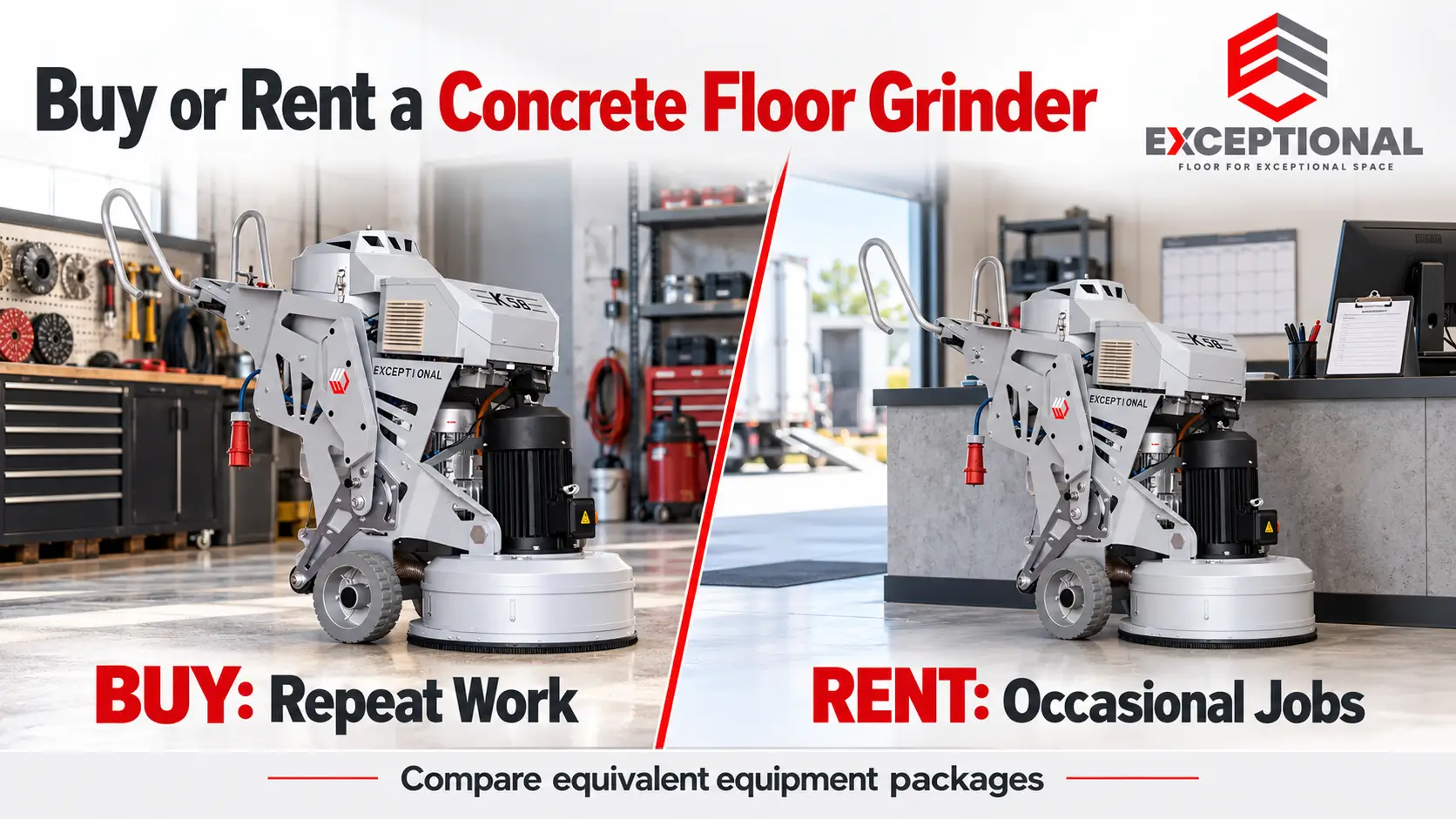
Renting shifts much of the service burden to the supplier. It does not remove every risk. You may still pay for damage, cleaning, missing accessories, or extra tooling wear.
Compare the Same Grinder and Equipment Package
Compare planetary floor grinders by working width, power, tooling, and job requirements before comparing purchase and rental costs.
A small single-disc grinder and a large planetary floor grinder do different work. Comparing their prices alone will give you the wrong answer.
Start with the job. Are you removing epoxy, preparing concrete for a coating, or producing a polished concrete floor? What finish does the client require? How much open floor is there, and how much edge work?
Compare grinding width, weight, motor power, power supply, tooling, and dust extraction. Also check whether the machine fits through doors and can be loaded safely.
A lower rental rate can still cost more if the machine takes longer to finish. A larger grinder can also be a poor investment if most of your work is in tight rooms.
Compare the cost of completing the same work to the same standard.
Concrete Floor Grinder Rental Costs
Daily, Weekly, and Monthly Rates
No single rental price fits every location and machine. Ask for a written quote with the model, booking dates, accessories, and fees.
For example, Home Depot lists an EDCO 10-inch concrete grinder rental and notes that accessory fees may apply. United Rentals lists single-head and other concrete grinding equipment. Sunbelt Rentals offers a fleet of concrete grinders and polishers. These are places to request quotes, rather than proof that each provider offers the same package.[1][2][3]
| Quote detail | What to record |
|---|---|
| Location and date | Branch, currency, and quote date |
| Equipment | Model, width, power, and included accessories |
| Booking terms | Daily, weekly, and monthly rates; allowed hours |
| Diamond tools | Included, purchased separately, or charged by wear |
| Dust control | Extractor, hoses, filters, and bags |
| Other charges | Delivery, pickup, waiver, cleaning, and taxes |
| Return rules | Deadline, extensions, and weekend billing |
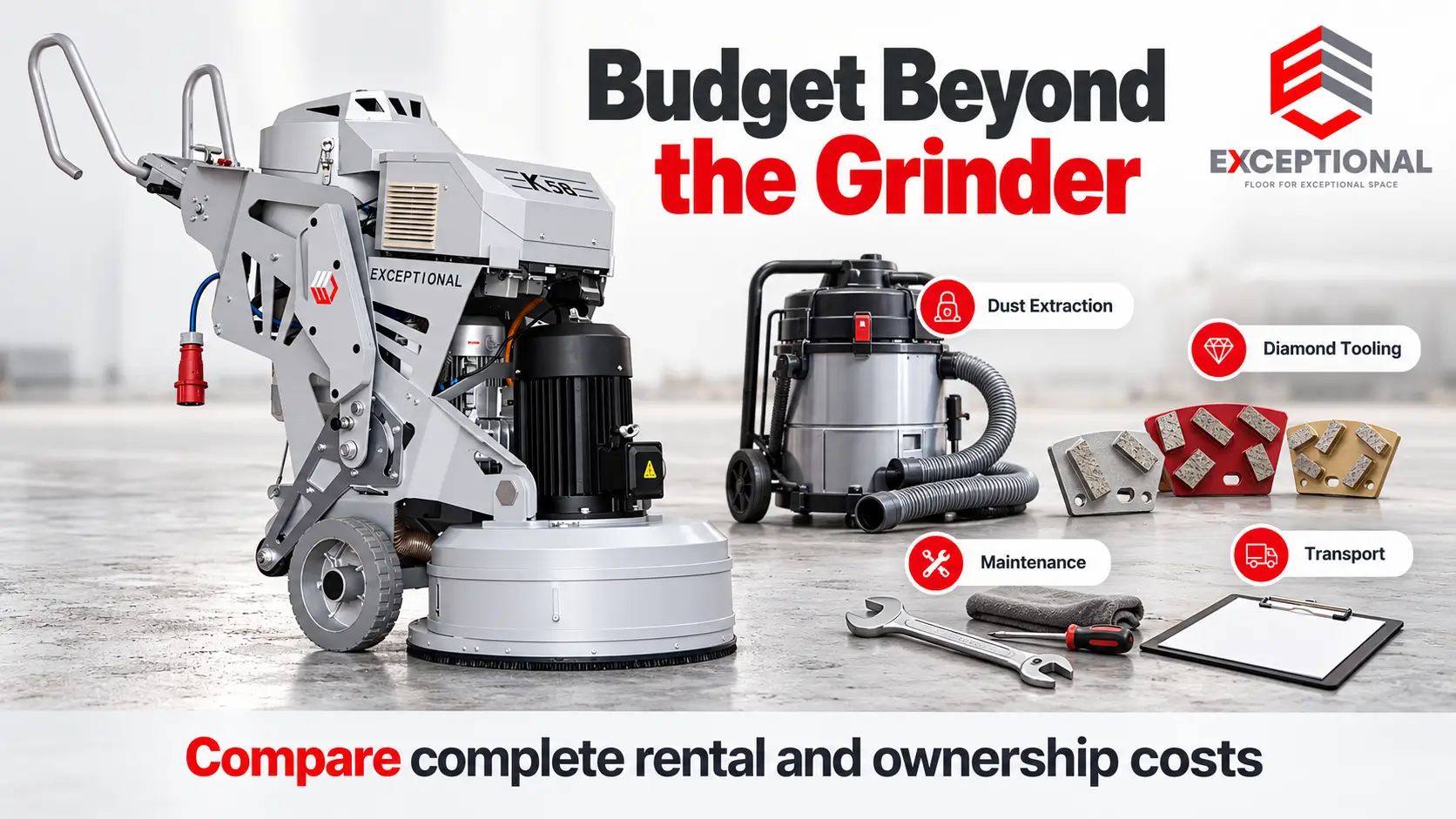
Request a weekly quote even when you expect only a few working days. A package rate may be cheaper than separate daily bookings.
Billable Days and Productive Days
Your grinder may work for two days but remain on rent for four. Site access, floor curing, delayed materials, and return schedules can stretch the booking.
Track both numbers. Productive days measure use. Billable days explain the rental invoice.
Extra Rental Costs
Check diamond tooling, dust extractor rental, delivery, pickup, damage protection, and cleaning. If the site lacks suitable power, add generator rental and the right cables.
A refundable deposit ties up cash but is not an expense when returned. Keep it separate from rental cost.
Purchase Price and Total Cost of Ownership
The Complete Working Package
The grinder price is only part of the investment. Get a quote for a package that can start work on your jobs. Include suitable industrial dust extractors, hoses, filters, and collection bags in both equipment quotes.
| Upfront item | Reason to include it |
|---|---|
| Floor grinder | Main machine cost |
| Dust extractor | Dust collection suited to the grinder |
| Initial diamond tooling | Tools for expected concrete and coatings |
| Power accessories | Correct cables, plugs, and any required power equipment |
| Freight and import charges | Cost of getting the equipment to your business |
| Transport and loading equipment | Safe movement between jobs |
| Training and setup | Time and support needed to begin work |
For overseas purchases, compare the delivered cost. Confirm shipping terms, duties, local taxes, electrical requirements, warranty terms, and spare parts supply.
Fixed and Variable Ownership Costs
Fixed costs remain even when the grinder sits idle. They may include storage, insurance, and scheduled service.
Variable costs rise with use. They may include wear parts, repairs linked to operating hours, and consumables.
Some costs occur under both options. If labor, electricity, and diamond wear are equal, they cancel out in the buy-versus-rent comparison. Keep them in your project budget. Include any difference between the two options in your equipment analysis.
New vs Used Concrete Grinders
A used grinder can reduce the upfront cost. A worn machine can erase that saving through repairs and lost work.
Check the service history, hours, grinding heads, tool holders, belts, bearings, controls, and electrical condition. Inspect the dust shroud and extraction connections. Run the machine under load if possible.
Before paying, confirm that parts and service are available. A low price offers little value if a failed part stops the machine for weeks.
Resale Value
Use recent sales of comparable machines to estimate resale value. Asking prices show what sellers want; completed sales are stronger evidence.
Age, condition, service records, location, and parts support can affect the result. Test a lower resale estimate before you commit to buying.
The Buy vs Rent Break-Even Formula
Use a set holding period, such as five years. Spread the expected loss in equipment value across that period.
Annualized capital cost = (Purchase and setup cost − Expected resale value) ÷ Holding period in years
Then calculate:
Annual ownership cost = Annualized capital cost + Annual fixed costs + Variable ownership cost per day × Annual use days
For a simple rental comparison:
Annual rental cost = Comparable rental cost per use day × Annual use days
The annual break-even point is:
Break-even days per year = (Annualized capital cost + Annual fixed costs) ÷ (Rental cost per use day − Variable ownership cost per day)
The daily saving must be positive for this formula to work. Use a rental cost that reflects your expected bookings, including fees. If weekly discounts or delivery charges vary by project, compare the actual booking totals instead.
This is an undiscounted, before-tax model. It assumes similar work each year. For a large investment, also review financing and the cost of tying up capital.
Can Buying Break Even at 12 Days per Year?
Yes, under the following hypothetical assumptions.
| Input | Example value |
|---|---|
| Purchase and setup cost | $6,000 |
| Expected resale value after five years | $1,000 |
| Holding period | 5 years |
| Annualized capital cost | $1,000 |
| Annual fixed costs | $500 |
| Comparable rental cost per use day | $150 |
| Variable ownership cost per use day | $25 |
The calculation is:
($1,000 + $500) ÷ ($150 − $25) = 12 days per year
At 12 days, both options cost $1,800 per year on an annualized basis. Above 12 days, ownership costs less in this model.
| Annual use | Annual rental cost | Annualized ownership cost | Lower-cost option |
|---|---|---|---|
| 6 days | $900 | $1,650 | Rent by $750 |
| 12 days | $1,800 | $1,800 | Equal |
| 24 days | $3,600 | $2,100 | Buy by $1,500 |
| 48 days | $7,200 | $2,700 | Buy by $4,500 |
The result changes when the inputs change. If the effective rental rate falls to $100 per use day, break-even rises to 20 days. If annual fixed costs rise to $1,000 while rent stays at $150, break-even rises to 16 days.
Twelve days is a result from one example, not a universal buying threshold.
Cash Payback and Equipment Investment ROI
Cash Payback
Annual break-even does not tell you how soon you recover the purchase payment.
At 24 use days in our example, renting costs $3,600 per year. Owning requires $500 in fixed cash costs plus $600 in variable costs. Annual net cash savings are $2,500.
Simple cash payback = Initial investment ÷ Annual net cash savings
$6,000 ÷ $2,500 = 2.4 years
This assumes steady use, a cash purchase, and no taxes or financing. It excludes resale proceeds until the machine is sold.
At only 12 use days, annual cash savings are $1,000. Simple payback would be six years if those savings continued. That extends beyond our five-year holding period; the full five-year comparison must include the final sale proceeds.
Equipment Investment ROI
For an unfinanced purchase, calculate a simple total-period ROI relative to renting:
ROI = (Avoided rental costs + Verified extra project profit + Resale proceeds − Purchase and setup cost − Ownership cash expenses) ÷ Initial investment × 100
Using 24 days per year over five years:
| Item | Five-year amount |
|---|---|
| Avoided rental cost | $18,000 |
| Ownership cash expenses | $5,500 |
| Purchase and setup | $6,000 |
| Resale proceeds | $1,000 |
| Net benefit compared with renting | $7,500 |
| Simple five-year ROI | 125% |
This is a total five-year return, not an annual return. It assumes no extra project profit and does not account for the time value of money.
Do not add all polishing revenue to the grinder’s ROI. You could earn much of that revenue with rented equipment. Add extra profit only when ownership makes a measurable difference, after the added labor, materials, and other project costs.
Financing, Leasing, and Rent-to-Own
A loan payment below a rental invoice does not prove that buying is cheaper. Compare the down payment, interest, fees, maintenance, term, final payment, and asset value at the end.
Use the same comparison period. Do not count both the purchase price and loan principal repayments as separate expenses in the same model.
For rent-to-own, confirm how much rent counts toward the purchase, when ownership transfers, and what happens if you end the agreement early.
US Tax Considerations
US businesses may recover qualifying equipment costs through depreciation. Section 179 and the special depreciation allowance may also apply, subject to current rules and eligibility. IRS Publication 946 explains these methods.[4]
A deduction reduces taxable income. It does not reimburse the purchase price. Have your tax adviser review the buy, rent, or lease options, including the tax effect of a later sale.
Worked Examples for Flooring Contractors
These scenarios use the same hypothetical equipment and costs as the 12-day example. They assume the equipment suits the work and the costs remain stable.
| Contractor scenario | Annual use | Rental cost | Annualized ownership cost | Decision suggested by the model |
|---|---|---|---|---|
| Occasional epoxy preparation | 6 days | $900 | $1,650 | Rent while demand is limited |
| Repeat coating projects | 24 days | $3,600 | $2,100 | Consider buying if cash flow supports it |
| Regular polishing and floor prep | 60 days | $9,000 | $3,000 | Ownership has a stronger cost case |
Now consider one large, temporary project. A long-term rental discount may lower the effective rate. Buying and reselling could also work, but the sale price and timing are uncertain.
Compare the complete rental quote against purchase cost, project expenses, and conservative net resale proceeds. A one-off project needs its own calculation.
A Break-Even Worksheet for Your Business
Use this worksheet with supplier quotes and your job records. It is a manual calculation guide, not an interactive calculator.
| Input | Your figure |
|---|---|
| Purchase and setup cost, P | _____ |
| Expected resale value, S | _____ |
| Holding period in years, T | _____ |
| Annual fixed costs, F | _____ |
| Variable ownership cost per use day, V | _____ |
| Effective rental cost per use day, R | _____ |
| Expected annual use days, D | _____ |
Calculate:
- Annualized ownership cost:
(P − S) / T + F + V × D - Annual rental cost:
R × D - Break-even days per year:
((P − S) / T + F) / (R − V) - Annual cash savings:
(R − V) × D − F - Simple cash payback:
P / annual cash savings, if savings are positive.
For a cash purchase, total ownership cost over the holding period is purchase cost minus resale proceeds plus ownership cash expenses. Compare that with rental spending over the same years. Do not add depreciation again.
Run three cases: expected use, lower use, and higher repair costs. If buying only works under an optimistic forecast, renting may protect your cash.
When to Rent, Buy, or Combine Both
Rent when demand is uncertain, the job is unusual, or the machine would spend most of the year in storage. Renting can also help you test a machine class before buying.
Buy when confirmed work supports the cost calculation, suitable parts and service are available, and the purchase leaves enough working capital for wages and materials.
For many contractors, a mixed fleet makes sense. Own the grinder that handles your regular work. Rent a larger machine for an open warehouse, an extra unit for overlapping jobs, or specialist equipment for work you seldom perform.
Check rental availability before relying on that plan. Keep a backup option for a breakdown during a booked project.
Productivity and Jobsite Costs That Change the Answer
Diamond Tooling and Floor Conditions
Your diamond grinding and coating-removal tools affect cutting speed, wear, and cost per completed job.
Concrete hardness, abrasive aggregate, coating thickness, diamond bond, grit, and tool condition affect cutting speed and wear. Track these factors with each job.
A tooling set is not a fixed cost per project. Record how much floor it covers and the finish it achieves. Tooling costs can differ between owned and rented equipment, even when the grinder class is similar.
Labor and Finished Floor Area
Equipment cost per square foot is useful only when the work is comparable. Epoxy removal and fine concrete polishing are different scopes.
Record setup, grinding, edge work, tool changes, cleanup, and downtime. A machine that reduces those hours may lower labor costs. Count the savings only when you can measure them.
Power, Transport, and Service
Match voltage, phase, current demand, and connections to the site. A three-phase machine may need extra power equipment on jobs without a suitable supply.
Check loading weight, ramps, door access, and transport capacity. Confirm service lead times and which spare parts you should keep on hand.
Dust Extraction and Silica Control
Include suitable dust control in both quotes. A vacuum connection alone does not establish compliance.
In the US, OSHA’s construction silica standard, 29 CFR 1926.1153, gives Table 1 controls for walk-behind floor grinders. Its dry collection option calls for manufacturer-recommended airflow or greater, a filter with at least 99% efficiency, and a filter-cleaning mechanism. Indoor work also calls for a HEPA-filtered vacuum to remove loose dust between passes.[5]
Follow the full applicable requirements and the equipment instructions. Budget for filters, bags, cleaning, and any wet-method slurry handling.
Contractor Buying Checklist
Before you order, answer these questions:
- How many use days can confirmed work support?
- What do comparable local rental bookings actually cost?
- Have I priced the grinder, dust extractor, tooling, and delivery together?
- Can I buy without weakening cash flow for wages and materials?
- Do I have suitable power, storage, and transport?
- Who will supply repairs and spare parts?
- Does buying still work with lower use or a lower resale price?
- What is my backup plan if the grinder stops working?
For rental fleet buyers, use a different income model. Compare paid rental income with purchase, service, transport, downtime, and resale costs. Track paid rental days and credit risk. Contractor rental savings do not measure a rental yard’s investment return.
Choosing an Exceptional Grinder for Your Workload
Choose the machine for your regular jobs first. Then compare the investment with renting.
When requesting a quote from Exceptional Grinder, provide your main application, typical project size, concrete or coating condition, available power, expected use, and delivery location. State whether you need dust extraction and diamond tooling.
Ask for a complete delivered package quote, model specifications, warranty terms, parts information, and lead time. If you need several machines, request clear quantities and costs for each configuration.
Request a complete grinder package quote from Exceptional Grinder. Compare it with your local rental costs using the worksheet above.
Frequently Asked Questions
How many days per year make buying a concrete floor grinder worthwhile?
There is no fixed number. Divide annualized capital and fixed ownership costs by the daily saving from owning. Use equivalent equipment and realistic rental terms. Buying becomes cheaper above that calculated threshold, assuming the costs and workload remain as forecast.
Is buying cheaper above 12 days per year?
It can be, but only under certain assumptions. Our example reaches annual break-even at 12 days with a $6,000 package, a five-year holding period, and $125 in daily savings before fixed costs. Different rental rates, maintenance, or resale values change the answer.
How much does concrete floor grinder rental cost?
Get a dated quote for your location, machine, and booking length. Compare the full invoice, including tooling, dust extraction, transport, and other fees. A bare grinder’s daily rate isn’t the same as the full cost of preparing a floor.
Do rental grinders include diamond tooling and dust extraction?
Do not assume they do. Ask for written confirmation of included tools, wear charges, extractor capacity, hoses, and consumables. Home Depot’s grinder listing, for example, notes that accessory fees may apply.[1]
Should I buy a new or used planetary floor grinder?
Choose based on condition, support, and total cost. Used equipment can lower the purchase payment, but repairs and downtime can offset the saving. Inspect it under load, review service records, and confirm parts availability before comparing it with a new machine.
How do weekly rental discounts affect break-even?
They reduce rental cost for grouped work and can raise the usage needed to justify buying. Use the full weekly booking price rather than multiplying the daily rate by five. Include unused booked days and fees in the comparison.
What is the difference between break-even, payback, and ROI?
Annual break-even shows the use level where annualized costs are equal. Cash payback estimates how long savings take to recover the purchase payment. ROI measures the net benefit over a stated period relative to the investment. Each answers a different buying question.
Is financing cheaper than renting?
It may be, but a monthly payment alone cannot answer that. Compare deposits, interest, fees, ownership expenses, rental discounts, and the final asset value over the same period. Also check whether the payments remain affordable during slower months.
Should contractors own one grinder and rent extra machines?
That can be a practical approach. Own equipment that serves steady work, and rent for larger projects or extra capacity. Confirm local availability and keep a backup plan. The right balance depends on workload, cash flow, and the types of floors you handle.
Make the Decision With Your Own Numbers
Buy when full ownership costs less than renting for your expected work, and the purchase fits your cash flow. Rent when demand is uncertain or the job needs equipment you rarely use.
Start with real rental invoices, a complete purchase quote, and a conservative use forecast. Those numbers will give you a stronger decision than a fixed rule about annual use days.
Sources
- Home Depot: EDCO 10-inch concrete grinder rental.
- United Rentals: Electric concrete grinder.
- Sunbelt Rentals: Surface preparation equipment.
- IRS: About Publication 946, How to Depreciate Property.
- OSHA: 29 CFR 1926.1153, Respirable crystalline silica.