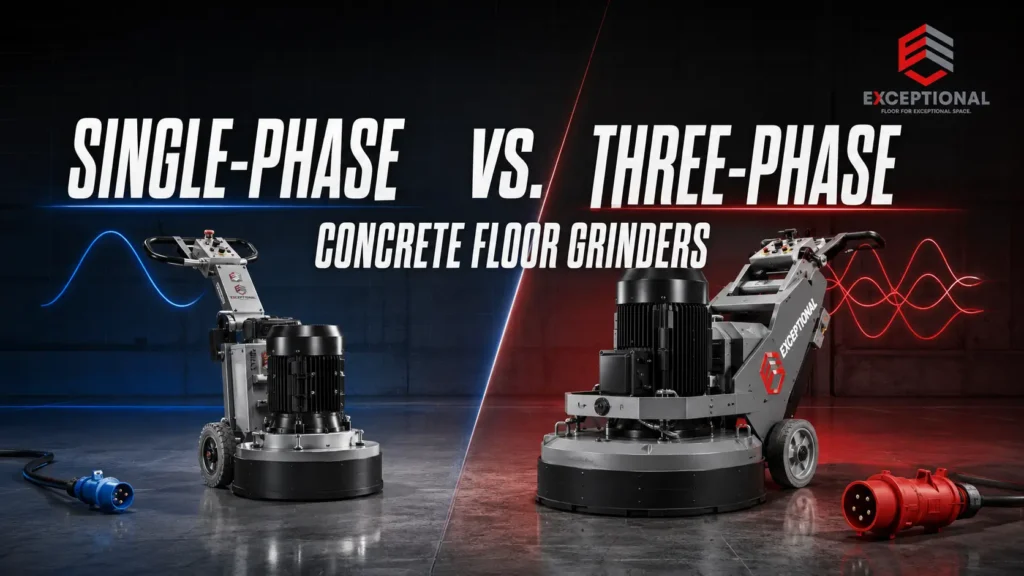
When comparing a single-phase vs. three-phase concrete floor grinder, the decision comes down to your available power supply, typical project size, production requirements, and long-term business goals. Single-phase concrete grinders plug into the electrical service found at most residential and light-commercial job sites, making them the practical choice when you need portability and broad site compatibility.
Three-phase concrete grinders connect to industrial electrical supplies. They deliver higher motor output for wider grinding paths, heavier coating removal, and sustained production. As industry leaders build the skylines of tomorrow, matching power supply to project scope is essential.
Neither option is universally better. The right machine depends on a match between your electrical infrastructure, motor capacity, and the specific concrete surface preparation required. Your choice should consider grinding pressure, head design, diamond tooling, and the scale of floor grinding you perform most often.
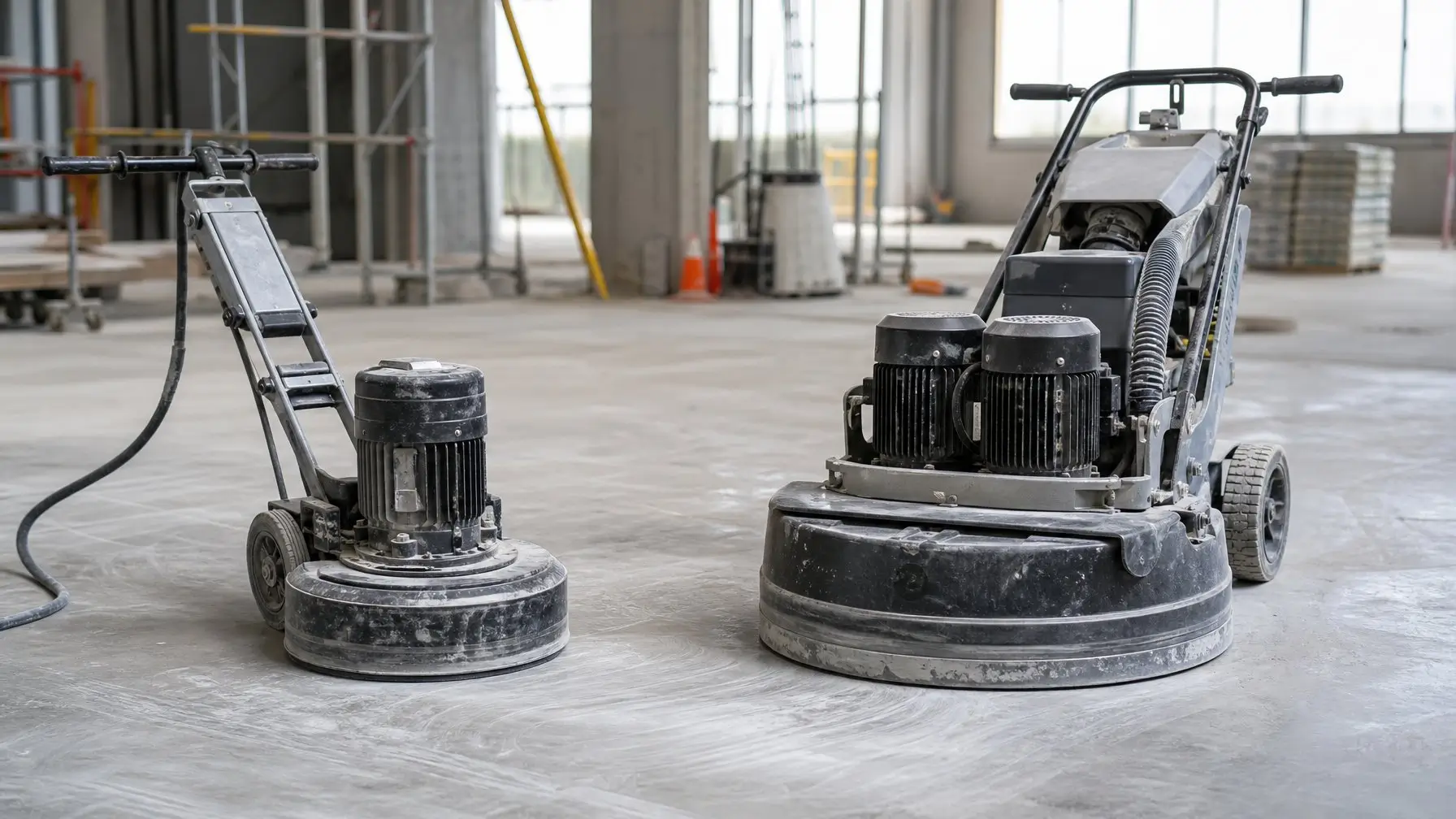
Phase is only one variable in the concrete grinder buying guide equation. A 240 V floor grinder could be single-phase or three-phase depending on its wiring configuration, and a higher-horsepower motor does not automatically grind faster if the head design, tooling, or available current cannot support it. This article walks through the electrical fundamentals, motor behavior, grinding performance, infrastructure requirements, generator sizing, and floor grinding cost analysis you need to make a confident purchase. We also explore application matching and the benefits of different power configurations.
Whether you are a contractor evaluating your first walk-behind machine, a distributor building an import program, or a facility manager specifying equipment for a warehouse renovation, the comparison that follows will help you choose the right concrete floor grinder for your power supply and production targets. If you already know your jobsite voltage, phase, and project scope, consider reaching out to Exceptional Grinder by email or WhatsApp for a specification-matched recommendation.
Quick Answer: Single-Phase Or Three-Phase?
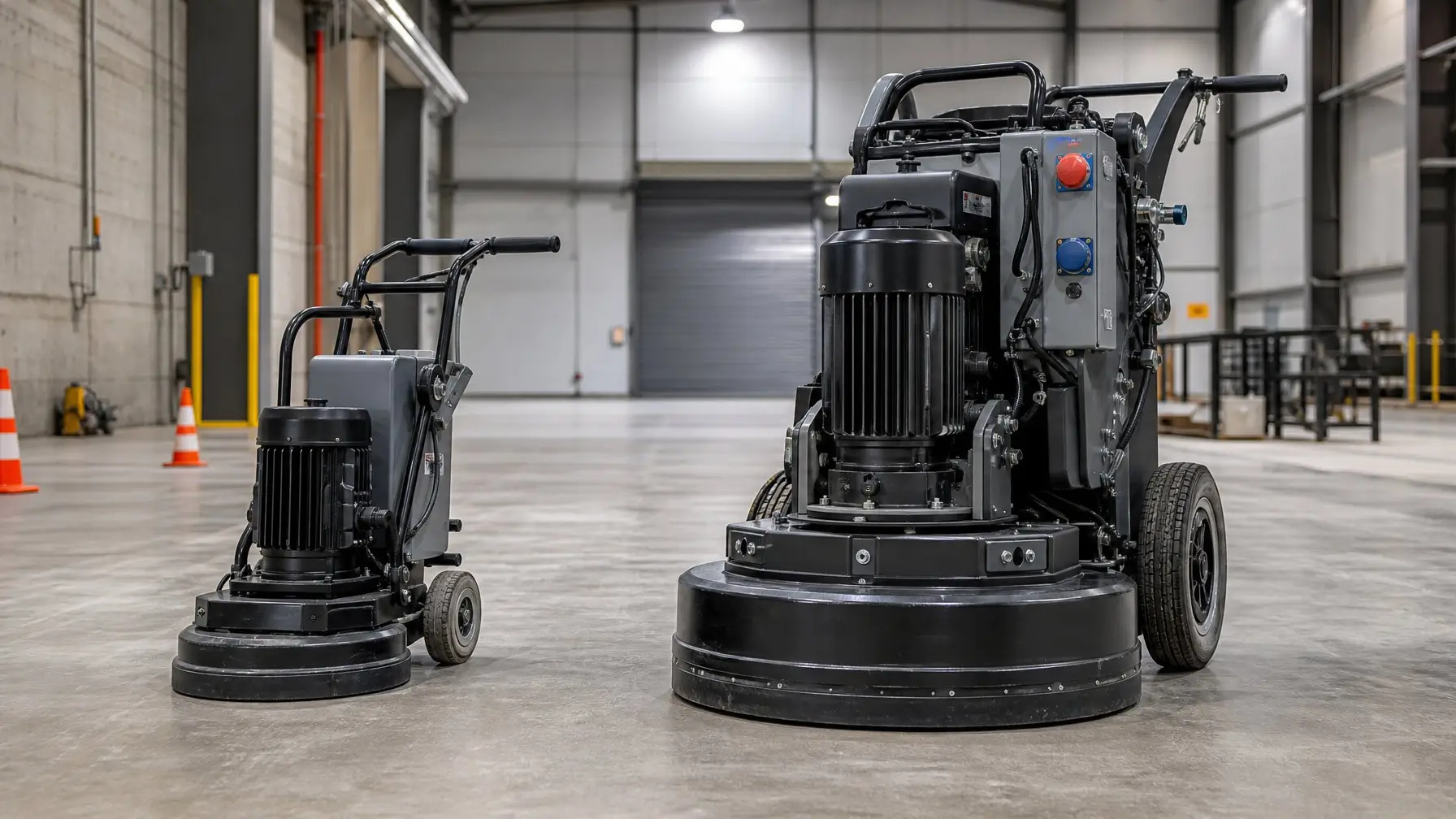
A single-phase machine fits best when three phase power is unavailable and portability matters. It is ideal for floor area under a few thousand square feet. A three-phase machine is the stronger choice for warehouses and factories where industrial three phase power is already wired in.
When A Single-Phase Grinder Makes More Sense
Choose a single-phase grinder if your projects rotate through residential garages, basements, small retail spaces, and restaurants where the only available circuit is 120/240 V split-phase service. Single-phase machines are typically lighter, easier to load into a van, and ready to run without calling an electrician. They also suit rental fleets that serve a broad customer base, because most renters have access to standard residential or light-commercial electricity. Smaller models often function as an edge grinder. A portable single disc concrete grinder is also ideal for reaching tight corners where larger units cannot fit.
A single-phase concrete grinder in the 2–5 HP range handles coating removal and surface prep. These machines use various grinding discs to reach specific grit levels. They are often used for residential concrete polishing on floors up to 3,000 sq ft.
Your initial investment is usually lower. Supporting equipment like a single-phase dust extractor or portable dust collectors are easier to source and transport.
When A Three-Phase Grinder Is The Better Fit
Pick a three-phase grinder for distribution centers or manufacturing plants. These machines excel at concrete polishing projects exceeding 10,000 sq ft. The extra torque from three phase power is essential for achieving a high-gloss concrete polish on industrial slabs. Three-phase motors in the 7–20 HP range deliver more torque under load, sustain head speed during aggressive grinding passes, and power wider planetary heads that cover more area per pass.
Three-phase power also supports remote-controlled and self-propelled grinders designed for extended production shifts. If electrical access is completely restricted, a propane floor grinder may be necessary to maintain high production without a cord. If your jobsites reliably provide 208 V, 480 V, or another three-phase service, the electrical setup is straightforward and the grinder can run at full capacity without tripping breakers.
When A Mixed Fleet Is The Smartest Choice
Many growing contractors find that owning one compact single-phase grinder and one production-class three-phase grinder covers the widest range of work. The single-phase machine, often a single head design, handles tight spaces, edge areas, and small jobs. The three-phase machine takes over on open warehouse slabs. This mixed-fleet approach also provides redundancy: if one machine is down for maintenance, the other keeps your crew productive.
Single-Phase And Three-Phase Grinders At A Glance
Single-phase electric floor grinders draw power from a single AC waveform available at virtually every building, while three-phase grinding machines use three offset waveforms common in industrial and commercial electricity. The differences in voltage availability, machine size, cost, and portability follow general patterns, but exceptions exist across manufacturers and models.
General Differences In Power Availability And Machine Size
Single-phase electricity is the standard in residential buildings and many small commercial spaces across North America. You can plug a single-phase grinding machine into a dedicated 120 V or 240 V circuit and start working. Three-phase electricity is installed at factories, warehouses, large retail buildings, and other facilities with heavy electrical loads.
Because three-phase power supports higher motor output at lower current per conductor, manufacturers tend to build their larger, heavier planetary grinders around three-phase motors. Single-phase grinders typically range from compact edge machines up to mid-size walk-behind units with working widths around 250–550 mm. Three-phase grinders commonly start at mid-size and extend to wide-path machines reaching 650–850 mm.
Typical Voltage, Cost, Portability, And Application Trends
| Factor | Single-Phase Grinder | Three-Phase Grinder |
|---|---|---|
| Common voltages | 110–120 V, 220–240 V | 200–240 V, 380–415 V, 440–480 V |
| Typical format | Compact to medium | Medium to extra-large |
| Motor output | Usually lower | Usually higher |
| Portability | Generally easier | Usually heavier |
| Grinding width | Commonly narrower | Commonly wider |
| Purchase cost | Usually lower | Usually higher |
| Rental suitability | Broad customer base | Mainly professional users |
| Best applications | Residential, small commercial | Large commercial, industrial |
| Generator need | Single-phase generator | Three-phase generator |
Why These Comparisons Are Only General Tendencies
Machine design varies significantly by manufacturer. Some single-phase concrete grinders draw 20+ amps at 240 V and deliver serious grinding performance on medium commercial floors. Conversely, a compact three-phase grinder designed for polishing may weigh less than a heavy-duty single-phase coating-removal machine. Always check the actual nameplate specifications rather than assuming that phase alone determines capability. You should also verify if the machine is optimized for wet grinding or strictly dry use.
Understanding Electrical Phase And Power Supply
Electrical phase defines how alternating current is delivered to your concrete grinder, and it directly affects motor sizing, current draw, circuit requirements, and generator compatibility. Understanding single-phase waveforms, three-phase waveforms, the distinction between phase and voltage, North American split-phase service, line-to-line versus line-to-neutral measurements, and the difference between input phase and motor phase will prevent costly mismatches on the jobsite.
What Single-Phase Power Means
Single-phase AC power delivers one alternating voltage waveform that cycles from zero to peak and back 60 times per second (60 Hz in North America, 50 Hz in many other markets). Voltage drops to zero twice per cycle, creating brief gaps in power delivery. Residential electricity in the U.S. is single-phase, available as 120 V line-to-neutral or 240 V line-to-line from a split-phase service panel.
For concrete floor grinder motors, single-phase power works well up to moderate output levels. Typical single-phase induction motors use a capacitor-start or capacitor-run design to generate the rotating magnetic field needed to spin. These motors are common in grinders rated from fractional horsepower through roughly 5–7 HP, though some manufacturers push higher with careful electrical design.
What Three-Phase Power Means
Three-phase AC power uses three separate voltage waveforms, each offset by 120 electrical degrees. Because the waveforms overlap, the combined power delivery is far more continuous than single-phase. Voltage never drops to zero, which translates to smoother torque at the motor shaft. This efficiency is why companies like Husqvarna Construction utilize three-phase systems for their largest and most powerful equipment.
Three-phase electricity is standard in factories, warehouses, large commercial buildings, and industrial facilities. Common three-phase voltages in North America include 208 V, 240 V, 480 V, and 600 V. Internationally, 380 V, 400 V, 415 V, and 440 V are typical. A three-phase squirrel-cage induction motor is simpler than its single-phase counterpart because the three-phase supply naturally creates a rotating magnetic field without auxiliary start windings or capacitors.
Why Phase Is Not The Same As Voltage
A 230 V concrete floor grinder is not automatically single-phase. A 240 V machine could be wired for single-phase or three-phase service. Even a 480 V machine, which is almost always three-phase in practice, should be confirmed by reading the nameplate.
Voltage, phase, frequency, and rated current are four independent specifications. Consider a nameplate that reads:
400 V, 3~, 50 Hz, 16 A
This tells you the machine requires 400 volts, three-phase supply, at 50 Hz frequency, drawing 16 amps at rated load. Changing any one of those parameters without the manufacturer’s approval can damage the motor, VFD, or control system. Always confirm all four values before connecting.
North American Split-Phase Power Explained
The standard residential and light-commercial service in North America is 120/240 V split-phase. A center-tapped transformer provides two 120 V legs. Measuring across both legs gives 240 V. This is still single-phase power. It does not provide a third phase.
If your concrete grinder is rated for 240 V single-phase, it connects between the two live conductors of a split-phase panel on a dedicated breaker. The presence of a 240 V outlet does not mean three-phase power is available. Confirming this before purchasing a three-phase grinder saves you from a machine that cannot operate at the site.
Line-To-Line And Line-To-Neutral Voltage Basics
In a common international 230/400 V three-phase system, the voltage between any single phase conductor and neutral is approximately 230 V. The voltage between any two phase conductors is approximately 400 V. These are called line-to-neutral and line-to-line voltages, respectively.
When you read a floor grinder’s rated voltage, confirm whether it references line-to-line or line-to-neutral measurement. Also verify whether the machine requires a neutral conductor, how many conductors the supply cable must have (three-wire, four-wire, or five-wire), and what protective-earth arrangement is needed. The plug pin arrangement should match the jobsite socket in both current rating and conductor configuration.
Input Phase Vs. Motor Phase
The machine input and the motor supply are not always identical. Some modern floor grinders accept single-phase input power, pass it through a variable-frequency drive (VFD), and deliver controlled three-phase output to a three-phase motor. The VFD converts the power electronically, managing motor speed, acceleration, and protection.
This means you cannot identify the required supply by inspecting the motor alone. A grinder with a three-phase motor may still operate from a single-phase wall outlet if the manufacturer designed the system with a single-phase-input VFD. Check the complete machine input rating, the VFD specification, and the wiring diagram. Only use manufacturer-approved electrical configurations.
How Phase Influences Motor Behavior And Grinding Performance
Phase shapes how much current your circuit can practically deliver, how the motor behaves during startup and under heavy load, and how consistently the grinding head maintains speed and pressure across a long production shift. The relationship between rated motor power, available amperage, torque under load, grinding pressure, head speed at working RPM, and real-world removal rate determines whether a single-phase or three-phase concrete grinder is the productive choice for your application.
Motor Output, Current Capacity, And Practical Power Limits
A single-phase motor draws all its current through one pair of conductors. At 240 V single-phase, a 5 HP motor may pull roughly 23–28 amps at full load. That current must travel through the breaker, cable, plug, and receptacle, all of which have rated limits. Pushing a single-phase grinder above 5–7 HP often requires a dedicated 40–50 amp circuit with heavy-gauge wiring, which limits practical jobsite deployment.
A three-phase motor distributes current across three conductors. The per-conductor current is lower for the same motor output. A 10 HP three-phase motor at 480 V draws roughly 13–14 amps per phase, well within standard industrial circuit capacity. This is why three-phase grinders scale more easily to 10, 15, or 20 HP motors without extraordinary wiring demands.
Torque, Starting Behavior, And Load Handling
Three-phase induction motors produce strong, consistent starting torque because the three-phase supply naturally creates a rotating magnetic field. A squirrel-cage three-phase motor accelerates smoothly when loaded with aggressive diamond tooling on hard concrete.
Single-phase motors rely on auxiliary windings and capacitors to generate a starting field. Starting torque on a capacitor-start motor can be substantial, but it is typically less uniform than on a comparable three-phase motor. Under heavy grinding load, a single-phase motor may experience more torque ripple, and on marginal circuits, voltage sag during startup can further reduce available torque.
A VFD on either motor type controls acceleration ramp-up, which reduces inrush current and mechanical shock. If your single-phase grinder uses a VFD, the starting behavior can be quite smooth.
Grinding Pressure, Head Width, And Removal Rate
Grinding pressure is the force applied through the diamond tools to the concrete surface. It depends on total machine weight, weight concentrated over the grinding head, adjustable counterweights, and the number of tool holders in contact with the floor.
Wider heads distribute weight across more tooling and cover more area per pass. These larger setups demand more motor power to maintain head speed under load. A machine using three phase electricity can sustain higher contact pressure across more diamonds.
The removal rate difference on a large warehouse slab can be dramatic. A larger three-phase machine may grind 600+ sq ft per hour. This efficiency is critical for professional concrete polishing results on industrial floors.
Head Speed, Loaded Speed, And Long-Run Consistency
Check both the no-load RPM and the loaded RPM of any grinder you evaluate. A motor that spins at 1,500 RPM unloaded but drops to 1,100 RPM under heavy grinding load is losing speed and cutting efficiency. Three-phase motors generally maintain speed better under load because the three-phase supply delivers more continuous torque.
Variable-frequency drives allow you to set target speeds and the drive will adjust current delivery to maintain them within its capacity. On long production shifts, a VFD-controlled three-phase motor with adequate cooling can run at consistent head speed for hours. A single-phase motor on a marginal circuit may slow progressively as the motor heats and voltage drops accumulate over cable length.
Why Nameplate Power Does Not Equal Real Productivity
A 10 HP nameplate does not guarantee 10 HP reaches the diamond tools. Power passes through belts, gears, or chain drives before reaching the planetary head, and each transmission stage introduces mechanical losses. A machine with an efficient gear-drive system and well-matched planetary-head design may deliver more usable grinding power from 7.5 HP than a poorly designed machine delivers from 10 HP.
Actual productivity depends on loaded head speed, grinding pressure per tool, diamond bond hardness matched to concrete hardness, travel speed, and the number of passes required. Measure performance in square feet per hour and tool wear per square foot, not just motor horsepower.
Electrical Infrastructure, Generators, And System Compatibility
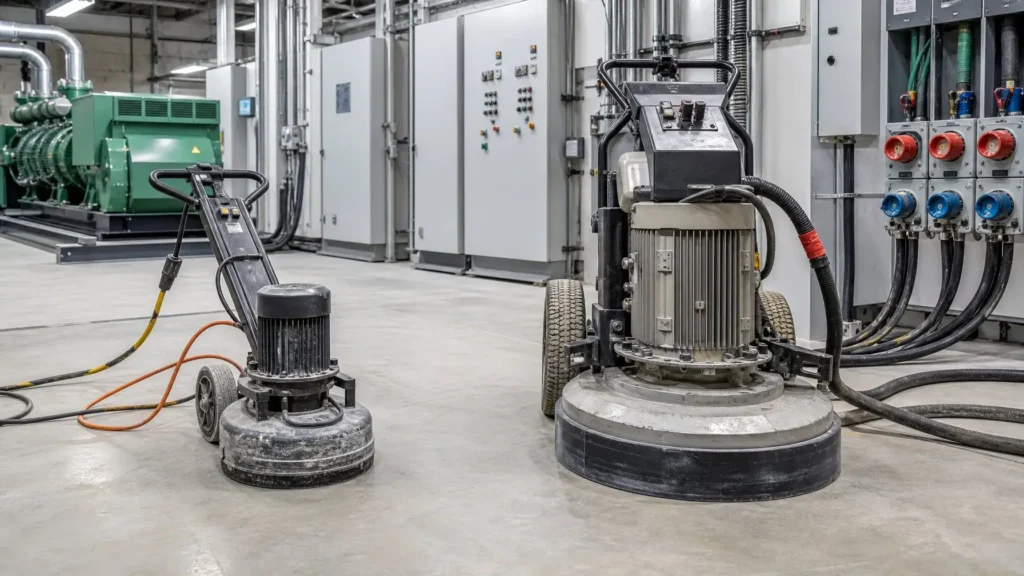
Before you commit to a single-phase or three-phase concrete floor grinder, verify that your jobsite electrical supply, cables, connectors, protective devices, and generator capacity can support both the machine and its dust extractor. Electrical mismatches cause breaker trips, voltage drop, motor overheating, VFD faults, and damaged equipment.
Power Supply Checks Before You Choose A Machine
Walk the jobsite before purchasing. Identify the service panel, confirm the available voltage, phase, and frequency, and read the breaker ratings. Determine whether a dedicated circuit is available or whether the grinder will share a branch circuit with other loads. Note the distance from the panel to the work area, because longer cable runs increase voltage drop.
For three-phase service, confirm that all three phases are active and balanced. A missing phase or significant voltage imbalance between phases can damage a three-phase motor within minutes. If you are unsure, hire a qualified electrician to perform a site electrical survey.
Circuit Capacity, Cables, Plugs, And Connector Standards
Your circuit breaker must be rated for the grinder’s full-load current plus the starting surge. A 5 HP single-phase grinder pulling 28 amps at 240 V typically needs at least a 40-amp dedicated breaker with appropriately sized wiring.
Extension cables are a common weak point. Use cables rated for the grinder’s full-load current, keep runs as short as possible, and never coil excess cable during operation because coiled cable generates heat that can damage insulation and increase resistance. In North America, NEMA-type plugs and receptacles are standard. For international equipment, IEC 60309 industrial connectors are common. Verify that the plug pin arrangement, current rating, and voltage rating match your site outlet.
Voltage Drop, Imbalance, And Other Power-Quality Risks
Voltage drop across long cable runs reduces the voltage reaching your motor. A 5% drop on a 240 V circuit means the motor receives only 228 V, which increases current draw and motor temperature. On undersized or excessively long cables, the drop can reach 10% or more, causing the motor to overheat or the VFD to fault.
Three-phase systems face additional risks from voltage imbalance and phase loss. Even a 2–3% imbalance between phases can increase motor heating by 15–25%. Phase-loss protection relays and phase-sequence monitors are essential safety devices on three-phase grinders.
Starting Systems, VFDs, And Phase Conversion Limits
Direct-on-line (DOL) starting is the simplest approach: the contactor closes and the motor receives full voltage immediately. The inrush current can be 5–8 times the full-load current, demanding a strong circuit and generator.
Soft starters ramp voltage gradually, reducing starting current and mechanical stress. They do not provide variable speed during operation.
Variable-frequency drives (VFDs) control speed and direction, and provide acceleration and overload and fault protection. Some VFDs accept single-phase input and deliver three-phase output to the motor, but they must be correctly sized, often derated by 40–50% compared to their three-phase input rating, and approved by the grinder manufacturer.
Phase converters (rotary, static, or digital) produce three-phase output from single-phase input. They are not universally compatible with grinders, especially those using VFDs, and must be verified for the specific machine and load.
Generator Sizing For The Grinder And Dust Extractor Together
When utility power is unavailable, you need a generator that can power the grinder, dust extractor, and any other connected equipment simultaneously. Size the generator for continuous kW output, not just peak kVA. Account for motor-starting surges: if both the grinder and extractor start within seconds of each other, the generator must handle the combined inrush current.
For a 10 HP three-phase grinder plus a 3 HP three-phase dust extractor, a common starting point is a generator rated at roughly 20–25 kVA continuous, but always verify with the specific motor data. Confirm the generator provides the correct voltage, phase count, frequency (60 Hz in North America), voltage regulation within 3–5%, and acceptable harmonic distortion for VFD-equipped machines.
Safety Protections And Fault Monitoring
Every grinder installation should include a main disconnect, an emergency stop accessible to the operator, motor overload protection, and appropriate ground-fault or residual-current protection. Three-phase machines should also have phase-loss protection, phase-sequence monitoring to prevent reverse rotation, and voltage monitoring.
Inspect cables and plugs before each shift. Look for heat discoloration, cracked insulation, loose pins, and damaged connectors. Stop operating immediately if you detect a burning smell, excessive cable warmth, or intermittent power. Consult a qualified electrician rather than repeatedly resetting a tripping breaker.
Choosing The Right Grinder For Your Projects, Costs, And Growth Plans
Your ideal concrete floor grinder balances application requirements, total cost of ownership, ease of transport, and your business trajectory over the next three to five years. A single-phase grinder priced lower upfront may cost more in labor on large floors, while a three-phase machine that sits idle between warehouse jobs may never earn back its premium.
Best Fit By Application, Floor Size, And Jobsite Access
For residential garage floors, basements, and small retail renovations under 2,000 sq ft, a single-phase concrete grinder with a 250–400 mm working width handles the scope efficiently without electrical complications. Medium commercial floors of 2,000–8,000 sq ft can go either way: a powerful single-phase machine works if the timeline allows, or a mid-size three-phase grinder accelerates the schedule when three-phase power is available.
Warehouse slabs, factory floors, and distribution centers exceeding 10,000 sq ft almost always call for a three-phase industrial concrete floor grinder with a 550–850 mm head. Heavy coating removal with PCD tools on thick epoxy or mastic also favors three-phase output because the motor must sustain high torque against aggressive tooling resistance.
Ownership Cost, Labor Efficiency, And Return On Investment
Purchase price tells only part of the story. A three-phase grinder may cost more than a single-phase model. However, the labor savings on large projects recover the difference quickly. If your business focuses on high-end concrete polish finishes, the efficiency of three-phase power is unmatched.
Supporting equipment adds up. A three-phase dust extractor, heavier cables, a possible generator, and a transport trailer increase the total system investment. Compare the full package cost against the revenue potential of the projects each configuration enables you to bid on.
Portability, Transportation, And Setup Time
Single-phase grinders typically weigh 100–350 lbs and fit into a cargo van or pickup truck. Setup involves rolling the machine off the vehicle, plugging into a wall outlet, connecting the dust extractor hose, and starting work. Total setup time can be under 15 minutes.
Three-phase grinders in the 500–1,500 lb range often require a trailer, loading ramp, and sometimes a forklift. Cable runs to three-phase panels may be longer, and verifying correct phase sequence adds time. On small jobs, this setup overhead can consume a significant percentage of the billable work window.
Renting Vs. Buying Vs. Building A Mixed Fleet
Rent when you face a one-time project, want to test a machine class before purchasing, or lack maintenance capability. A single-phase rental grinder serves the broadest range of renters because most jobsites have compatible power.
Buy a single-phase grinder if you perform frequent small-to-medium work, serve varied sites, or run a rental business where customers need plug-and-play simplicity. Buy a three-phase grinder when you consistently grind large industrial floors with confirmed three-phase service.
A mixed fleet covering both phases gives you maximum flexibility. The compact single-phase unit handles residential work and tight areas. The production three-phase machine takes over on open slabs. Together, they let you bid on projects across the full spectrum.
A Practical Model-Comparison Checklist For Buyers And Importers
When evaluating specific models, request and compare these specifications side by side:
- Input voltage, phase, and frequency
- Rated current (amps) and motor output (kW or HP)
- Grinding width and number of tool holders
- Grinding pressure and adjustable weight options
- Head speed range (no-load and loaded RPM)
- Drive type (belt, gear, or chain) and transmission ratio
- VFD brand, input/output phase, and programmable features
- Machine weight, dimensions, and transport features
- Compatible dust extractor model and power requirements
- Diamond tooling attachment system and compatible grinding discs
- Electrical protection devices included (overload, phase loss, emergency stop)
- Plug type and cable specification
- Warranty terms, spare parts availability, and after-sales support
Manufacturers like Exceptional Grinder can supply voltage and frequency customization for destination markets. As your trusted partner, we also focus on sustainable ways of working by providing equipment that maximizes energy efficiency. Contact us for wiring diagrams, nameplate data, and pre-shipment test reports. Send your country, jobsite voltage, phase, and typical project area to get a matched recommendation.
Frequently Asked Questions
These are the most common questions buyers ask when comparing single-phase vs. three-phase concrete floor grinders, covering power compatibility, performance differences, and equipment selection.
Which power option is better for heavy-duty concrete grinding jobs?
Three-phase power is generally better suited for heavy-duty concrete grinding because it supports larger motors with higher sustained torque, wider grinding heads, and longer production runs. A three-phase grinder in the 10–20 HP range maintains head speed under aggressive diamond tooling on hard concrete more effectively than most single-phase alternatives. If three-phase service is not available at your site, a propane grinder or a properly sized three-phase generator may be an option. Some manufacturer-approved VFD systems with single-phase input can also bridge the gap.
How do I choose the right concrete floor grinder for my project size and surface condition?
Start by measuring your typical floor area and identifying the surface condition: bare concrete, existing coatings, adhesive residue, or aggregate exposure requirements. For floors under 3,000 sq ft with light coatings, a single-phase grinder with a 300–400 mm head usually provides adequate productivity. For floors above 5,000 sq ft with heavy coatings or multiple polishing steps, a three-phase grinder with a planetary head 550 mm or wider significantly reduces labor hours. Match the diamond bond hardness to the concrete hardness, and confirm that your available electrical supply supports the machine before purchasing.
What are the main differences in performance between 120V and 240V concrete grinders?
A 120 V concrete grinder is limited by the low current capacity of standard 15–20-amp household circuits, which restricts practical motor output to about 1–2 HP. A 240 V single-phase grinder draws the same power at half the current, allowing motors up to 5–7 HP on a dedicated 40–50-amp circuit. The 240 V machine delivers more grinding pressure, maintains head speed under load, and handles tougher coatings. For any professional concrete grinding work beyond light surface cleaning, a minimum of 240 V is recommended.
When is a three-phase machine required or recommended on a jobsite?
A three-phase grinder becomes the recommended choice when the project involves large open floor areas exceeding 10,000 sq ft, heavy coating removal, aggressive aggregate exposure, or sustained daily production shifts. It is effectively required when the grinding head width, motor output, or machine weight exceeds what single-phase circuits can practically supply. Remote-controlled and self-propelled grinders almost always operate on three-phase power. Confirm three-phase availability at your site before specifying the machine.
How do planetary and rotary concrete grinders differ in results and applications?
Planetary grinders use a large rotating head with multiple satellite discs that spin independently, creating overlapping grinding paths for a more uniform, scratch-free finish. They are the standard choice for polished concrete, aggregate exposure, and precision surface preparation. A rotative grinder uses a single rotating head and is typically more aggressive, making it effective for rapid coating removal and heavy leveling. Phase type does not determine whether a grinder is planetary or rotary; both configurations are available in single-phase and three-phase models depending on machine size and intended application.
What are the pros and cons of single-disc versus dual-disc concrete floor grinders?
Single-disc grinders are lighter, more maneuverable, and easier to transport. They work well in confined areas, along walls, and on small floors. Their narrower working width means more passes on open areas, increasing labor time on larger projects. Dual-disc (double-headed) grinders use counter-rotating heads to balance torque, making the machine easier to steer and enabling it to cover a wider path of 750–1,000 mm. They require more motor power and are typically heavier, but they significantly reduce production time on medium and large floors. Your choice should factor in project scale, available power, and access constraints rather than disc count alone.